
WO 172 South-East Asia War Diaries: Trace a Unit, Not an Unnamed Soldier is an evidence-first guide to WO 172 war diaries, not a promise that one archival item can reconstruct a complete biography. Start with the archive’s stated scope, record the exact entry and date, and separate the administrative act from the larger historical conclusion. The National Archives series guidance establishes the first search route; a related official research guide explains the next evidentiary checks. Use the route below to find what a record actually says before inferring a person, voyage, estate, or event.
Select the South-East Asia Theater First
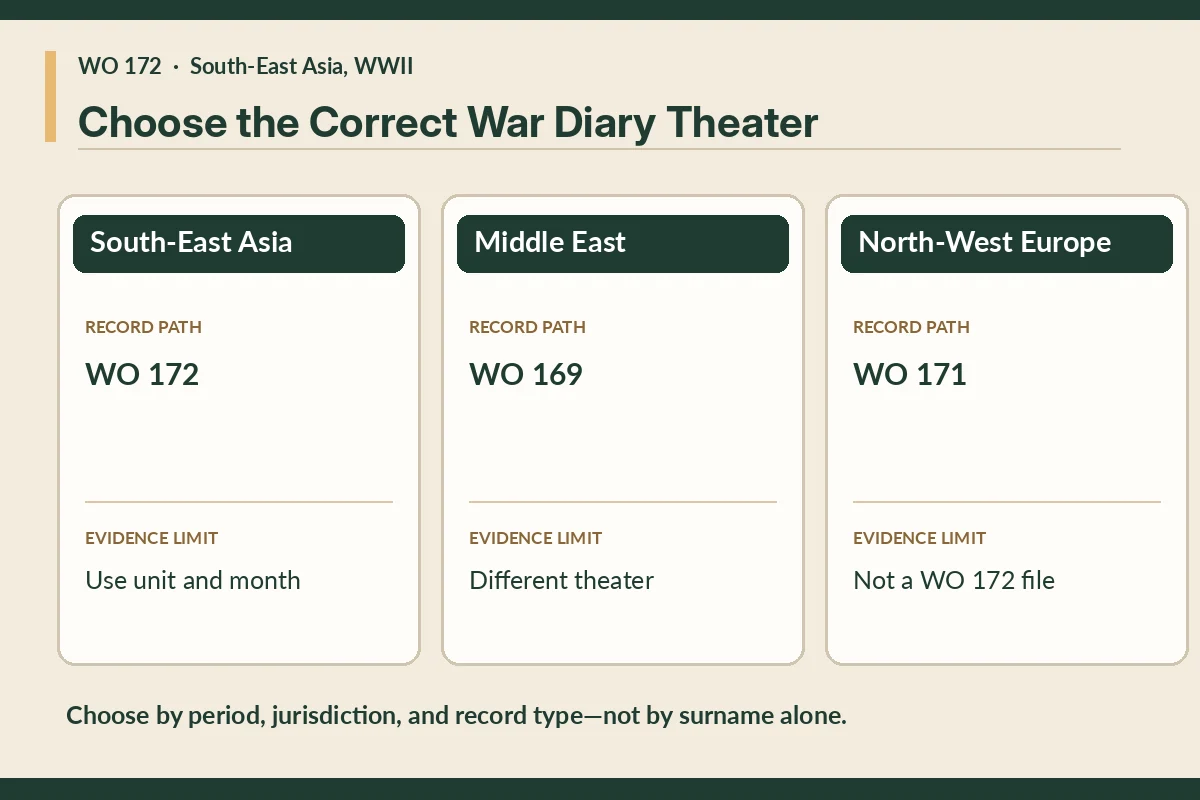
WO 172 contains British Army operational war diaries for South-East Asia Command in the Second World War. The National Archives groups wartime diaries by theater: WO 169 is Middle East, WO 171 is North-West Europe, and WO 172 is South-East Asia. A regiment could appear in more than one theater during the war, so do not use a single series as if it followed the formation around the globe.
Start with the battalion or equivalent unit, a dated episode and the location. Search Discovery by unit number and name within WO 172, narrowing to a month or known operation. If you cannot establish the right battalion, investigate the soldier’s personal posting record first. A regimental name alone may cover several units with different movements.
Read the Diary as a Unit-Level Document
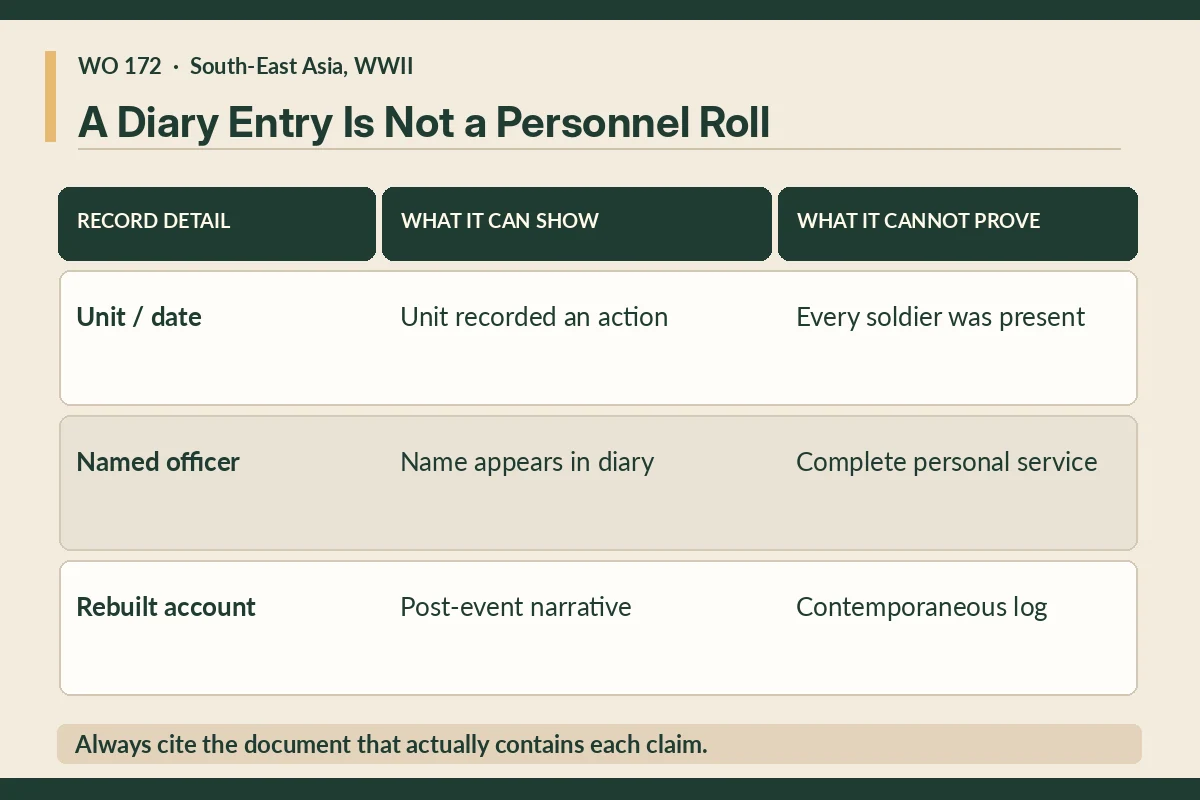
War diaries summarize daily activities, orders, movements, actions and administrative circumstances. They can also include appendices such as orders, maps or reports, depending on survival. Their original purpose was operational recording, not assembling a complete list of service personnel. A paragraph saying a battalion advanced toward a named point does not prove that any specific private soldier took part.
Write the exact entry date and distinguish it from the period covered by a report filed later. Note who signed the diary, whether attachments appear, and whether pages are missing. A later summary may compress several days into a single account. If the diary describes a patrol rather than the whole unit, identify the echelon before attributing the action broadly.
Check Numbers, Formations, and Renaming
The same regiment could have several battalions serving under different brigades and divisions. Headquarters diaries may refer to all subordinate formations without detailing each subunit’s route. A diary for one company should not be substituted for the battalion headquarters diary, and a brigade narrative should not be treated as an individual unit’s roll.
Track the unit’s full title, numerical designation, attachment and command relationships across the relevant period. If a unit changed command, was reorganized or became separated from its parent formation, make a dated note. Search adjacent headquarters or neighboring units where the focal diary is missing, but label the resulting evidence as indirect.
Treat Reconstructed Reports With Caution
The South-East Asian campaign involved rapid withdrawals, disrupted communications and record losses. Some accounts of operations were compiled later from memory or surviving fragments. Rather than assuming all material is an unbroken daily manuscript, inspect the document’s cover, date span, author, amendments and description. A reconstructed narrative can be important historical testimony without being a contemporaneous entry.
Where a report conflicts with another dated diary, compare who created each document and for what purpose. Do not erase contradictions by choosing the story that best fits a family tradition. A missing day may reflect lost paperwork, movement under fire or a change of reporting unit—not proof that nothing occurred.
Confirm a Soldier Independently of the Diary
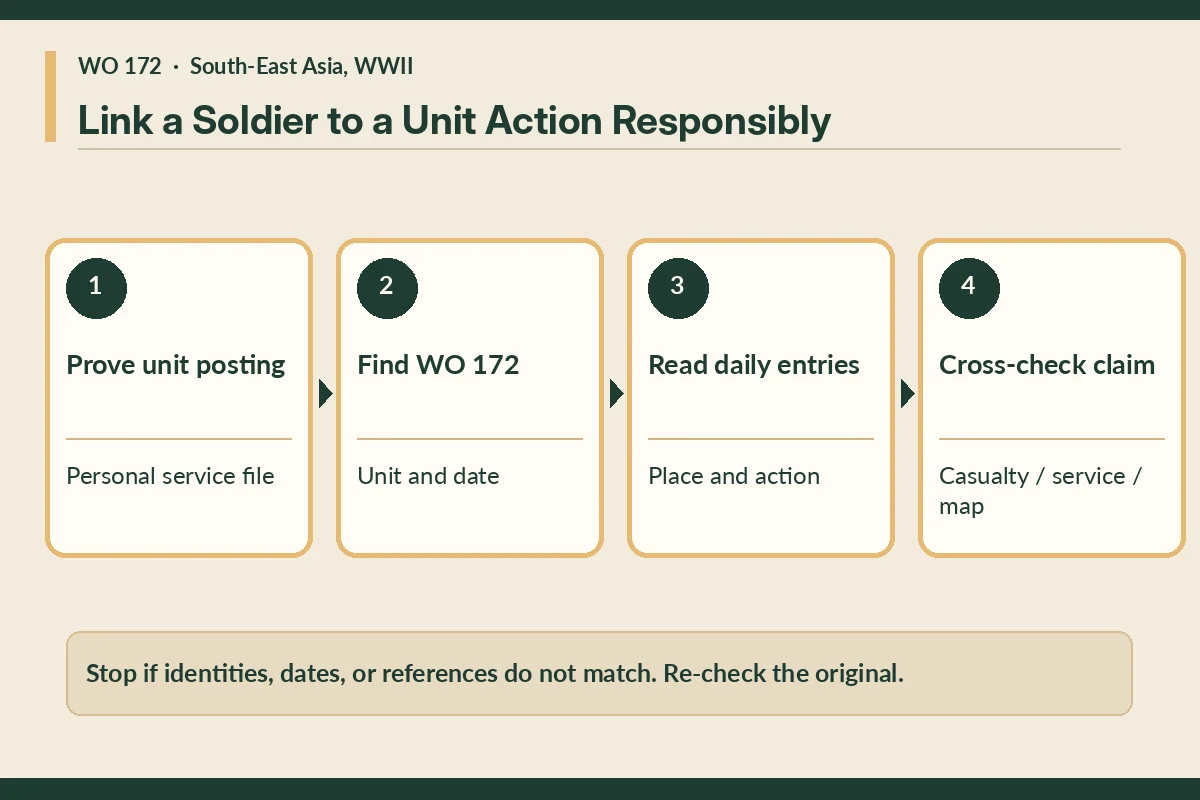
The National Archives stresses that service records, medal records and unit diaries serve different functions. A service record can establish a posting interval and transfers; the unit diary offers operational context. Even when both show the same battalion and month, you should account for leave, hospital admission, detached duty or an assignment elsewhere before asserting presence at one specific action.
Names found in a diary require the same identity check as names elsewhere. An officer’s surname and initials can recur within a regiment; a casualty list may show a different location or date. When a name is absent, do not infer exclusion from the unit. When a name is present, do not infer a complete personal career from a single mention.
Use Maps and Other Units to Test a Timeline
Operational maps, location statements and higher headquarters diaries can help place a formation in an evolving campaign. Compare grid references and contemporary map editions, not only modern country names. A line on a situation map may represent a planned axis of advance rather than a confirmed march at that hour. A neighboring unit’s report is corroboration only when it actually identifies the same operation.
Maintain a date-and-evidence matrix: unit as named, described action, location, source reference, and degree of confidence. Mark an operation as planned, reported, confirmed or disputed. That practice prevents a single dramatic passage from becoming the unsupported centerpiece of a named ancestor’s biography.
Test a Dated Operation Against a Posting
Suppose a WO 172 battalion diary reports an action on 12 March, while an individual service file shows attachment to the regiment during the same month. First establish that the file names that battalion rather than only the regiment. Next check hospital, leave or detached-duty entries. The diary supports the battalion action; the individual file supports a posting. Their overlap may strengthen context without proving the soldier personally joined that patrol.
If an operational report was compiled later, include both the report date and the dates described. Compare a higher headquarters diary, a contemporary map and personal casualty information when available. A difference in timing or location is a research problem to resolve, not a reason to convert planned movements into completed ones.
More Records and Archives Guides
How We Research Second World War Unit Evidence
Our recommended sequence is personal posting evidence when available, the correct theater and battalion, then the dated WO 172 diary and independent material. We cite a complete series and piece number for every event. We do not replace the soldier’s service file with a unit account, and we do not label a reconstructed report as an untouched day-by-day log.
Where surviving documents are inaccessible or incomplete, we explain that limitation and give a specific next search. Official series descriptions guide the search but do not supply every personal fact. For transparency about linked services, see our affiliate disclosure.
The National Archives places WO 172 under South-East Asia Command for British Army Second World War operations.
A unit or battalion and a date are usually more reliable. War diaries generally describe units and most ordinary soldiers are not individually named.
No. It records a formation’s activities and selected events, not attendance for all personnel on every day.
Not necessarily. Some surviving accounts may have been reconstructed or compiled later; check the date and nature of the specific item.
Use an individual service record establishing unit and posting dates, then compare diary events with casualty, award or other personal evidence as available.