
WO 169 holds Second World War war diaries for British Army forces in the Middle East theatre. The reliable way to locate a diary is by unit designation, operational theatre and dates, not by entering a soldier’s surname into a general search. A diary can document an advance, supply difficulty, headquarters order or change of location, but it usually does not list everyone present. The National Archives’ army-operations guide identifies WO 169 as the Middle East series among several theatre-specific war diary collections. The question of whether a particular soldier took part must be tested in separate person-level evidence.
Choose the Theatre Before Searching the Diary
Second World War diaries were arranged in different War Office series by operational theatre. The official series table assigns Middle East forces to WO 169, Central Mediterranean forces to WO 170, North-West Europe to WO 171 and South-East Asia to WO 172. A battalion could change command or theatre during the war; a long service story therefore may require more than one series. Do not infer the correct series merely from the regiment’s traditional home district or the site of its recruitment. Start with where the unit was operating on the date of interest.
A good first search uses the complete battalion or unit name, its number where applicable, and a date range rather than a place name alone. A brigade headquarters diary is not interchangeable with the attached battalion diary. If the wartime title changed, try each historically documented designation. The spellings and abbreviations used by clerks can differ from modern regiment names. Record the catalogue description and exact piece reference before deciding that a candidate file is the correct unit.
Check the Diary Date Against the Soldier’s Posting
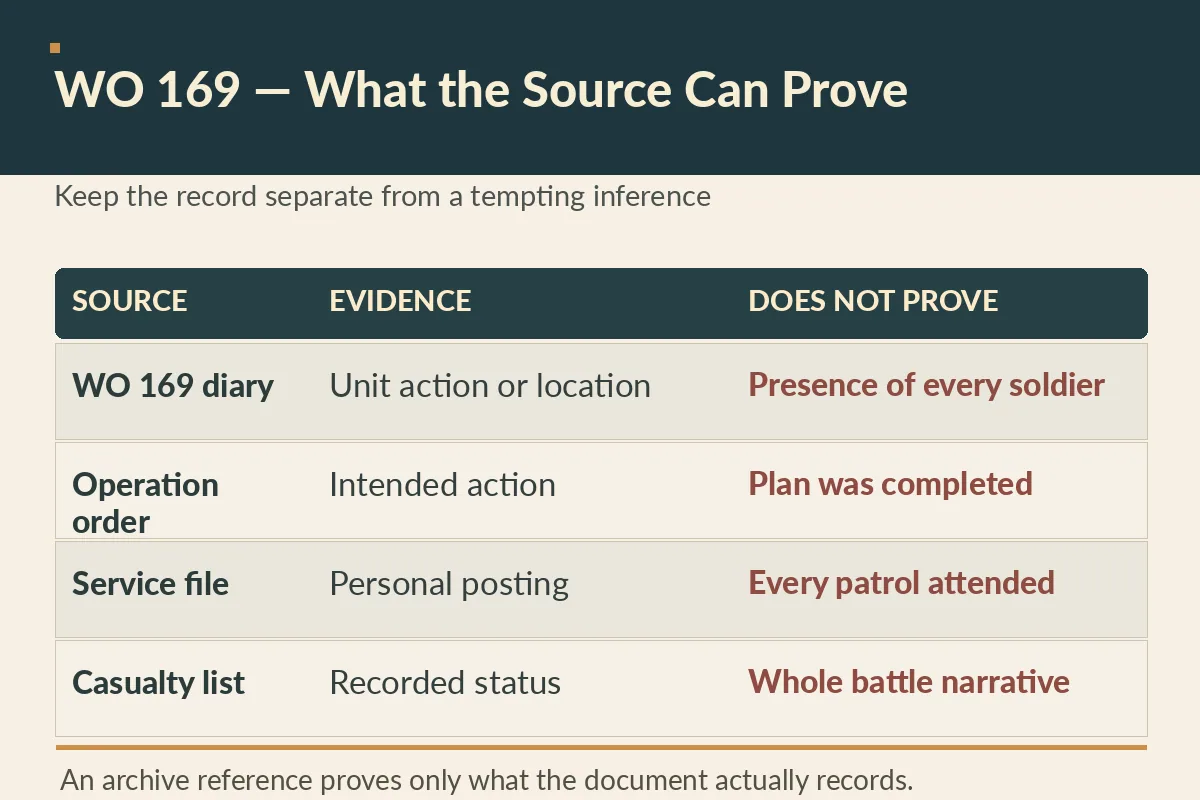
The National Archives guide for British Army soldiers of the Second World War explains that service records, medals and unit diaries serve different purposes. A surviving individual service record may give a series of postings, attachments and transfers; a war diary concerns the unit. Only after establishing that the person was assigned to the relevant unit on the date should the diary be used as context for that soldier’s experience. Even a correct posting does not prove presence at every named action.
A person may be in hospital, on leave, detached, missing or assigned to duties away from the main formation. When a diary says ‘the battalion moved,’ it describes an administrative unit’s activity, not necessarily the movement of every soldier on its establishment. If the diary names an officer, do not assume it identifies all the men under that officer. Keep a table with diary date, recorded unit action, independent personnel date and confidence in the proposed connection.

Read Orders, Maps and Appendices Alongside Daily Entries
Daily diary entries can be short, sometimes only recording locations, timings and major events. Attached operational orders, situation maps, intelligence summaries and appendices may explain the action in more detail. The attachment is evidence of what was issued to or held by the unit; it is not always proof that the plan was carried out exactly as written. Compare subsequent diary entries before describing an ordered attack, withdrawal or patrol as completed. A map grid reference is a coordinate in a historical system, not a modern GPS fix.
When working with a reproduced diary, check whether appendices were scanned with the daily narrative and whether a missing image is a preservation gap or a genuinely absent document. Transcribe the original place-name spelling and identify the map sheet and grid convention if possible. Do not move a point on a modern map just because two villages share a name. The strongest reconstruction shows both the dated source and any uncertainty in the unit’s actual position.
Separate Headquarters Reports From Eyewitness Accounts
Headquarters and subunit diaries can describe one episode differently because they were written for different audiences, at different times and with unequal access to information. A later war history may harmonize reports or add names that the contemporary daily record lacks. Preserve those layers instead of replacing an awkward diary entry with a polished retrospective. Casualty numbers, prisoner estimates and claimed vehicle losses may be provisional, particularly when a daily report was compiled before confirmation could reach headquarters.
For a specific event, build an evidence matrix with the diary, relevant subordinate or neighboring unit files, dated operational orders and independent casualty or personnel entries. Mark whether each source observed an event, relayed a report or made an estimate. A discrepancy may reveal changing information rather than an obvious error. Avoid naming an individual as killed or wounded solely because the unit reported casualties; verify the soldier against the person-level casualty lists or service record.
Look Across a Unit’s Sequence, Not One Day in Isolation
One dramatic page does not explain how the unit arrived at an operation. Read the days immediately before and after the date of interest, checking dates of movements, periods of rest, changes of commanders and attachments to different formations. A unit bearing the same name could have parallel elements on separate tasks, while an abbreviation may refer to a company rather than the whole battalion. Copy the diary’s own headings to avoid confusing an entry for one element with a summary for all troops.
A useful chronology distinguishes an order to march, the actual departure, reported arrival and later confirmation. When these are recorded separately, retain the separate times. If a diary only states that ‘a patrol was sent,’ it does not automatically prove that the patrol reached the objective. A person who served with the formation during the same month cannot be assigned to that patrol without a named roll, report or personal testimony that supports the inference.
Cite What the Unit Record Says—and Stops Saying
The final citation needs the WO 169 piece, page or image reference, date, level of formation and any appendix used. Quote precisely if a short passage is necessary, but distinguish transcription from your interpretation. If you inferred that a modern place matches an old grid reference, cite the map evidence and state the method. Unit histories and memoirs can be valuable secondary accounts, yet they should not replace the contemporary diary when you claim that the unit recorded a specific action.
If no diary exists for the required date, widen the search to the higher headquarters, neighboring units, local maps or operational reports, but say that these are substitutes. A missing page is not evidence that a battle did not happen. The final result may show that the unit was at a location on a date but leave the individual soldier’s participation unresolved. That is an appropriately supported conclusion rather than a failure of research.

More Records and Archives Guides
How We Research and Cite These Records
We use the National Archives theatre table to separate WO 169 from WO 170, WO 171 and WO 172. Each dated diary assertion is checked against the actual unit level and attachments; service and casualty records are kept separate so that movements are not attributed automatically to a named soldier. Availability, image completeness and current access restrictions require checking the exact piece. Our affiliate disclosure explains commercial transparency.
The War Office series for British Army Middle East forces war diaries during the Second World War.
Generally not. Most diaries focus on units and frequently omit individual other ranks.
Check the official series table and search the appropriate additional series.
No. Look for later dated entries or independent operational evidence.
Use their service record and, when applicable, casualty or other named personnel documents.