
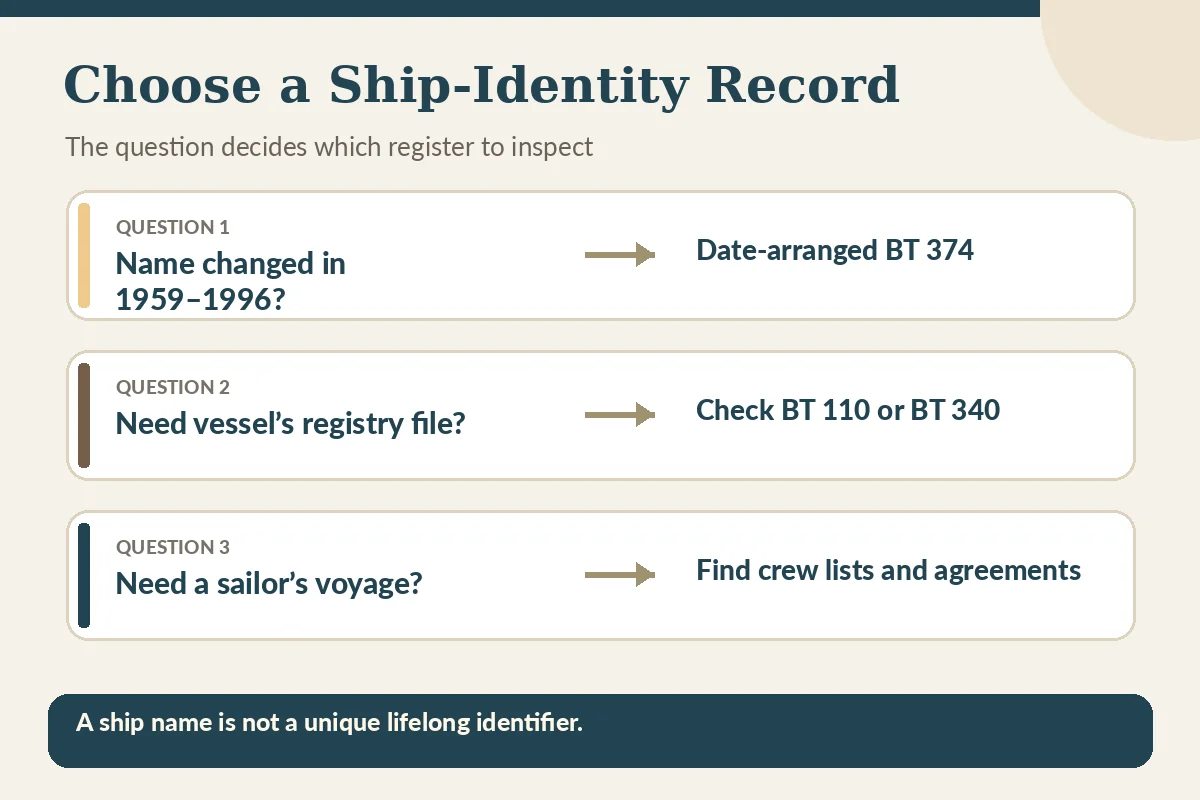
BT 374 contains registers of changes of names of merchant ships covering 1959–1996. The records are arranged by date, not as one universal alphabetical index of every name a vessel ever carried. Start with the closest known date of a rename, the vessel’s old or new name and, if available, its official number and port of registry. A remembered ship name can refer to different vessels over time; a legal change of name does not create a new hull, while two ships sharing a name are not necessarily connected.
Start with a dated name rather than a story
The National Archives merchant-ship registration guide identifies BT 374 explicitly and explains that official numbers were introduced from 1854. It also distinguishes port registration numbers, which could repeat across ports and years, from a vessel’s official number. Before telling a migration or sea-service story, construct a timeline with the exact form of each ship name as it appears on a dated record. Include alternate spellings and punctuation without silently merging vessels.
Find the right record by registration date
Browse BT 374 against the relevant date or range and transcribe any old and new names, identifying numbers, dates and references shown in the entry. A search by name in Discovery may find a catalogue description, but the guide warns that many ship-registration files are not fully name searchable. If the register cannot be viewed online, record the specific piece to request at Kew or through the archive’s copying service. State clearly when a candidate has only been located in a catalogue description.
A date clue might come from a contemporary shipping directory, a survey, a news report, or a dated document bearing the old name. None of these substitutes automatically for the registration entry. Do not extend a BT 374 range earlier than 1959 or later than 1996; for other periods, use the appropriate registry sources. If the rename was reported secondhand, look for a second record on each side of the proposed change, preferably carrying the same official number.
Treat the official number as the identity anchor
A vessel’s official number is generally a stronger bridge across renamings than the ship’s display name. The National Archives guide to crew lists and log books explains how official numbers follow ships and support discovery across changes in documentation. Compare the BT 374 entry with registry records, taking account of the time period: BT 110 collects closed registry papers from 1889–1998, whereas BT 340 concerns registries current in 1994. The correct complementary file depends on status and the relevant registration date.
Check more than one identifier: registered tonnage, build year, dimensions, place of construction and registry port may help reject a same-name vessel. Changes in dimensions or propulsion recorded in registers require interpretation rather than forced agreement. An official number bridge strengthens ship identity, but a copyist’s error is still possible. Mark a candidate “unconfirmed” until its combination of dates and identifiers is consistent. A former name does not in itself prove a new owner, a sale or a new route.

Keep renaming apart from ownership and crew changes
A name change may coincide with new ownership, a transfer of registry or a conversion, but none follows automatically. To investigate ownership, consult the associated transaction or registry documents for the correct period. For a crew member, look for a crew agreement, service record or other person-level evidence. BT 374 is a ship-identity source, not a list of everyone who served aboard. A captain’s name from one year’s source must not be carried across decades or renamings without records covering the later dates.
Suppose a vessel named “North Bay” in a family letter is thought to be “Eastern Star” in a later photograph. A BT 374 name-change entry plus the same official number could support a continuous vessel identity; a photograph or a passenger’s reminiscence alone cannot. If the records provide only an approximate year, search a suitable date range, record failed attempts and avoid inventing a precise change date. Preserve both the original names and the sources that report each name.
Build a name-history timeline that another reader can check
Use a worksheet with columns for record date, name written, official number, port, supporting series, and what the document proves. Start with the earliest reliable appearance, attach BT 374 where applicable, and then compare later registry and crew records independently. Label the date of a document and the event it reports separately; a directory published in January might summarize information collected earlier. Keep a separate column for alternative vessels sharing a name, especially when a family story involves several ports.
A clear conclusion might say, “The BT 374 register records a change of name on a stated date; the official number links the two names to the same registered ship.” That does not prove the ship was in a particular port on a particular voyage. Movement cards, crew agreements and log books are separate, period-dependent questions. Some series exist mainly in physical archives, so cite the exact catalogue reference and say whether the underlying record was inspected or only identified.
For example, a vessel carrying a name in an early registry might later appear under a different name in a family photograph. Without a matching official number, ship specifications and the date-specific rename entry, the identification remains tentative. Even when continuity is proved, crew membership, voyage dates and ownership changes require their own records. A single ship history can contain many different people and transactions.

More House and Local History Guides
How We Research Vessel Renamings
We follow the National Archives ship-registration guide for the date-arranged BT 374 series and the distinction between port and official numbers. We test each name against at least one additional ship registry or dated source and do not turn a rename into an assumption of sale, ownership or crew service. We distinguish a recorded event from a later printed directory entry.
Our citation ledger notes every name variant, known date and competing vessel. A missing online name hit is treated as a catalogue limitation until the relevant register has been checked. External-link practices are explained in our affiliate disclosure.
The National Archives describes registers of ship-name changes from 1959 through 1996, arranged by date.
No. Verify the continuous identity with the official number and registry information.
No. Port registration numbers could recur by year and port; official numbers are more durable vessel identifiers.
No. Check ownership transactions and individual crew agreements separately.
Browse the date-arranged series and related registers rather than treating the catalogue search as exhaustive.