
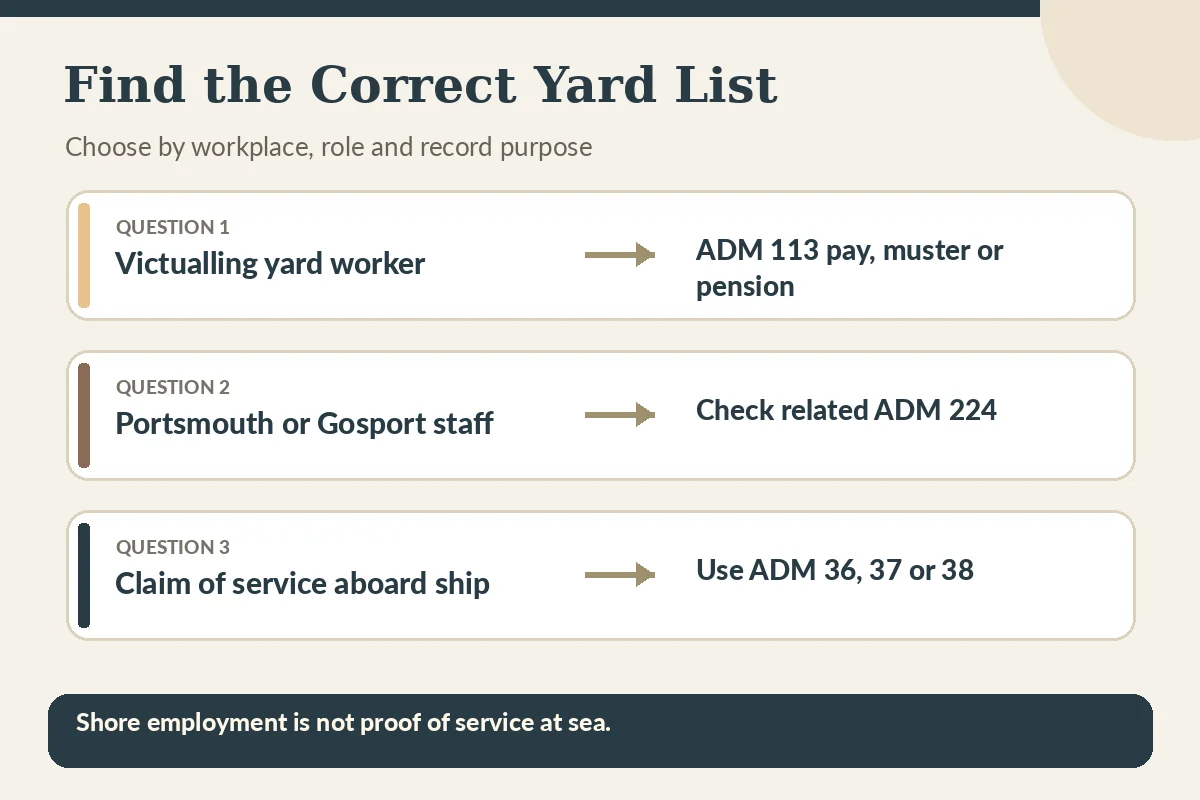
ADM 113 brings together pay lists, musters, pension lists and related registers for Royal Navy victualling-yard workers, broadly 1703–1857. These establishments supplied and administered food and other necessities for naval operations. Being recorded at a victualling yard is not, by itself, evidence of serving aboard a warship. Start with the worker’s approximate dates, occupation, residence and most likely yard. If a family story uses the term “Navy man,” determine whether it means a sailor, a shipboard cook or a civilian supplying the fleet before selecting a record series.
Begin with the establishment, not an assumed sailor
The National Archives guide to dockyard staff distinguishes ADM 113 from ADM 42 dockyard pay books and ADM 36–38 ship musters. Those series address overlapping administrations but not interchangeable kinds of service. In Discovery, search the historic establishment name and narrow to ADM 113, then browse the date range and document category. Do not assume every list is searchable by each employee’s full name.
Account for changing names of victualling yards
The historical name of an establishment may differ from its later or more familiar title. According to the National Archives guide, Deptford became Royal Victoria, Plymouth became Royal William, and Portsmouth became Royal Clarence. A record indexed under a later name should not be used to relocate the original site or invent a move by a worker. Make a table containing the name actually written, the modern equivalent when relevant, the town, and the date of the source.
Search both historic and later establishment names, with chronological care. Some records might be catalogued under broad administrative labels rather than under the local workplace. For Portsmouth and Gosport, ADM 224 contains staffing and pay registers from 1712–1903 and can provide a related route; it is not a guaranteed substitute for each missing ADM 113 entry. If a worker appears in one yard’s list and another under a different spelling, verify dates, role and identity before presenting this as an actual transfer.
Read a pay list and a muster as different evidence
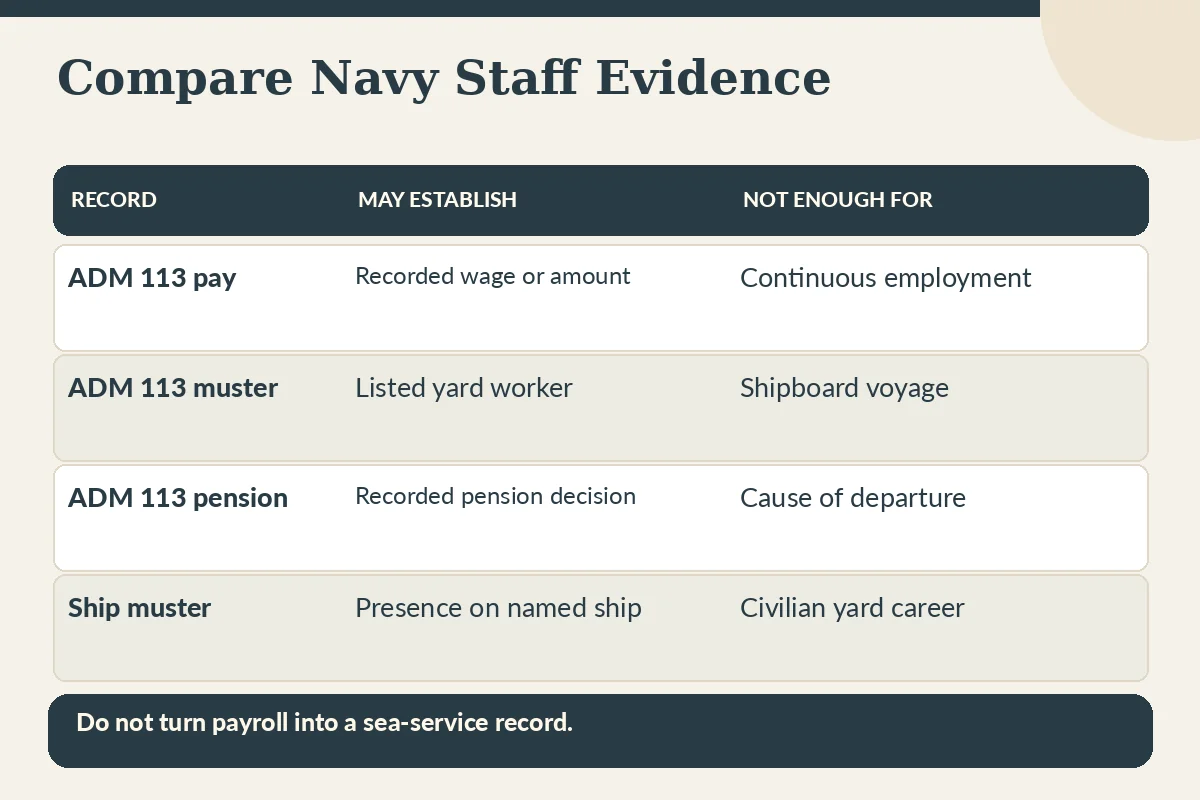
A muster may show that a person was included in a list at a particular establishment and point in time. A pay list may record wages due or paid under the administrative conventions of that volume. Pension lists and registers may record entitlement, decision or an actual periodic payment; their specific fields and vocabulary must be checked. In all cases, transcribe the individual’s name, role, rate, dates, yard and exact page or folio where available. Avoid converting a wage line into an uninterrupted career without intervening records.
A name may be entered for several reasons: active worker, temporary laborer, supernumerary, pensioner or another category indicated by the clerk. The absence of a person from a later list may reflect survival gaps, transfer, a new naming convention or changes in administrative coverage rather than death or dismissal. Check annotations, column headings and totals. If the payment calculation is unclear, distinguish the amount written from your estimate and do not add unrecorded months to create a fictional annual wage.
Keep shore employment separate from ship service
A dockyard or victualling-yard worker may have supported naval operations for many years without going to sea. If a story claims an ancestor sailed on a named ship, that requires shipboard muster or pay evidence for the right dates. The ship lists in ADM 36, ADM 37 and ADM 38 were created for different purposes than yard staffing and cannot be treated as automatic continuations of an ADM 113 entry. Conversely, the same surname on a ship muster should not be accepted as the yard worker without age, trade, residence or other identity links.
A useful case example would compare an ADM 113 entry for a cooper in Portsmouth with a separately dated claim that a cooper served aboard a frigate. Both could be true for one person, but only an independent ship record and convincing personal identifiers would establish the connection. Some individuals shared names within naval communities for generations. A pension award also cannot supply a spouse’s identity unless the record actually gives the relationship; use a marriage, probate or parish record when necessary.
Create a career timeline with explicit blanks
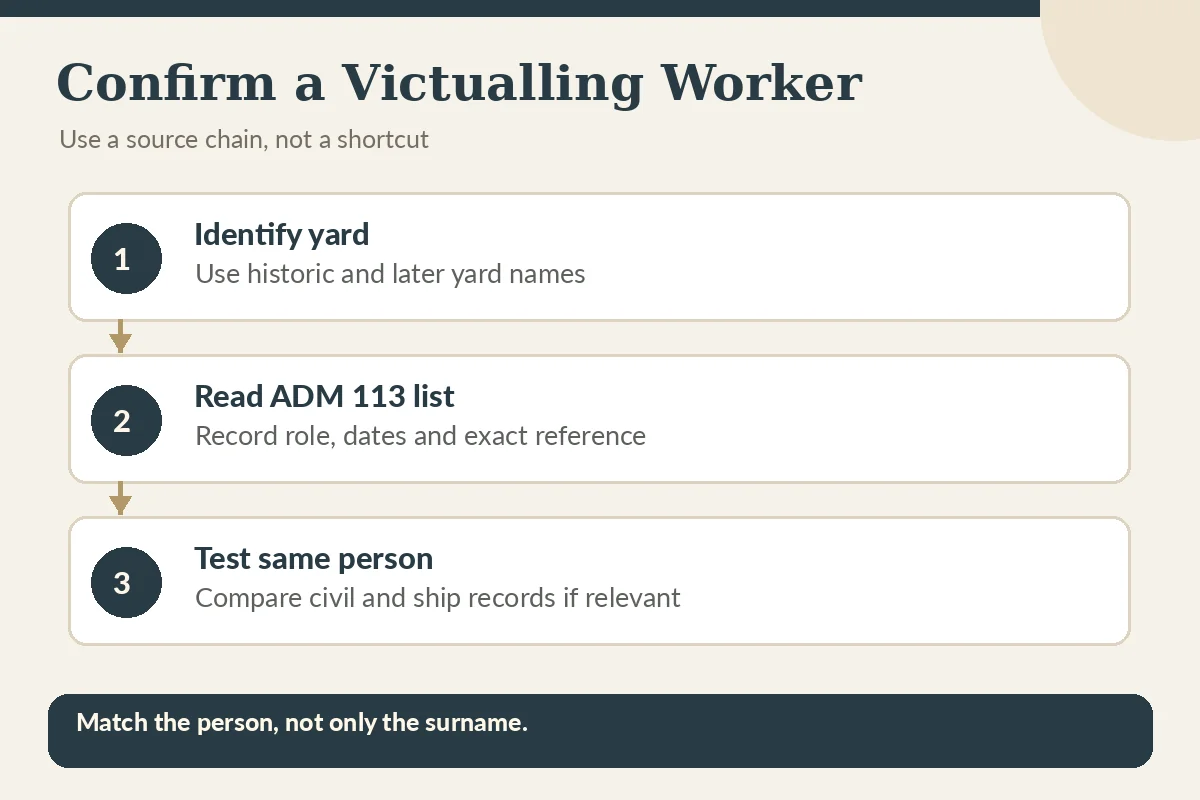
Build a timeline by year, yard, historic yard name, record type, job title and evidence category. Transcribe dates of lists separately from effective dates of appointment or pension if those differ. Record every checked ADM 113 piece, including negative results and whether it was physically examined or only searched via catalogue. Where a later ADM 224 register exists, place it as a parallel record and flag any discrepancy rather than choosing the most convenient age or pay rate. This makes a more reliable occupational history than an unqualified statement that someone “worked for the Navy for thirty years.”
When publishing a conclusion, use bounded language: “The 1819 victualling-yard pay list records this named cooper at Portsmouth” is defensible if the original supports it. “He sailed with the fleet” requires different evidence. A worker’s last appearance is not necessarily a death date; a pension list may postdate actual employment. Try local directories, parish registers and other civilian sources to resolve competing identities and locate the family.
For example, a copper or cooper at a victualling yard could appear on an ADM 113 payment list but not on a ship muster. The payroll can establish that a payment was recorded; it cannot show a voyage. A similarly named crew member might be a relative or unrelated person. Test residence, job, dates and any service number before joining the records into a single biography.
More Records and Archives Guides
How We Research Victualling-Yard Staff
Our first check is the official yard-staff guide, including its three historic yard-name changes and ADM 113/ADM 224 distinctions. Then we consult the catalogue description and relevant list, preserving headings that define who was counted. We never describe shore work as seagoing service without a matching independent muster. We do not infer dismissal, death or a family relationship solely from the end of a pay sequence.
Our occupational ledger marks original names and places, precise dates, access restrictions and records not found. For transparency on external editorial links, consult our affiliate disclosure.
Pay, muster, pension and related registers of Royal Navy victualling-yard workers, chiefly covering 1703–1857.
No. The records can concern civilian employees at shore establishments; shipboard service needs separate evidence.
The victualling establishment changed names, as did those at Plymouth/Royal William and Portsmouth/Royal Clarence.
Not always. ADM 224 covers particular Portsmouth and Gosport staffing and pay records and has its own scope.
No. A departure, transfer, survival gap or accounting change may explain the disappearance.