
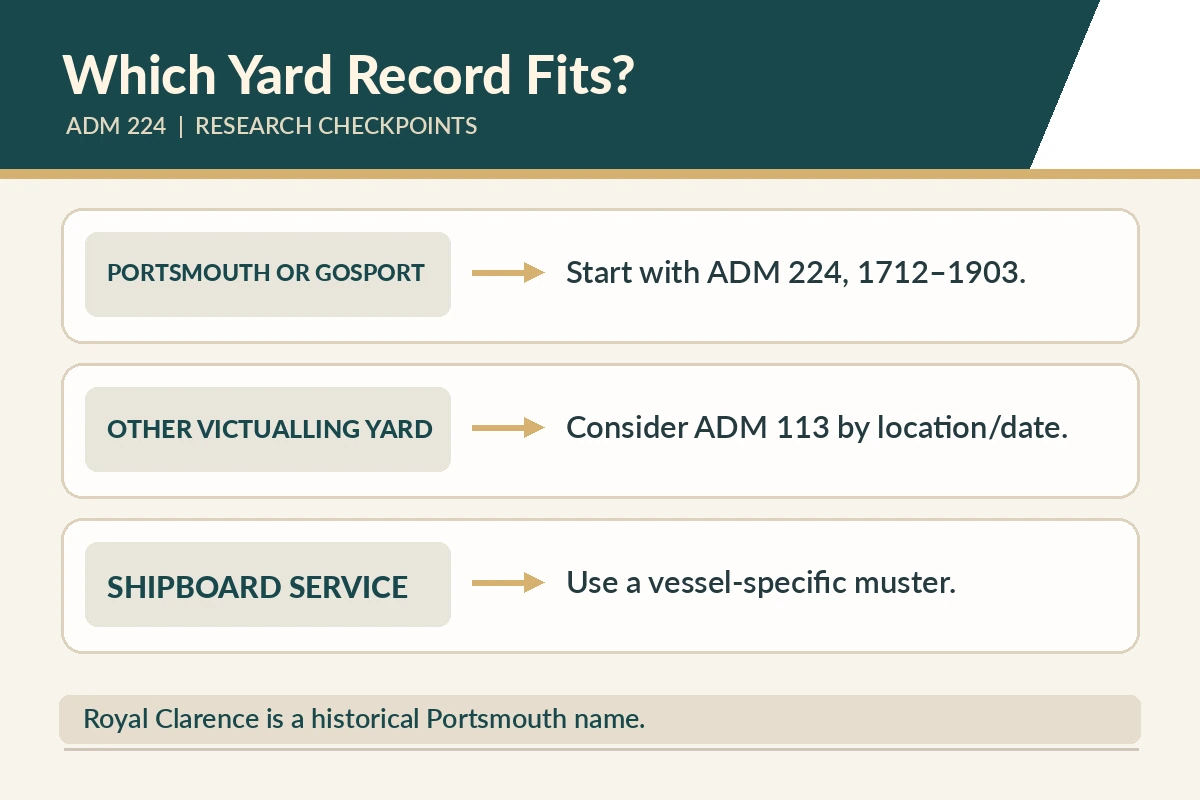
ADM 224 concerns staff and pay records of Royal Navy victualling establishments at Portsmouth and Gosport, with the main guide giving an overall date span of 1712–1903. It is useful for investigating a civilian or shore-based naval worker, but a name in a yard register does not show that the person sailed on a warship. The first search key is the establishment and its historical name, not just a surname. The National Archives explains that Portsmouth’s victualling yard became known as Royal Clarence; both names may matter when finding related books or interpreting family descriptions of employment. For official series scope, consult The National Archives research guide.
Locate Portsmouth and Gosport by historical yard name
A modern location may conceal a succession of historical names. The National Archives specifically notes that Portsmouth victualling became Royal Clarence and distinguishes its staff-and-pay records from those of the six principal naval dockyards. A family account stating ‘Portsmouth Navy Yard’ may mean a dockyard, a victualling establishment, a gun wharf or even civilian work near the harbor. These sites had overlapping geography but different record creators. Before searching ADM 224, identify the worker’s occupation and whether the available clue concerns food supply, provisioning, storage, carpentry or shipbuilding.
Work backward from a dated residence, trade directory, marriage record, pension note or family letter. Search the catalogue by Portsmouth, Gosport, Royal Clarence and other relevant local names, then browse the year and institution. If the catalogue describes only a pay book for a yard and year, it may not expose every employee’s name. A failed full-name search is therefore weak negative evidence. Make a list of original books actually examined; do not label a worker absent until the right institution and accounting period have been tested.
Interpret ordinary and extraordinary employment correctly
The official guide uses ‘ordinary’ for permanent establishment staff paid salaries, including senior officers, foremen, clerks, skilled workers and laborers. ‘Extraordinary’ means unestablished or casual personnel hired when needed, particularly during busy or wartime periods. These labels describe employment category, not social rank or moral character. A wage record may show a paid period without defining a man’s whole career. An extraordinary worker could have repeated engagements, while an ordinary worker might have absences or role changes that need a series of entries to reconstruct.
Create separate fields for name, yard, role, ordinary/extraordinary category if stated, period covered, payments and any notation of absence. Look for the actual accounting unit: weekly, monthly or another cycle. One payment line is not a continuous appointment for the entire date range of the volume. If a person appears with a similar name under another trade, check age, address or a distinctive signature before combining records. Never infer sea service merely from the administrative association with the Admiralty.
Choose ADM 224 or neighboring Admiralty records
ADM 224 is geographically specialized: the guide associates it with staffing and pay at Portsmouth and Gosport victualling establishments. For victualling workers at other yards, and for earlier or overlapping pay evidence, ADM 113 may be the appropriate alternative; the guide lists ADM 113 pay lists, musters, pension lists and registers for 1703–1857. Ordinary dockyard pay books lie in ADM 42, and those records concern a different administrative workplace. These are source choices, not automatic consecutive steps in a sailor’s career.
A person might genuinely have worked in two departments, but that career transition should be proved. First match exact dates and occupation to the establishment; then read the headings and any administrative marks. If searching for a gun-wharf employee, the ordnance administration can direct the research away from Admiralty victualling registers. An empty ADM 224 search for a Plymouth or Deptford worker should not be treated as a surprising loss: those locations were outside the series’ central Portsmouth–Gosport scope.

Separate staff pay from shipboard service
Victualling establishments supplied food and equipment for the fleet, which makes their work essential to naval history. Nevertheless, a cooper or laborer paid at Royal Clarence did not necessarily sail with a vessel being provisioned. A pay list can document employment at a site and perhaps a task or wage, but a muster or separate naval service record is needed to place the same person on a ship. A ship listed in a yard account may be a customer or destination for stores rather than the employee’s posting.
This distinction is particularly important when a surname appears in both a yard payroll and a published account of a naval campaign. Search for a ship-specific muster under the appropriate ADM series, with a date and role that fit the supposed service. If you cannot match both, keep the story in two parts: the yard employment is supported, while the sea-going claim remains unverified. Pay grade, handwriting and a common surname cannot substitute for a personnel cross-reference.
Reconstruct a realistic career across accounting periods
Rather than extracting one line as a lifetime description, track consecutive pay periods and possible changes in work category. Record whether each book names the individual, gives only a group total or lists a contractor. A payment to a supplier or head worker is not by itself a roster of all laborers working under that person. If a worker disappears from one year, test a change of yard, promotion, discharge, non-survival or a shift in accounting format before declaring death or migration.
Independent local records may resolve some uncertainties. Civil marriage or death registrations, local directories, census households and pension correspondence can help connect a name in ADM 224 to a known family. These sources do different work: a census may establish a stated occupation and address, while a payroll establishes a department’s recorded financial relationship. Neither alone proves all intervening years of employment. Write approximate dates as ranges when the evidence permits no sharper statement.

Keep a yard-specific evidence ledger
For each item preserve the ADM 224 piece number, establishment name as written, period of the volume, page or folio and the type of financial entry. Add a confidence field for identity matching and a separate column for any ship claim. If an original is not available online, note the discovery description and intended consultation rather than pretending to have seen unseen handwriting. Use the exact vocabulary of the register where possible, with a plain-English explanation for readers unfamiliar with naval administration.
Before publishing, verify that the person really appears as a paid or registered worker and was not merely mentioned as the recipient of a supply order. Check whether a later pension or workhouse record concerns the same individual using more than one identifier. It is legitimate to conclude that the payroll places a named person at a specific victualling establishment for a documented interval while leaving his earlier training, subsequent service and family connections open for further investigation.
More House and Local History Guides
How We Research ADM 224 Records
We start with the National Archives’ dockyard-staff guide, select Portsmouth, Gosport or Royal Clarence as the historical workplace, then inspect the relevant ADM 224 staffing/pay book. We separate ordinary and extraordinary employment, compare ADM 113 only where the institutional scope fits, and require independent evidence for a shipboard claim. Our citations preserve the original yard name and accounting date. Our affiliate disclosure explains links and potential commercial relationships.
No. It concerns staff and pay at Portsmouth and Gosport victualling establishments.
The National Archives identifies Royal Clarence as the later name of Portsmouth victualling.
It generally denotes unestablished or casual employment rather than a permanent post.
Yes when the establishment and dates match the separate victualling pay records it covers.
No. A specific ship muster or equivalent service evidence is needed for that claim.