
ADM 358 is the Admiralty Casualty Branch series for enquiries into missing naval personnel during the 1939–1945 war. The National Archives advises searching by a person’s name or ship name. The word “missing” is a status at a particular moment in a process, not an automatic finding of death, capture or survival. A careful researcher reconstructs the report and the later evidence in chronological order, then checks any final conclusion in a separate authoritative source.
Decide Whether You Have a Person or a Ship Lead
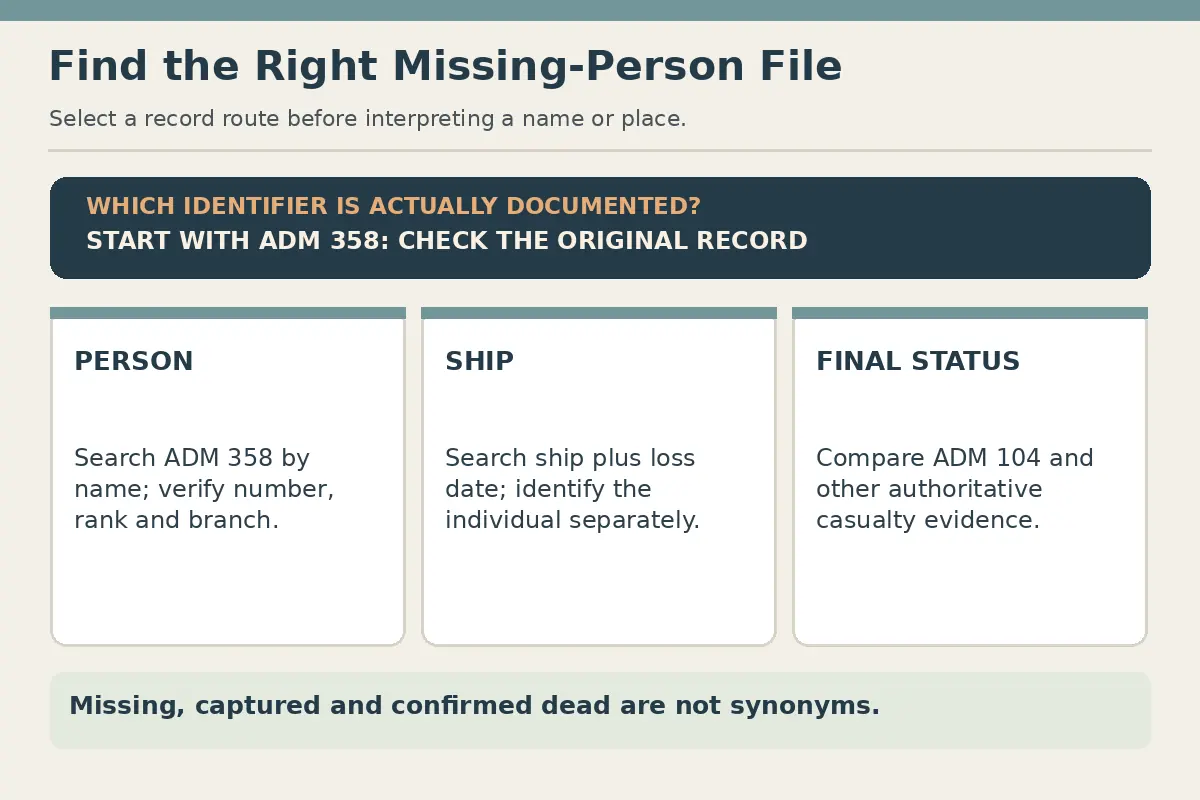
Start with the identity you can document: full name, service number if known, rank or rating, branch and a dated ship or unit association. An Admiralty record may describe several men with the same surname or refer collectively to a vessel. When a missing report names only a ship, use the ship as a lead rather than guessing that every named ancestor served aboard at the time.
Create two search paths. A person-first search tests spelling variants and a service number; a ship-first search checks the vessel’s name and incident date. Bring the results together only if a record supplies a real link between them. Ship names can be reused, and a person might have changed ships before an incident.
Keep Report, Incident and Enquiry Dates Apart
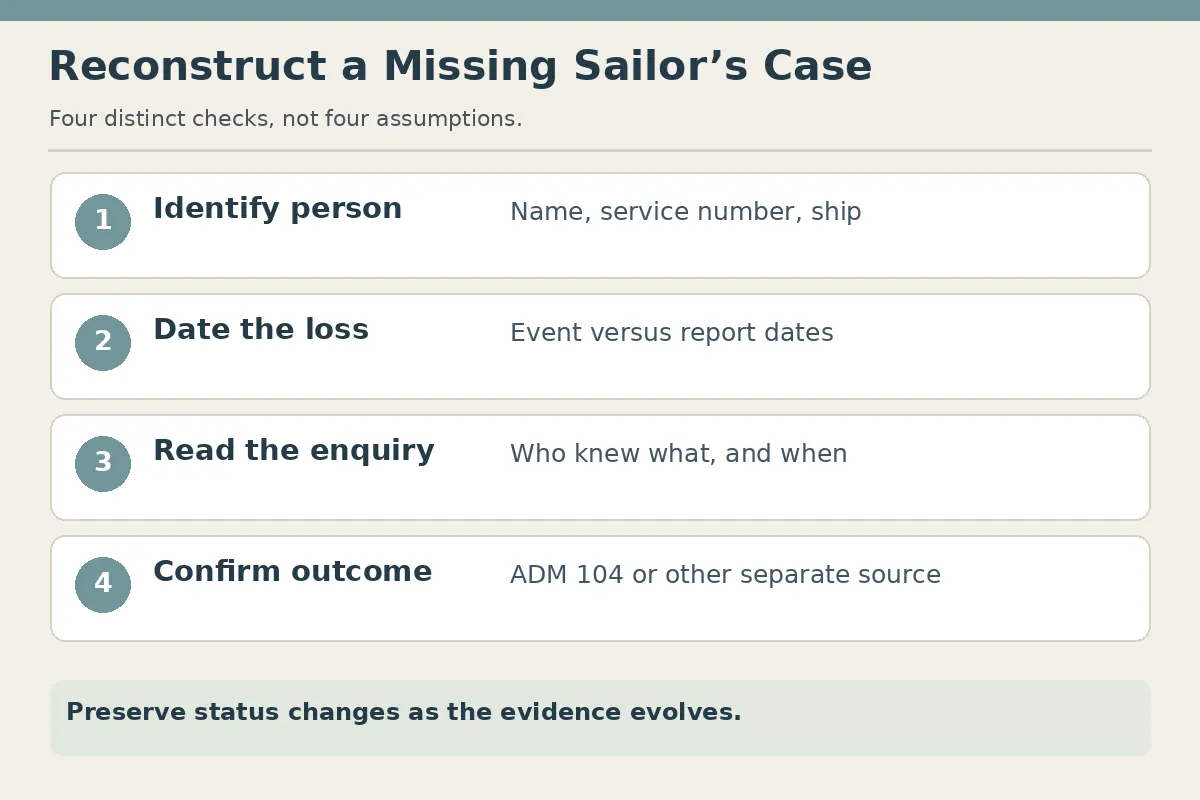
A family notice may say someone was missing on a certain date, while the event that caused the report occurred earlier. An official enquiry could take place months later. Transcribe the date of the incident, the date the person was reported missing, the date of any statement and the date of a later decision in four separate fields.
If a later annotation changes a status, preserve both the original entry and the subsequent update. The earliest document reflects what the office knew then, not necessarily what historians know now. Do not rewrite the initial record as “killed” merely because a later source uses that outcome. Conversely, an early “missing” label cannot erase a later independently documented return.
Understand What an Enquiry File Represents
ADM 358 comprises enquiries handled by the Admiralty Casualty Branch. It is an administrative evidence trail assembled for a particular purpose, not an eyewitness diary written solely at the scene. Some files may contain summaries, statements or correspondence; record exactly which document is present and who supplied the information instead of assuming a standard content list.
Give each witness or correspondent a source role. A survivor reporting what they saw is different from an officer repeating a list, and a family member asking for news is different from an Admiralty finding. Dates, circumstances, proximity and whether the writer personally saw the event all affect what a statement can establish.
Compare the Claim With Separate Casualty Evidence
The National Archives identifies ADM 104 registers of reports of deaths on Royal Navy ships for 1893–1950. A matching death entry may help resolve an enquiry, but the two sources still need an identity check. Compare full name, age, rank, ship, date and cause as stated. A name hit alone is not enough, particularly where naval ratings shared common names.
Another record may be a war grave entry, service record, memorial or official casualty list. Each has a different reporting chain and creation date. If two records disagree about when a man died, do not silently select a single date: the difference might be between casualty event, formal presumption and later registration.

Distinguish Capture From an Unresolved Loss
Missing at sea could include uncertainty about capture, detention or survival; it does not imply any one explanation. The National Archives places ADM 358 alongside other prisoner-of-war and missing-person sources, but also distinguishes RAF AIR 81, Army WO 361 and Merchant Navy BT 373 material. Choose the branch and event relevant to the documented individual.
If a purported prisoner-of-war report appears, determine whether it describes a confirmed person, an unverified name list or a later repatriation account. Do not identify someone as a prisoner simply because a letter wondered about that possibility. A separate captivity record or reliable postwar statement can strengthen the inference.
Work Through a Fictional Two-Status Example
Imagine a ship is reported lost in 1941, and an administrative note lists one sailor as missing. A later family letter claims he was captured, while a different register reports a death. Write the three statements on separate dated lines. Identify each informant and look for a service number, actual ship assignment and additional independently recorded evidence before deciding whether the documents describe the same person.
This example is hypothetical. It demonstrates why an enquiry file can support the history of uncertainty without settling every final question. If the evidence never becomes conclusive, the proper outcome is an explained unresolved status. That is more useful to descendants than a dramatic but unsupported narrative.
Search the Catalogue Without Overstating Access
Search Discovery with ADM 358 restricted as a reference and compare both person and ship keywords. Record full item references and current access details, including any restrictions. A catalogue result may describe a case but not display the underlying pages. If you have only read the description, do not claim to have examined witness testimony within the file.
Your final citation should identify the exact ADM 358 piece, any document date, writer and folio when visible. Record every missed spelling and date range in a search log. Be thoughtful about sensitive personal testimony and next of kin: historical records deserve accurate quotation and context, not sensational retelling.
More Records and Archives Guides
How We Research Original Records and Verify Each Claim
We began with the relevant National Archives research guide, compared its specific series statements with a second directly relevant source, and kept the document’s administrative purpose separate from later interpretations. Descriptions, indexes, printed extracts and originals can give different levels of evidence. We therefore track custody, original reference, document date, named actor, historical context, conflicts and the next independent verification source. Hypothetical examples above are clearly labeled; they are not purported transcriptions of real cases.
Archive catalogues are living research aids. Individual files may not be digitized, search indexes can be incomplete, and access restrictions may differ by piece. Before claiming that a document has been read, confirm the original image or a clearly identified reproduction rather than relying on a search snippet. We avoid claims about the private circumstances of living people. Our site explains possible commercial relationships at the affiliate disclosure page; citing an archive does not imply sponsorship.
Admiralty Casualty Branch enquiries into missing personnel in the Second World War.
Yes. The National Archives recommends searching by person name or ship name.
No. It describes a status that must be tested against later evidence.
ADM 104 includes reports of deaths on Royal Navy ships within a broader period.
No. Preserve each document’s author, date and information source before interpreting it.