
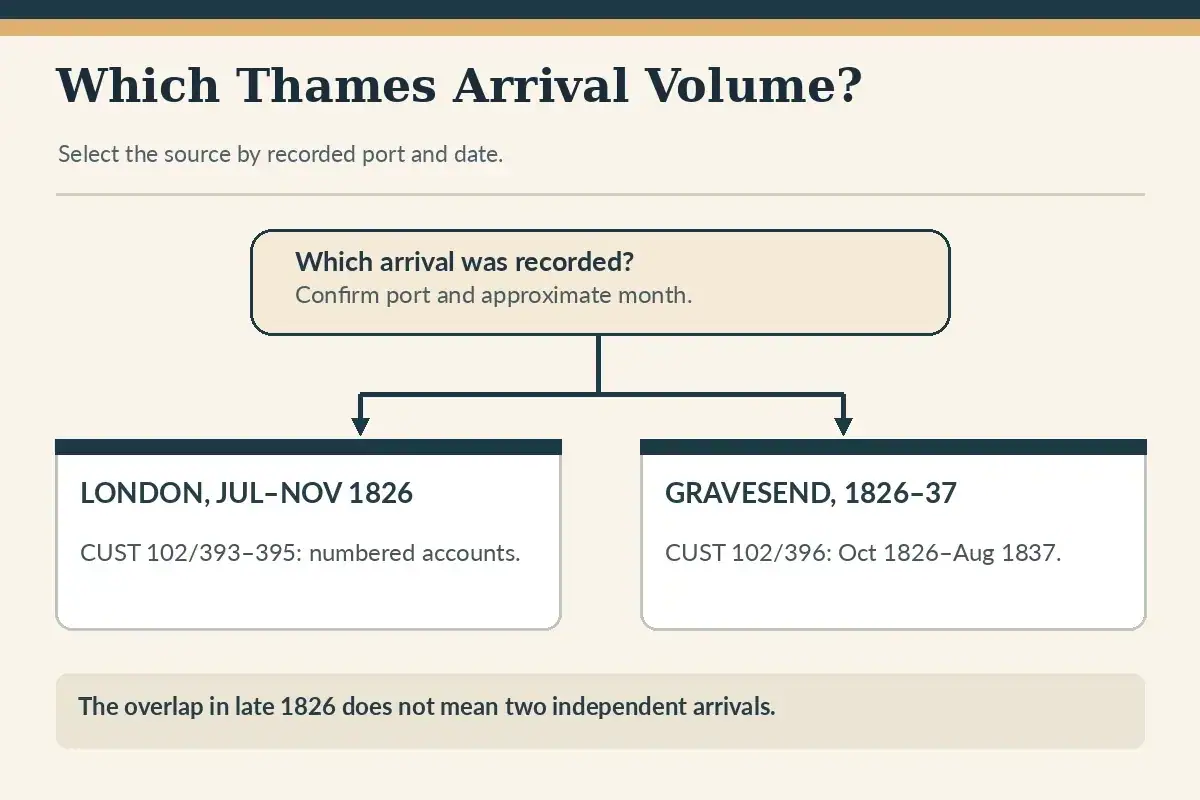
CUST 102 preserves two unusually precise early nineteenth-century Thames routes for searching the arrival of foreigners, historically described in the records as “aliens.” The National Archives identifies CUST 102/393–395 as accounts for the port of London in July–November 1826, and CUST 102/396 as Gravesend arrival accounts from October 1826 to August 1837. These date and port limits should determine the first search.
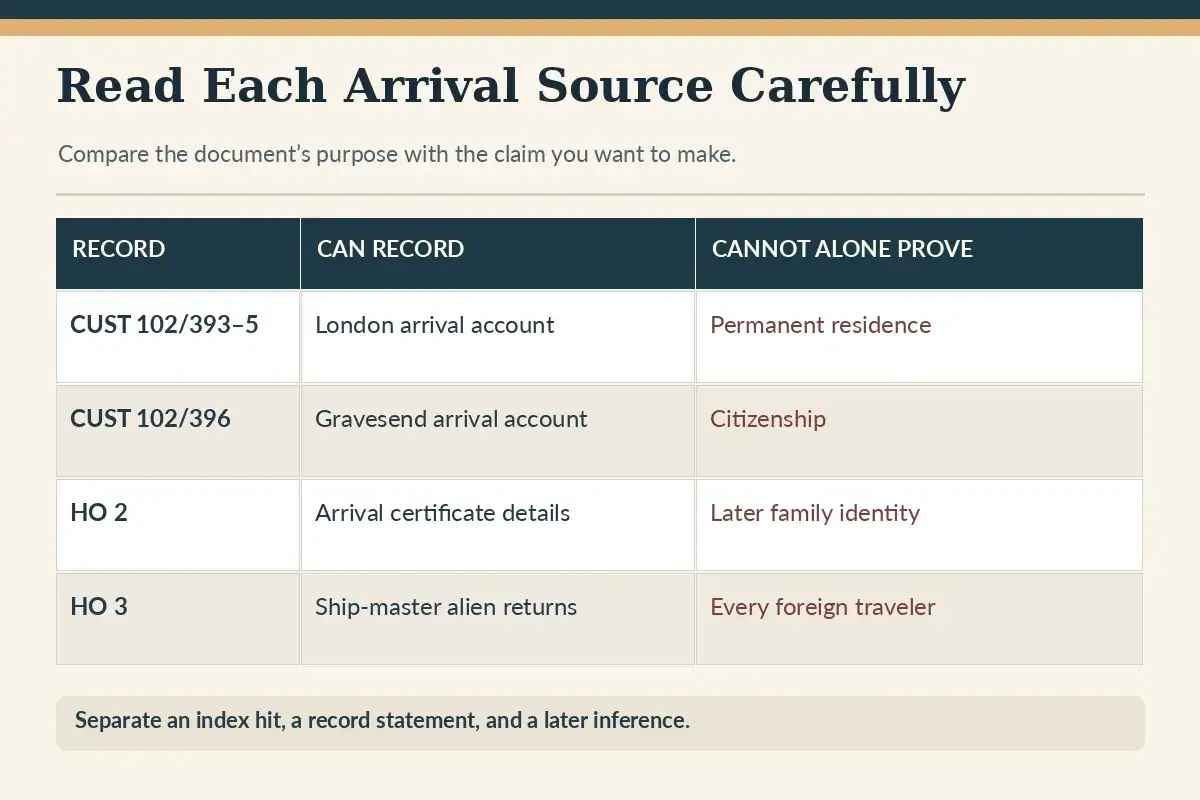
An arrival certificate documents a reported port event, not permanent residence, marriage or citizenship. Because wider nineteenth-century arrivals survive unevenly, failing to locate a person in these narrow Customs volumes cannot disprove immigration. Start with an independently estimated date, a ship or river-port clue where available, a careful spelling list, and the possibility of other routes that fall outside these particular records.
Choose London or Gravesend Using the Actual Date Range
For a reported July–November 1826 London arrival, inspect the London references CUST 102/393–395. For October 1826–August 1837 Gravesend accounts, inspect CUST 102/396. The two groups overlap in autumn 1826, but that does not make them copies or imply that every traveler should occur in both. A ship may have called at different points, or a person may have been processed under only one administrative arrangement.
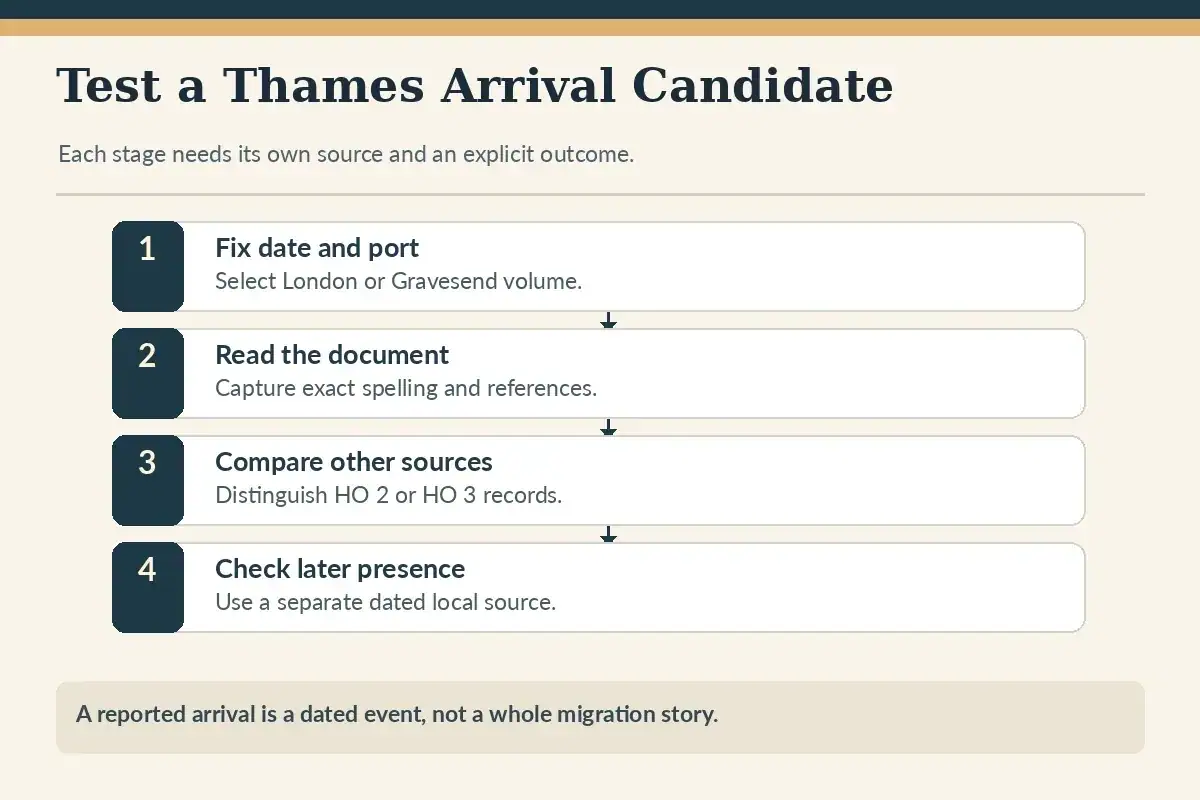
Write the proposed arrival month and port on the first line of your search log. If both are uncertain, test the two possibilities without merging them. “London” in a family letter may refer broadly to the destination rather than a particular Customs recording point. Look for a ship, lodging address or contemporary letter that clarifies it. Do not translate an apparent no-match for one port into proof that the person never reached the Thames.
Identify What an Arrival Account Actually Records
The archive describes CUST 102/393–395 as accounts of aliens arriving in certificates numbered 1–1055, and CUST 102/396 as accounts of arrivals in Gravesend. The wording suggests a record of official arrival processing, but never assume every surviving item has the same detailed fields. Examine the original image or transcript and capture name form, date, port, any certificate identifier and any stated origin or occupation only if the record supplies it.
The certificate number is a document locator, not a personal identification number that follows the traveler through life. Never infer a person’s later address or legal status from the presence of a numbered entry. A surname recorded phonetically by a clerk may differ from a later census spelling. Note alternative readings and look for accompanying travelers, age or occupation where such information actually survives. Evidence that a traveler entered Britain is not proof that they remained there.
Compare with HO 2 and HO 3 Without Doubling One Event
The National Archives also lists Home Office certificates of alien arrivals in HO 2, together with HO 3 returns and papers. HO 3 includes later ship-master passenger returns under the 1836 Aliens Act, with surviving lists from July 1836 to December 1869 but a gap from January 1861 to December 1866. These are distinct collections with overlapping research interests rather than an automatic continuation of a single Customs numbering sequence.
If an apparent match appears in more than one group, compare exact names, port, dates, ship and reference. Two database hits may be different descriptions or copies of the same underlying document, not independent corroboration. Mark derivative indexes as derivative. Where the goal is broader migration, later BT 26 and BT 27 passenger lists cover different periods and travel patterns and cannot fill an 1826 Customs gap by themselves.
Test Whether the Arrival Belongs to the Right Family
Imagine a fictional Anna Meyer listed as arriving at Gravesend in 1831. A later parish baptism names an Anna Meyer in a London household. The two names are a useful hypothesis, but a match requires more than a decade and a common surname. Build a comparison table of stated origin, age where available, occupation, named companions, marital status and household address. Extract only the data that each independent source actually provides.
The recorded designation “alien” was a historical administrative category and should not be treated as a modern ethnic identity or an assessment of belonging. Nationality and birthplace are also separate attributes. A foreign traveler may later naturalize or move overseas, and the Customs arrival alone cannot establish either event. If the evidence never links the candidate to the household, preserve the arrival as an unidentified same-name record instead of claiming a new ancestor.
Record Narrow Survival Windows and Access Conditions
The official immigration guide warns that many individual immigration records were destroyed and no comprehensive name index exists. The alien-arrivals guide points to digitized collections on a commercial database. Availability of a searchable derivative does not guarantee a complete source image for every date, and paid access may vary. Your research log should record exactly whether you read the original entry, a scan or only an index.
A negative search should name the Customs reference, exact date range, spelling variants and access route attempted. It should not claim the absence of an event beyond the examined volume. If the likely arrival predates July 1826 or follows August 1837, switch to the broader alien-arrivals guide rather than stretching the CUST 102 holdings. Make the port and year boundaries visible whenever you share a family timeline.
More Place and Jurisdiction Guides
How We Research Thames Alien Arrival Accounts
The piece-level dates follow The National Archives’ immigration guide, cross-checked against its alien arrivals guide. The separate passengers guide explains why later shipping lists do not amount to a comprehensive early nineteenth-century passenger search. These resources support a bounded port-and-date route, not a claim that all immigrant names are preserved.
Anna Meyer is a fictional example to illustrate same-name risk. The word “alien” appears only as a historical record classification. For any paid external source, consult our affiliate disclosure. We distinguish a reported arrival, an independent household match and a later legal-status record.
CUST 102/393–395 cover July–November 1826 London accounts of arriving aliens.
CUST 102/396 covers October 1826 to August 1837.
No. An arrival entry does not establish later residence or naturalization.
It may, but check the document reference and event before counting multiple database hits as independent evidence.
Record the exact narrow coverage searched; it cannot disprove an arrival at another port or time.