
Search MEPO 35 for a London resident recorded under the historical legal label “alien,” starting with name variants and the approximate date of arrival. The downloadable 1918–1957 cards are only a sample, and access restrictions protect more recent or potentially living people; an absent online card cannot rule out registration. For transparency see our affiliate disclosure.
Read the Historical Term Without Repeating Its Assumptions
The label ‘alien’ is the registration system’s own historical legal term, not an appropriate description of a person’s identity today. Registration requirements were introduced in 1914 and handled by the police. The records may concern people who worked, married or resided in Britain for many years; they also include some British-born wives whose legal citizenship status changed upon marriage under historic rules. Do not equate registration with criminal suspicion, a deportation order, disloyalty or unlawful residence. Explain the legal context when quoting a card and use a neutral description of the individual elsewhere. Begin with the official TNA cards guide.
Separate the Searchable Sample From the Series
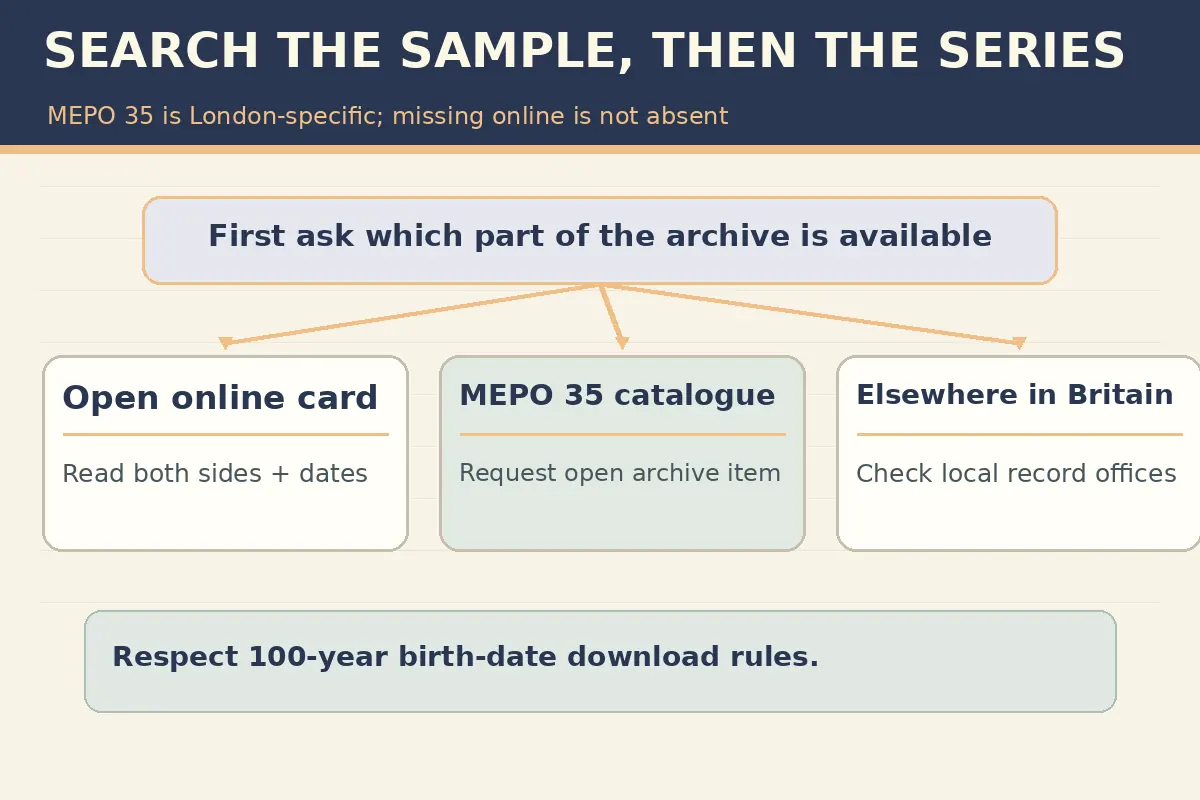
TNA describes digitized cards for over 600 immigrants who arrived between 1918 and 1957, while the Metropolitan Police series MEPO 35 concerns people resident in London from 1914. The online downloadable selection is not a census of everyone with foreign citizenship. The archives hold additional records, and some have not survived or have not been released. Search the name, maiden name and known aliases in Discovery; then try a catalogue search confined to MEPO 35 rather than relying only on the special search page. An unsuccessful result in the online sample is not a reliable negative finding for an entire immigrant community or for a named individual.
Use the Card Fields as a Dated Residence Timeline
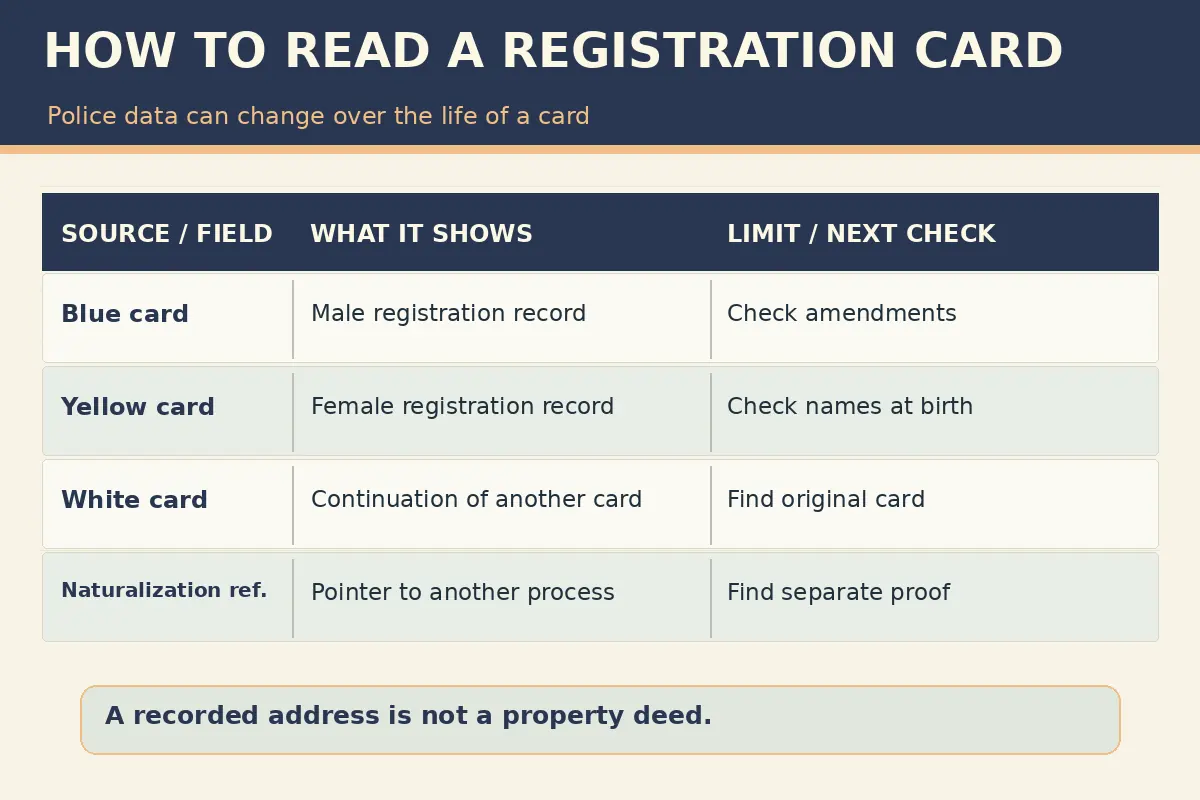
A registration card can provide a full name, birth date, arrival date, marital status, children, address, employers and references to naturalization. Many cards were annotated when circumstances changed. Transcribe every dated address and employer rather than selecting the first one displayed in an index. A residence update reflects information recorded by the police at a particular time; it does not prove ownership of the property, continuous presence between entries, or a specific working day. If an employer name is hard to read, keep the literal transcription with a question mark and compare a contemporary directory. Treat photographs as identifying clues only when provenance and the whole card match.
Follow Blue, Yellow and White Continuation Cards
The National Archives states that blue cards were used for men, yellow for women and white for continuations. A continuation card might hold later addresses, marital status or nationality information missing from the first scanned image. Check all available card sides and consecutive images. A married woman’s birth surname may be the better entry point, but do not assume that every married woman in the archive registered under one consistent surname. If a white continuation card is present, copy its file reference and link to the base card in your research log. Never merge two cards just because the name and a general address area match.
Check the Access Gate Before Requesting Personal Data
The special downloadable collection permits downloads only when the subject was born more than 100 years ago. Some other MEPO 35 documents may remain closed because they concern people who could still be alive. Use only the public catalogue description, follow official access instructions and honor any refusal; do not try to infer closed fields from social media or living relatives. The archival question is a historical one, not a license to publish private addresses, children’s details or photographs of living people. Record the access status beside the citation and return to appropriately open historical sources where the document is unavailable.
Route London Records and Other Regions Differently
MEPO 35 is a Metropolitan Police source, not a national register of immigrant arrivals. For a family living in Manchester, Cardiff or Glasgow, check local record offices rather than assuming a London result proves nationwide coverage. The TNA immigration guide explicitly suggests local archives for alien registers elsewhere in Britain. An arrival in London could precede residence in another region, so make a dated movement timeline before choosing custodians. Naturalization certificates and passenger lists may test whether a registration card corresponds to the right person, but they belong to separate administrative processes.
Run a Two-Person Identity Test
Suppose two fictional people named Emil Adler appear in London records between the wars. One card reports a different birth year and another has an employer matching a dated family letter. The latter is a plausible candidate, not a match on name alone. Compare date of birth, recorded occupation, arrival year, spouse, addresses and any naturalization reference. Note whether two apparent records could be continuation cards for one registration or separate people. Preserve negative matches in the log. A photograph alone cannot resolve the identity of a person whose appearance is known only from family memory without an independently attributed image.

More Records and Archives Guides
How We Research MEPO 35 Cards and Closures
We begin with an ancestor’s independently documented London residence and identify spelling, marital and nationality variations. We search the TNA special collection and MEPO 35 Discovery listings separately, flagging which query searched the limited digitized selection. Every potential hit receives a complete series reference, access status, date of birth, and dates of updates visible on the record. We inspect continuation cards and record inconsistencies without correcting them silently. We next test identity against open civil certificates and census material. The final claim is restricted to events actually recorded; we neither invent criminal histories nor disclose closed or living-person details.
A useful record audit has three statuses: digitized and legitimately open; catalogued but not currently available to the researcher; and not located after stated searches. Never collapse these into a single label of absent. Historical change-of-name annotations are important, especially when a birth surname and a later married surname differ. A city directory can help locate the recorded street but cannot independently verify nationality. If a card contains a reference to naturalization, search that record in its own custody and cite the outcome separately rather than assuming that the card itself is a certificate.
No. The featured digital sample concerns London, while other regions may have their own records in local archives.
The selection is small, name variants occur, documents may not survive, and some cards are closed.
TNA describes blue for men, yellow for women and white for continuation cards.
Follow TNA access rules; the special downloads are limited to people born more than 100 years ago, and more recent records can remain closed.
No. This was a legal police registration system and is not proof of a criminal allegation, deportation or illegal status.