
Great Central Railway RAIL 226 is most useful when a researcher distinguishes the administrative record from the event or relationship it mentions. Begin with a reference, the document’s author and date, and the specific question you want to answer. The safest method is to choose the correct record type, read its own wording, and seek independent corroboration before claiming a person, place, or outcome. This guide gives a source-specific route for RAIL 226; see the official National Archives research guidance and the related reference resource for context.
Identify the Railway Company Before the Employee
RAIL 226 contains records of the Great Central Railway and connected company administration, including selected staff material. The National Archives’ railway-workers guide includes this series among the surviving staff records of private railway companies. The modern company name alone does not solve every historical search, because companies changed names, inherited routes and absorbed predecessors. A worker recorded at a particular station in one decade may have served an earlier company under a different name.
Start with the employer named in the person’s own records, the place of work, occupation and approximate date. Use a pre-grouping railway atlas or contemporary gazetteer when the operator is uncertain. A census calling a man “railway clerk” is not enough to specify Great Central Railway without company or locality evidence. Keep the station’s owner, the line’s operator and the individual’s actual employing company separate in your notes.
Search the RAIL 226 Staff Material by Function
Not all RAIL 226 documents are personal files, and staff-related books may cover only selected occupations, departments or years. The National Archives lists Great Central Railway staff material in pieces including RAIL 226/178–179, 192–235, 386, 508 and 637, alongside related material in RAIL 1174. A piece reference leads to a particular type of volume; it should not be treated as a guarantee of a fully indexed list of all railway employees.
Inspect the catalogue entry and then the actual register arrangement. Some volumes are organized by department, staff number or appointment date rather than surname. Search with variant surnames and a plausible work location, but record unsuccessful searches by volume and year. If a digital index names a person, inspect the image or original when possible. A transcription can omit a later annotation that changes the interpretation of an appointment or retirement.

Read Salary Books and Staff Registers Differently
A salary register often focuses on clerical workers and may record pay increases, allowances, fines or a change of post. A staff register can list a name, occupation and workplace, sometimes with a start date or service note. Both are invaluable, but neither necessarily describes daily tasks or the entire period of employment. An amount in a salary column does not prove continuous paid work when the volume contains deductions, arrears or incomplete entries.
Make a transcription with exact columns, including headings and notations. Distinguish an effective salary date from a date when a bookkeeper entered an update. Watch for “transferred,” “resigned,” “retired,” or abbreviated remarks, and confirm a word before interpreting a scrawl. If a worker’s role changes from porter to clerk, do not assign the earlier and later salaries to the same post. Report only the dated movements visible in the register.

Test Workplace, Employee Number, and Namesakes
Railway companies employed many workers with common surnames and initials. An employee number, if present, can help connect entries more securely than a name alone. Department, place of work, age or birth date and salary changes offer additional tests. Do not assume that a Smith listed in two stations is the same person simply because the dates follow one another. A transfer must be documented or supported by strong independent identifiers.
Create a comparison ledger that preserves alternative candidates rather than merging them immediately. The same individual may appear in a staff book, pension source and census with different versions of the job title. A person living near a railway depot might have been employed by another company or a contractor. Use addresses and official documents to test employer identity, not just proximity to the tracks.
Connect the Register to Family and Local Sources
Once a person is identified in RAIL 226, use contemporary census entries, civil certificates, electoral registers, newspapers and locally held staff or union materials to corroborate relevant parts of the biography. A death certificate stating “retired railway employee” may support an occupation but may not name the company or the final post. Another employer’s pension ledger may help only if the dates and identifying details match.
The National Archives explains that railway records were unevenly preserved, especially for casual workers and construction laborers. Absence from a Great Central staff book is therefore not proof that someone never worked on the line. Equally, one dated salary rise does not establish an entire career of decades. Separate confirmed appointments from plausible periods of service and dates not yet supported by a record.
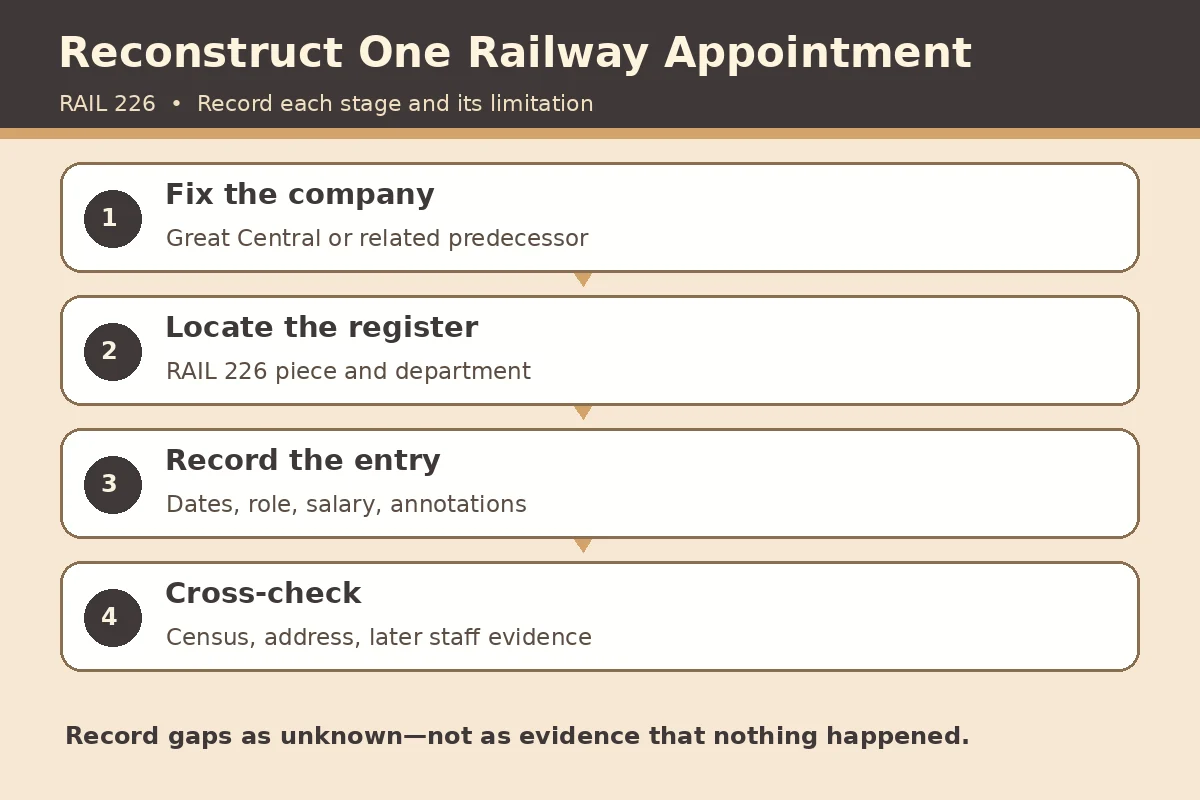
Make a Defensible Railway Employment Timeline
A robust career statement lists each reference and dated fact: appointment, occupation, workplace, pay change, transfer, and exit where recorded. Write “the register records” for direct evidence and “possibly the same employee” for a tentative identity. If records move between RAIL 226 and other collections, explain the employer or administrative reason for the cross-reference instead of creating a continuous employment history without documentation.
Retain the exact piece, folio or page, the original employer label and the date of inspection. If an online database omits a piece or the handwritten volume is illegible at its inner margin, record that limitation. The strongest result may be a modest span of verified employment with open questions at either end. It is more useful to family historians than an unsupported claim of lifelong railway service inferred from one entry.
More Records and Archives Guides
How We Research RAIL 226 Records
We begin with the National Archives series-level description and then read the second cited source to test the surrounding record system. Every search is logged by name variant, date, jurisdiction, and full archival reference. We separate an explicit statement in a source from a reasoned interpretation and from an unverified possibility. Cross-record matches require compatible dates and roles as well as a matching name. We never treat an index, map, petition, or summary as a substitute for the original when an original can be consulted.
This article is independent research guidance, not proof of a particular person’s biography, a guarantee of document survival, or professional legal advice. For transparency, read the GenHis affiliate disclosure. Links to public archives are provided for research, not as claims of sponsorship.
It holds Great Central Railway records, including selected staff and salary material; inspect each piece for occupation and date coverage.
No. Survival and indexing vary by occupation, company and period.
No. It confirms only what the dated pay or staff entry actually records.
Compare staff numbers, departments, workplaces, ages, dated transfers and independent records.
Use census records, civil documents, company successor or predecessor archives, and local staff or pension materials where appropriate.