
Great Harwood Cemetery, on Blackburn Road in Lancashire, opened in 1887. Its operator, Hyndburn Borough Council, describes an original section used through 1949 and a second section opened in January 1950. For a genealogy search, confirm the person’s identity and date first, ask the council cemetery office for a burial search, then match any recorded cemetery and grave reference with the relevant section. A family inscription or a person’s residence in Great Harwood alone does not prove interment there.
Confirm the Cemetery and Its Two Historical Sections
The council’s site history distinguishes the original cemetery section dating from 1887 to 1949 and a later section opened in January 1950. These dates are a map-selection clue, not a rigid proof that every later burial must be in the new section: reopening family graves or later interments can complicate a simple timeline. Record the exact date found in the original register and follow the plot or section reference rather than automatically assigning an address to a time band. The page also identifies Church of England, Non-Conformist, Roman Catholic and ashes areas, a reminder that a common site contains several record types.
Great Harwood Cemetery should not be conflated with Rishton and Great Harwood Cemetery, which Hyndburn describes as a separate modern burial option, nor with the Church and Clayton-le-Moors and Accrington sites that the borough also operates. A person who died in the town might have been buried at another local cemetery, private ground, or churchyard. Begin with the exact name of the burial place in an obituary or certificate, and treat ‘Great Harwood’ when used merely as a residence as geographically ambiguous.

Provide Details for the Official Historical Grave Search
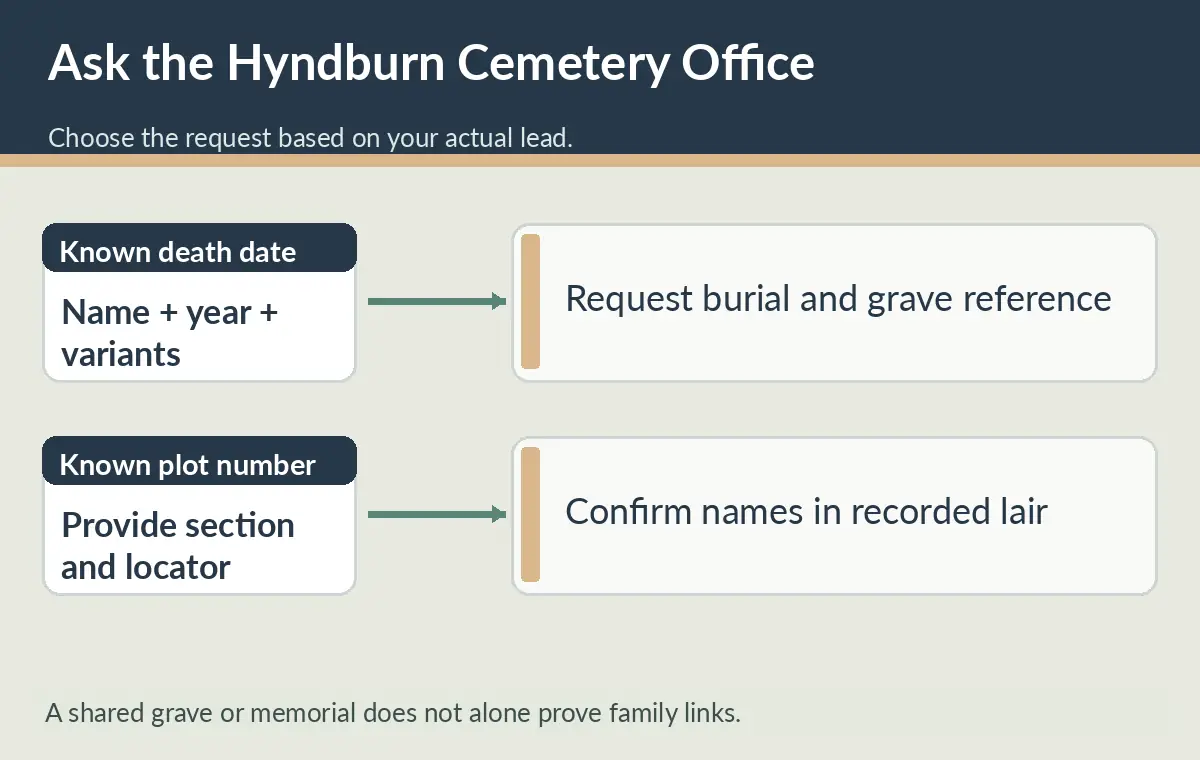
Hyndburn’s grave search instructions direct researchers to the cemetery office and specifically ask for as much information as possible, including the date on which the person died. Supply the name including possible variants, approximate death and burial dates, age if known, and any address or funeral clue. Say clearly whether you seek an interment entry, a grave number, another person in the same grave, or a possible cremation. A precise question is more helpful than requesting an unspecified entire family tree.
Keep the written response, the office’s terminology, and any reference or fee quoted. The council page confirms a search service; it does not promise every historical volume is already online, that a grave map is searchable by name, or that all record classes contain equal detail. If several individuals match a common surname, ask for distinguishing recorded facts instead of asking the clerk to choose a relative. Do not publish private contemporary information supplied through a restricted request.
Read the Burial Entry Before Looking for a Marker
A burial register can document a recorded interment even when no marker remains. Transcribe the name, interment date, cemetery, grave reference, any recorded age or residence, and the identity of the administrative source. If the grave number is not shown in a preliminary search result, it is a separate follow-up question. A cemetery office record should not be cited as an image of an original entry if you received only an administrative summary. Mark separately whether the record proves the interment or only refers to a possible memorial.
Take care over different dates: the day of death, issue of a death certificate, funeral service, burial, and later memorial dedication are not interchangeable. A nineteenth-century newspaper notice can help identify the correct deceased by address or spouse but may be wrong about an event date. A modern listing may include ashes, memorial-only information, or other categories; preserve the exact service description rather than turning every result into a coffin burial.

Use the Cemetery Plan for Sections, Not for Identity
The council provides a plan of Great Harwood Cemetery on its site page. Use that plan to understand where the older and later areas and denominational sections lie after the register has supplied a trustworthy reference. If the source says ‘Roman Catholic section’ or ‘ashes grave,’ copy that wording into the location worksheet before asking for a physical position. Paths, subdivision labels, grave numbering, and reuse practices can change; follow an official current map rather than a tourist sketch for fieldwork.
A marker found within the predicted section is useful independent physical evidence, especially if its inscription lists dates, but its presence does not replace an administrative burial record. Someone can be commemorated on a relative’s stone without being interred beneath it. Photograph inscriptions respectfully and record the date, full wording, condition and location. Avoid making claims from unreadable stones or inferring kinship from neighboring plots.
Search Earlier Deaths in the Appropriate Other Records
If the person died before Great Harwood Cemetery opened in 1887, do not report a missing grave there as a negative genealogical result. Search parish burial registers, churchyard descriptions, older local cemetery records and dated funeral newspapers appropriate to the person’s denomination and neighborhood. When a later monument mentions a person who died before the cemetery opened, it may be commemorative or refer to a reinterment that needs independent evidence. The absence of that evidence is not license to create a transfer event.
Similarly, if a death occurs around 1949 or 1950, do not simply assign the old or new section by the year printed on a stone. Ask the burial office for the actual grave locator. Families may have preexisting graves, and the administrative classification of a site may differ from a family’s informal name for an area. Historical local maps and municipal records can support location research but are not substitutes for the exact burial entry.
Resolve Namesakes and Cite the Outcome Conservatively
For two historical William Brown candidates, make two rows: age, death date, last residence, burial date, grave reference and independently verified spouse or occupation. A same-surname family marker could match either candidate or a third person. Seek a civil death registration or a reliably dated obituary as an independent test. Separate the evidence for a burial from evidence for parentage: several surnames in the same grave do not alone create a proven family relationship. Names in a plot-rights account likewise do not automatically establish who was buried.
A good conclusion is narrow: ‘the Hyndburn cemetery office confirmed an interment with this name and date at Great Harwood; identity supported by a matching address in a death record,’ for example. If the match remains weak, keep it as a candidate. Cite the council’s site history and the separately supplied register result accurately. The diagrams are original illustrative layouts, not official maps or reproductions of a particular grave. For general commercial transparency consult the affiliate disclosure; there is no paid grave-finding recommendation here.
More Records and Archives Guides
How We Research This Collection
We checked the borough’s 1887 opening date, 1949/1950 section boundary and denominational layout against the same authority’s historic search instructions and cemetery office page. We distinguish a time-range clue from an actual grave allocation and reject any suggestion that residence, memorial wording, or plot administration alone proves interment or a family connection.
Hyndburn Borough Council says the cemetery opened in 1887.
The council dates the second section to January 1950; older family plots still require record-level verification.
The operator provides a historical grave-search service through its cemetery office; do not assume complete public name-index coverage.
No. A plot location or shared memorial does not establish parent-child or spousal relationships.
Use older local parish or churchyard registers and other contemporary burial records; Great Harwood Cemetery had not opened yet.