
The National Archives lists SC 1 as Ancient Correspondence spanning the reigns of Henry II to Henry VI, with much of the material originating in the thirteenth and fourteenth centuries. The series is not limited to foreign diplomacy: domestic letters also survive. Researchers can look for individual names and places in the catalogue, then investigate the actual correspondence. A medieval name alone is not proof of ancestry, and a catalogue summary cannot replace the wording of a document. See the official research guide for the archive series and its purpose.
Letters can preserve valuable connections between royal officials, clergy, traders, communities and messengers. The genealogy problem is to identify what role each person actually played. A person delivering a letter is not its author; someone mentioned as a tenant may not own the property; an honorific does not automatically identify the individual’s father. A role-by-role transcription helps prevent these errors.
Find the right SC 1 item by name or medieval place
Search the catalogue with a verified historical name form and try plausible spelling variants. Place names may appear in Latin, Anglo-Norman French or spellings very different from modern forms. The archival guide explicitly points researchers to SC 1 for named individuals and places. Keep a list of the exact searches that returned results, along with the references and date ranges supplied by the descriptions.
If several promising letters mention the same surname, do not merge them into one person. Separate the geographic setting, office, known associates and proposed date. Catalogues can use a modernized heading or a supplied date that is only approximate. Maintain a distinction between a date printed in the description and the date expressed by the letter itself.

Read who sent, received, carried and witnessed the letter
Build a small role table before making a family claim. A sender’s authority and a recipient’s responsibility may be explicit; a messenger could merely be carrying a document. A witness or third party named in a dispute should not be promoted to a relative. Transcribe personal titles, places and relationships as actually worded. If a term could denote an office rather than a family bond, mark the translation as uncertain.
Medieval letters were copied, translated and summarized by later editors. An English calendar can help locate a document, but its shorthand may flatten distinctions in a formal address or petition. Where palaeography prevents a secure reading, preserve the uncertainty rather than silently choosing the most genealogically convenient wording.
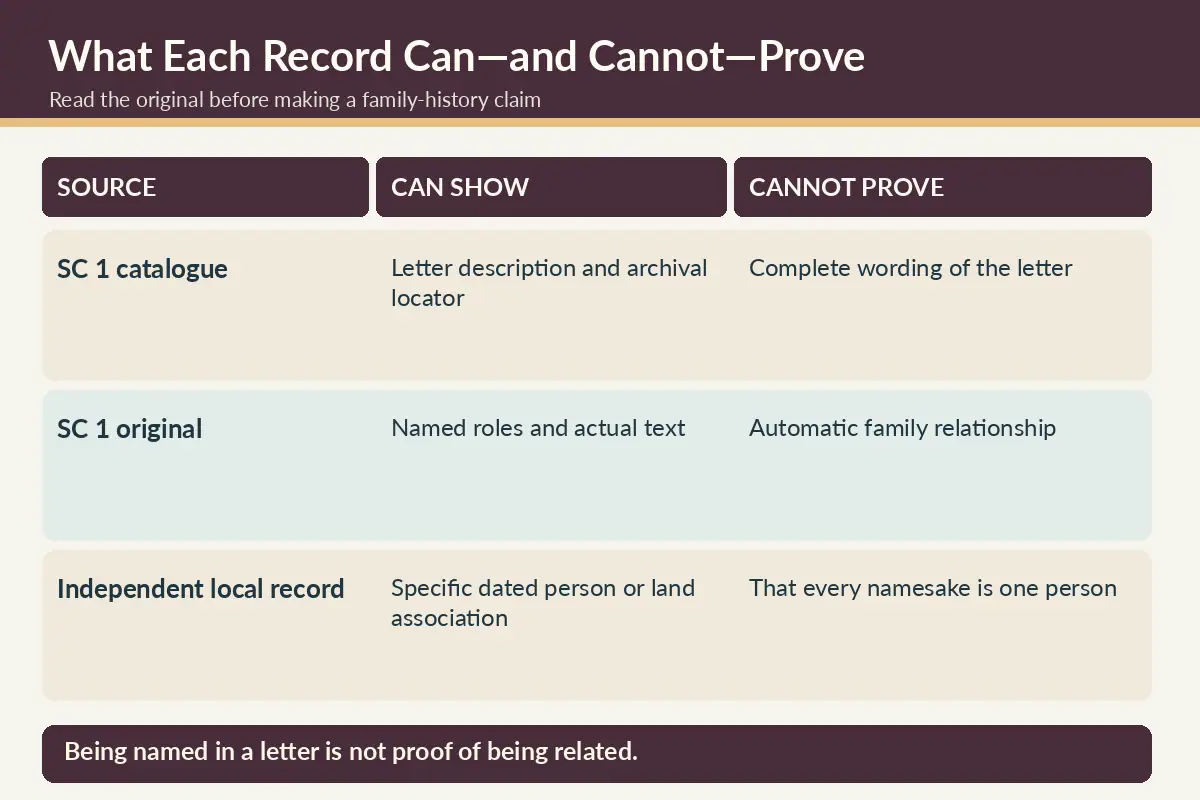
Use context without creating an invented lineage
The context of royal correspondence can explain a person’s presence in a region or on an official mission. It does not automatically establish birthplace, residence or hereditary lands. Compare the correspondence with independently dated grants, local deeds or administrative rolls only where the place and role correspond. A shared title is particularly weak evidence when several generations used it.
Write separate hypotheses for two same-named officials rather than forcing them together. If a letter is undated, use only a documented reign, office-holder or explicit event to narrow its period. Be cautious with modern catalogue date brackets: these may be editorial estimates. A specific family link must rest on language that directly names the relationship or strong independent correlation.
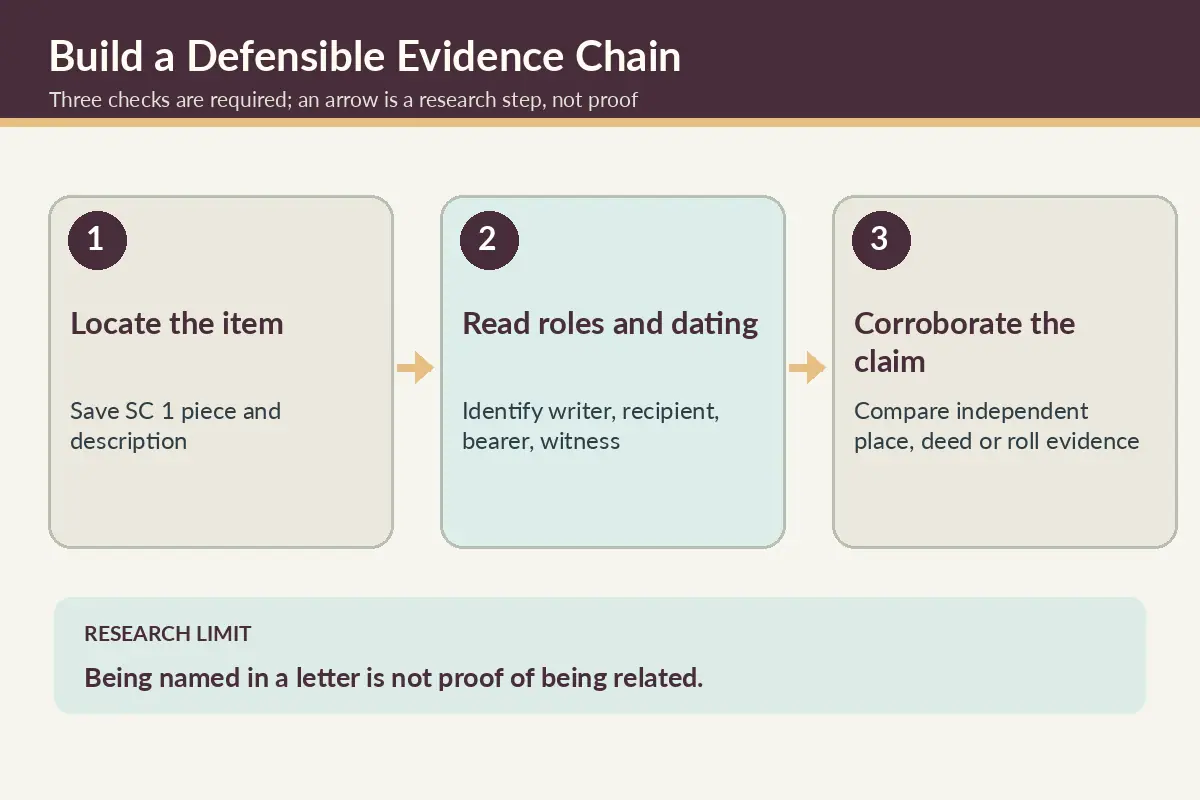
Cite the original and preserve the editorial trail
For a defensible citation, record SC 1, the piece or item, the repository and a short description of the document, then distinguish the original from any printed calendar or online catalogue summary. A quoted passage should be checked against an image or physical document where possible. Keep transcription and translation separately, with unresolved abbreviations marked rather than silently expanded into certainty.
The final narrative should state whether an individual is the sender, recipient, messenger, witness or a person discussed. If the record supports only that one person knew of another, write that narrow claim. Include an explicit gap when the letter does not state a parent, spouse or child. That restraint makes the result useful when future evidence changes the identity hypothesis.
Report your translation choices as evidence decisions
Spellings and titles in medieval letters may be Latinized or abbreviated. Keep a literal transcription, a cautious English rendering and a note explaining the disputed words. An uncertain personal name should not silently be replaced with the most convenient modern spelling. Use place and office as independent checks. Catalogues are a route to records, not the only source of medieval identities.
A reliable research note can be modest: a letter was sent to a named official and mentions a place. That is already useful evidence of administration and communication. It is not proof of an individual’s birthplace, a hereditary title or a continuous political appointment. An explicit boundary on the claim makes medieval research more reproducible. Where an item is known through a later catalogue, ask whether the original is an incoming letter, a draft response, or a copy entered for administrative use. That status affects what the item can demonstrate about its arrival, circulation and approval. Keep the physical reference and any calendar citation together, but not confused: a calendar’s date or modern personal-name heading may be a later editor’s decision. Even an independently dated seal or endorsement needs to be described as evidence of document handling, not proof that an order was obeyed. This distinction also helps historians avoid attributing a letter’s claims to the official who merely received it.
More Records and Archives Guides
How We Research and Verify This Evidence
We begin with the relevant guide from The National Archives to confirm the purpose and limitations of the record series. We then use Discovery to identify the actual series, piece descriptions and holding institution. We record the historical spelling, archive reference and date of each statement; our diagrams are explanatory reconstructions, not facsimiles of archival documents. A catalogue summary is not presented as a transcription of a complete original.
When no item survives, the honest conclusion is that a documented search has not located evidence within the series examined. We do not infer that the person never served, the event never happened or the asserted relationship is necessarily false. For editorial and affiliate policies, read our affiliate disclosure. The research process described here does not depend on a paid partner or a promised download.
No. The National Archives says Ancient Correspondence includes domestic as well as foreign material.
The series spans Henry II to Henry VI, with much material from the 13th and 14th centuries.
Only if the wording or strong independent evidence supports that specific relationship.
Treat supplied dates and summaries as finding aids until the original is checked.
Reference, date confidence, medieval spellings, and each person’s documentary role.