
BH 1 at The National Archives in Kew contains microfilm copies of records of the Hudson’s Bay Company, covering 1667–1991; the originals belong to the Hudson’s Bay Company Archives at the Archives of Manitoba. That custody distinction changes how you search and cite. A catalogue hit in Britain is a route to a reproduction, not proof that London holds the manuscript itself.
The company documented trade, settlement and employment for business purposes. Named records exist, but many people near a trading post were not paid company servants, and even genuine employees can share names. A useful search begins with the Manitoba indexes, follows an exact contract or engagement reference into a record, and then tests the identity against independent local evidence.
Choose an employee index before a full-text name search
The Archives of Manitoba provides several targeted name indexes. Servants’ contracts, dated 1776 to about 1926, may show a worker’s name, parish or post, age, contract length, role and wages. Northern Department engagement registers from 1823–1895 may provide contract numbers, dates and positions. These sources address different stages of employment. Decide whether your family question is about a signed contract, an engagement entry, a trading contact or later presence at a particular post.
Search variant spellings, abbreviated given names and occupational terms, not just one modern surname. A person’s stated parish or signing location may not equal a birthplace. Transcribe what the index actually labels each field, and preserve the index title and its location or microfilm number. An employee sheet compiled by archival staff is a lead to source records, not a substitute for checking them.

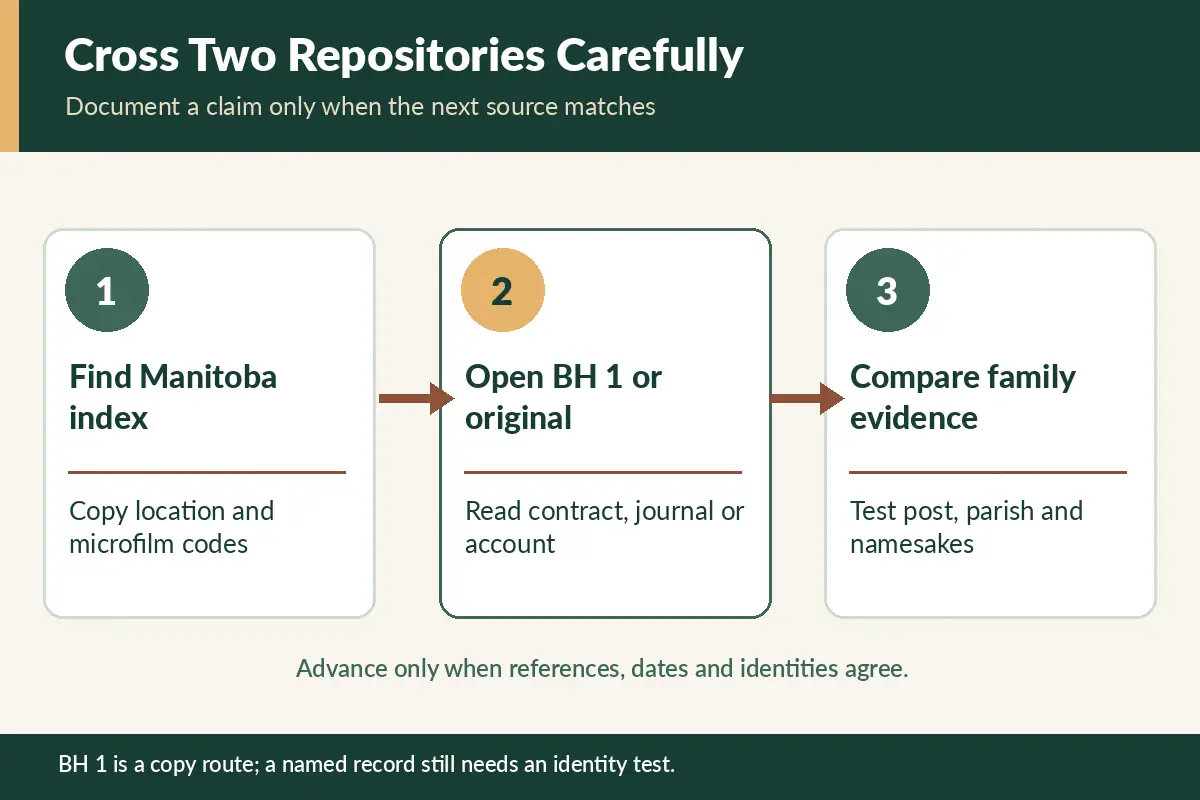
Connect the Manitoba index to BH 1 microfilm
Once an index result looks plausible, write down the full archival reference, the original record series or location code supplied by the Manitoba finding tool, any reel number and the record date. The National Archives labels its copies BH 1, but do not assume a Manitoba shelfmark and a Kew BH 1 piece use identical numbering. Build an explicit cross-reference for the document you will request.
Microfilm can omit color, margins or later annotations, and a single reel may reproduce many volumes. Cite the image or frame when available, together with the original series and repository. For a difficult reading, compare the reproduction with published context or ask whether an original is accessible in Manitoba. Some originals are withdrawn and cannot be consulted, so do not promise direct manuscript access.
Read a contract as a promise, not a complete career
A servants’ contract might record the term, agreed position, wages, posting and equipment. Those terms show what the parties agreed to, not automatically every station where the worker subsequently served or when employment ended. An engagement register can add an administrative entry; later accounts, journals and payroll may be needed to establish actual presence or a change of occupation.
Set up a timeline with columns for contract signing, intended posting, documented arrival, later service and departure. If a contract covers several years but no later document survives, leave the service interval partly unresolved. Distinguish a person named as witness or company representative from the named servant. Repeated names at nearby posts must be tested using age, role, parish and associated people.

Respect the limits and language of fur trade accounts
Archives of Manitoba holds indexes of Indigenous names drawn from selected HBC records, including account books, censuses, correspondence and treaty lists. Historical spellings, translations and naming practices can vary. Do not automatically equate a descriptive name, a translation and a later surname without corroboration, or imply that a name in a trading account makes that person an employee.
Company books were created within unequal colonial relationships and preserve a partial view of local communities. A trading entry may document exchange of goods, a debt or a mention by an employee rather than a freely chosen life history. Preserve the original wording, explain the source context, and, where relevant, consult community-governed historical sources rather than treating company categories as neutral descriptions of identity.
Use biographical sheets but verify their underlying facts
Employee biographical information sheets provide a convenient starting point for some HBC and North West Company workers. Archives of Manitoba explicitly warns that sheets were not made for every worker and facts should be verified against the source material. Their alphabetical arrangement can also conceal variant spelling or multiple individuals of the same name. Label a sheet as a compiled aid and identify the record cited behind any important date or posting.
A plausible match requires at least two independent identifiers when possible, such as age with post, named relative with parish, or a consistent contract number and later account entry. When the only evidence is a similar name, record the match as unconfirmed. In a family narrative, distinguish an employee’s reported post from evidence that spouse or children lived there.
Write a two-repository citation and next-search plan
Your evidence ledger should record four layers: Manitoba name index, manuscript origin, BH 1 copy used and independently checked family source. Include spelling, role, date, location, exact frame or folio and uncertainty. Keep the holding archive separate from a website displaying a derivative list; that makes later reproduction and correction possible.
Some temporary workers had no formal contract, early records are missing, and a person living near a post might not appear in company files. An unsuccessful index search is therefore not a finding that no association existed. Search the appropriate post journals, missionary or local records if the question requires more than contract evidence, and describe the remaining gap rather than filling it with an attractive but unproved career.
More Records and Archives Guides
How We Research and Verify These Records
Our archive-first review began by identifying the holding repository, creator and series rather than searching a family name in isolation. We compared the series description with subject-specific guidance, separated original documents from catalog descriptions and compiled indexes, and checked how dates, jurisdictions, omissions and access conditions affect each conclusion. The examples in these diagrams are editorial illustrations of evidence logic, not reproductions of documents or identified historical people.
We consulted this archive research resource on 2026-11-03. The National Archives identifies BH 1 as microfilm of Hudson’s Bay Company records spanning 1667–1991, with original archives in Manitoba. The next step for a real family claim is to examine the identified source item and test that one finding with independently created evidence.
We consulted this archive research resource on 2026-11-03. Archives of Manitoba describes named contracts, engagement indexes, Indigenous name indexes, original record limits and microfilm references. The next step for a real family claim is to examine the identified source item and test that one finding with independently created evidence.
We consulted this archive research resource on 2026-11-03. Archives of Manitoba cautions that employee biographical sheets are selective, derivative finding tools that should be checked against original or microfilmed records. The next step for a real family claim is to examine the identified source item and test that one finding with independently created evidence.
Our record descriptions and illustrated methods are informational, not advice that a specific commercial provider owns every relevant document. Some archival copies require a fee or a visit, and access restrictions must be respected. We have not assumed any paid relationship. Read the affiliate disclosure before following any recommendations.
BH 1 is microfilm of Hudson’s Bay Company records; the originals are held by the Archives of Manitoba.
Start with the Archives of Manitoba servants’ contract or engagement indexes and note original location codes.
No. It describes an agreement; later journals or accounts are needed to document actual movements and service.
Yes. Some workers had no formal contract and many residents or traders were not HBC employees.
No. They are compiled aids and the archive recommends checking their statements against original or microfilmed sources.