
REQ 1 contains judicial and administrative books of the Court of Requests, including orders, decrees, appearances and procedural records from the Tudor and early Stuart period. Start by asking which action the entry records: an appearance, an interim instruction, or an actual final decree. An order may show that a case advanced; it does not by itself confirm the plaintiff won or that a stated family relationship was true. This guide gives a precise source route, identifies what the archive can and cannot show, and names the independent documents needed before a personal or geographic conclusion becomes defensible.
Establish the Court, Parties and Relevant Reign
The Court of Requests heard many comparatively small civil disputes, including questions about payments, land, inheritance, marriage settlements and other obligations. Its written process could involve a plaintiff’s bill, a defendant’s answer, interrogatories and witness testimony, followed by a direction or, in some cases, a final decision. A person named in the defendant’s answer has not thereby been proved to have acted as alleged. Record the case name as contemporaries wrote it, including alternate spellings and the relative positions of each party, before consulting order books.
Date matters because finding aids differ substantially by reign. REQ 2 holds much of the surviving pleading material, yet many later cases in that series lack indexes. REQ 1, by contrast, preserves books of court actions and administration, some of them easier to select by date and document type than by modern name searches. A negative online search is therefore a weak argument against a suit having existed. Start with a short range of years, the parties and the particular legal step you hope to establish.

Separate Decree Books From Draft Orders and Appearances
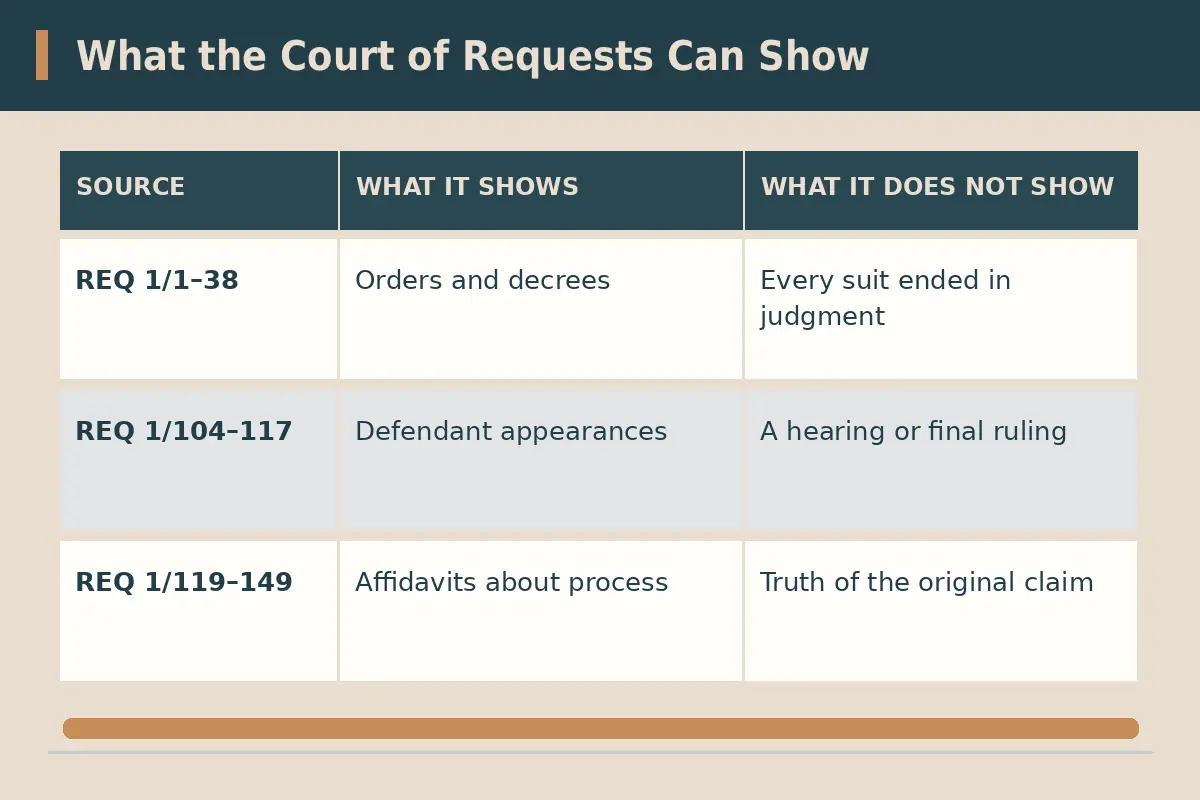
The official guide assigns REQ 1/1–38 and REQ 1/209 to order and decree books spanning the court’s long life, and REQ 1/39–103 to draft orders and related memoranda from the Elizabethan to Caroline period. REQ 1/104–117 comprises appearance books in which a defendant often appeared through an attorney. These groups are not chronological chapters in one lawsuit. Each was created for a different administrative purpose, and a single lawsuit may leave uneven traces across the records.
Read the exact procedural language. A decree may express a final judicial outcome, while an order may appoint a commission, require a party to do something or control the next stage of proceedings. An appearance entry can confirm a formal appearance, not a personal visit to the courtroom; representation by an attorney was common. REQ 1/171–197 process books record instruments including writs and injunctions. Do not label a summons an arrest, or an injunction a permanent adjudication, unless the document explicitly supports that interpretation.
The official guide also describes REQ 1/151–170 as note books, REQ 1/198–206 as witness books and REQ 1/208 as a commission book. These may be valuable alternatives if an order has a commission or witness reference. Record exactly why you moved from one book class to another; a list of series codes without a legal question does not improve a search. The 1493–1538 calendar mentioned by the archive is another date-specific aid, not a universal index for every later lawsuit.
Compare the REQ 1 Entry With Original Pleadings
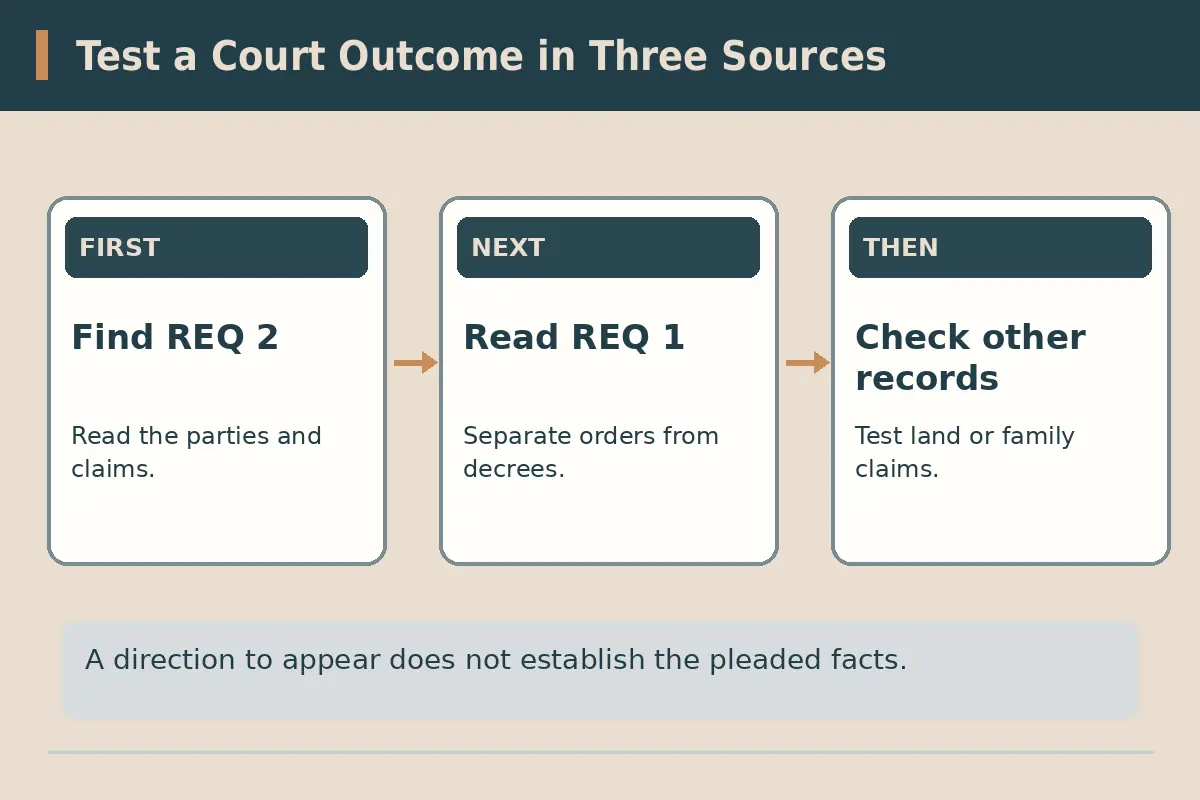
For a case located in an order book, try to identify its REQ 2 pleadings and then read the plaintiff’s account beside the defendant’s response. REQ 2 can reveal the dispute’s substance but finding an item may require older printed or manuscript aids or page-by-page browsing. A bill is an allegation, the answer may deny it, and a deposition may be one person’s sworn testimony. These records should be transcribed separately rather than compressed into a confident narrative that neither side would have accepted.
Build a case table with columns for date, document, named party, action and evidential limit. If the order book gives abbreviated party names, check whether the litigation actually belongs to the person of interest before attaching it to a family tree. The same surnames often recur across neighboring parishes, and land may be described through tenures that are not identical with modern ownership. Cite the particular REQ 1 folio or page and the REQ 2 reference where one is found; keep a missing-reference column where further work is needed.
Read Affidavits and Process as Actions, Not Proof of Guilt
Another REQ 1 group, REQ 1/119–149, holds affidavit books from the later Tudor and Stuart period. The official guide describes these as signed affidavits about service of process, especially writs of summons. A sworn statement that a summons was served concerns that procedural fact. It should not automatically validate the original charge, a debt balance, or an asserted family connection. Similarly, a process-book reference to an attachment may document an instruction for enforcement, but not necessarily its execution.
The surviving books are not a complete day-by-day history of every case. Some material remains unidentified or appears in other courts’ collections, while many disputes ended without a recorded final decree. When a final judgment is absent, state that the outcome has not been found rather than using a later family tradition to supply it. If there is an actual decree, identify who is bound, what is ordered, the date and any conditions, and seek independent property or probate documents before claiming the order had its intended real-world effect.
Write a Defensible Family-History Finding
Consider a hypothetical claim that an ancestor inherited a cottage because a relative appears in a Court of Requests order. The safer conclusion might be only that the court issued a direction in litigation involving people of those names. A pleading could name a cottage and its alleged tenants; a decree could settle a dispute; neither alone proves that your modern target is the same person or that possession was transferred. Examine title deeds, manor records, parish registers and later tax or occupancy evidence according to the specific claim.
A final citation should identify the archive, series and full piece number, book title, date or regnal year, folio or page, and the words that support your statement. Add a clear source-status label: catalogue lead, consulted original, transcription, order found, decree found or external confirmation. This approach makes the research reusable and prevents a procedural book from becoming an invented legal biography. If reading old legal hands or Latin is outside your expertise, mark disputed translations explicitly and seek specialist help.
Check procedural dates carefully. A regnal-year date and a modern historical calendar date should not be silently treated as identical, particularly near the start of a year under earlier dating conventions. If modernized dates are supplied, retain the original form in the research note. Missing references should be described with the date range and exact books searched, not used as proof that a litigant withdrew, vanished or died.
More Records and Archives Guides
How We Research This Archive Series
This guide starts with the official description in The National Archives’ research guidance, not a claim that we have inspected a particular person’s private file or a specific original piece. The archival statements here concern the series or research method. A hypothetical example is labelled as such; it is not a newly discovered historical event. We use the Discovery search guidance to distinguish keyword matches from archive holdings and document contents, because catalogue descriptions do not transcribe every word of an original.
For every real candidate, record its historical place or person’s name, the creator, document type, date, full REQ 1 piece or item reference, access restrictions, and the exact claim being tested. The official citation guide explains how to document those references so another researcher can retrace them. An unread document remains a catalogue lead, never proof of imagined details. If a record is missing, preserve the searched terms and dates and examine survival and alternate custodians before interpreting the gap.
Before sharing a conclusion, audit the difference between original source wording and your interpretation. Require independent evidence for any further claim about an individual, property owner, legal effect, or completed action. Respect archival access limits and living people’s privacy. This website also provides an affiliate disclosure; no paid partnership or commercial access is implied by these archival references.
No. Survival is incomplete and some cases were settled or abandoned without a final decree.
An order can direct proceedings; a decree is a final judgment, so read the wording and context.
Look for pleadings and other case papers, usually in REQ 2, where surviving and locatable.
Not necessarily. Defendants often appeared through an attorney.
Not by itself. Its subject and informant matter, and independent title or probate evidence is needed.