
For an English Chancery Division case between 1876 and 1955, the Entry Books of Decrees and Orders in J 15 can reveal parties, court dates and judicial directions. They are not the same as pleadings, proofs, a complete case history, or evidence that money actually changed hands. The National Archives directs researchers to indexes at Kew, including A and B divisions for surname initials and, for earlier volumes, separate written and printed order sequences. A usable family-history finding starts with a correctly identified cause and order, not a guessed payment to an heir.
Identify the Cause and the Correct Index
Start with the names of claimant and defendant, an approximate case period and any cause number found in a newspaper, probate file or family letter. From 1842 the civil courts used a cause number combining commencement year, claimant-name initial and running number; the National Archives offers 1885 A 1271 as a format example. A court date written on a later order is not necessarily the year proceedings began. Record both dates when they differ, and do not treat a common claimant surname alone as identification of the right lawsuit.
For J 15, the archive’s Chancery guide says the relevant indexes are available in the Map and Large Document Reading Room at Kew. Up to 1932, an A sequence broadly covers case titles beginning A–K and B covers L–Z, but the indexes are organized internally by law term and then claimant initial rather than strict alphabetical order. Until 1921 there are separate running numbers for written and printed orders. Capture the index year, division, number and format exactly; these are necessary retrieval keys, not expendable cataloging trivia.

Find the Correct J 15 Volume and Read the Order
Use the index details to search by year within J 15, sort the results by reference and choose the volume that fits the order number. Record the piece reference, pages or folios, the registrar and judge if given, all parties as written and the operative wording. The Entry Books can report multiple hearings and orders in a single cause across several years. If an index number runs across two columns, the archive advises that it may refer to an ‘order of course’; most such orders were destroyed. That is a preservation constraint, not a negative verdict about the historical claim.
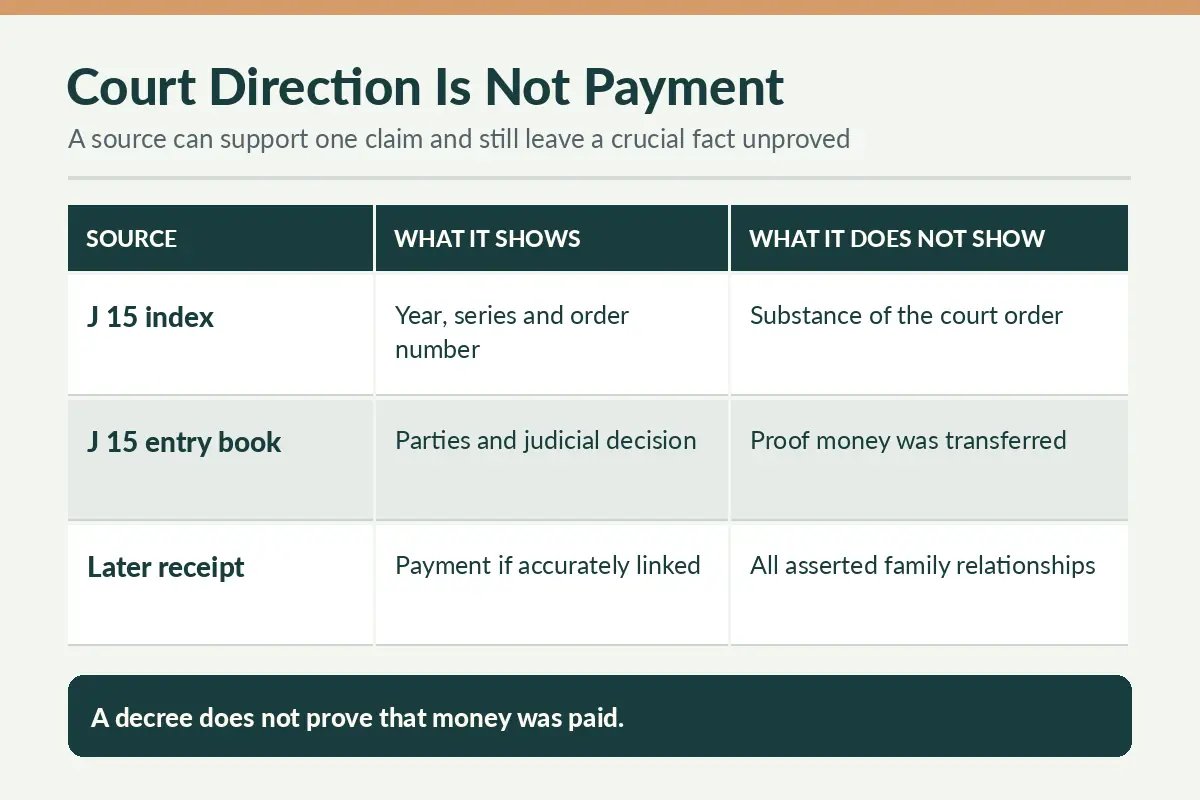
Make an order-level timeline: filing or cause year; hearing date; date of decree or subsequent order; reported next procedural step. A direction that trustees pay money, settle accounts, deliver documents or administer property is evidence of what the court directed, not conclusive evidence of compliance. Even a definitive judgment may need execution papers, receipts, later orders or estate accounts to establish what occurred afterward. Do not transform an instruction into a completed transfer or a named individual’s receipt of funds.
Separate Orders From the Rest of a Civil Suit
J 15 is one part of a system organized by record type. The National Archives lists selected action papers in J 84 and J 83, petitions in J 53, pleadings in J 54, affidavits in J 4 and court minute books in J 56, subject to their own dates and survival rules. These are alternatives or corroborating sources, not an automatic sequence every case followed. The particular case may lack a surviving pleading or judgment, or may have ended outside the court. Use the cause number to keep different files tied to the same action, not to every person sharing a surname.
A trust or probate dispute can mention proposed heirs and pedigrees without proving the biological connection alleged. Separate litigants, witnesses, beneficiaries, creditors and fiduciaries in your notes. If a pedigree appears as an exhibit, transcribe its stated relationships, record who supplied it and test critical links against independent civil, parish and probate sources. Formal submission to court shows what was offered as evidence; it does not guarantee that every relationship in the submitted tree was independently established or accepted.
Respect the Survival Boundary and Claims Process
The National Archives describes J 15 Entry Books surviving from 1876 through 1955, not an uninterrupted archive after that date. Its funds-in-court guidance reports that Chancery orders for 1955–1966 were destroyed in error; after 1966, orders were retained within case files and only a small sample of those has survived. Date-gate the search before reporting failure. A case from the wrong era may require a very different record route, and a missing index entry is not evidence the litigation never existed.
If the family question concerns money currently held in court, historical research and making a financial claim are separate activities. The Court Funds Office or the relevant authority decides present eligibility; the existence of an old J 15 order is not legal advice, entitlement or an instruction to reclaim funds. For genealogy, cite the order’s exact words, then check independent evidence of the claimed descent and any documented later compliance. If a crucial post-order step cannot be verified, leave it unresolved rather than announcing the family received an inheritance.
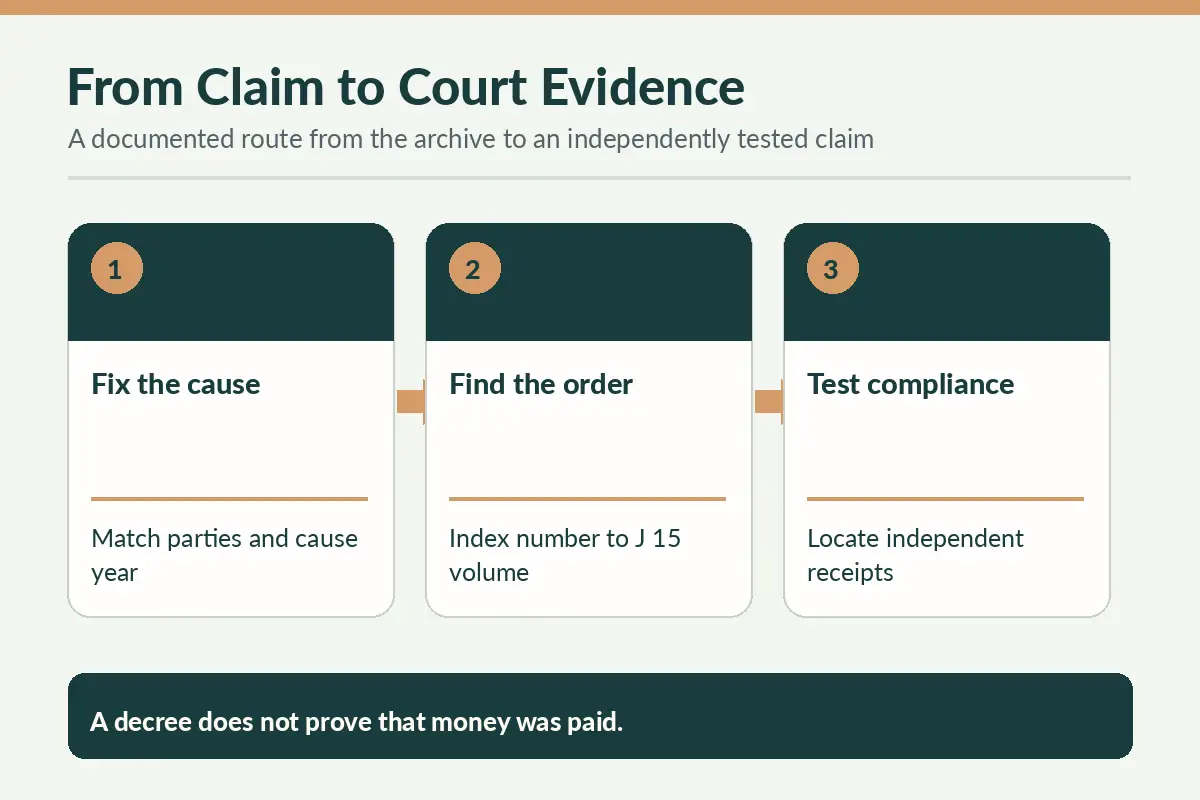
A practical fictional search shows the distinction. Imagine a family paper stating that ‘A. Bennett received £300 by Chancery order in 1911.’ First locate the cause using the actual parties and commencement year; then use the appropriate index and the J 15 order number. If the order merely directed an account to be taken, it cannot establish receipt of £300. If the amount was approved but no receipt survives, record approval separately from payment. Compare later orders, estate administration and independent financial evidence. The hypothetical example illustrates why the claim wording must be narrower than the family anecdote.
More Records and Archives Guides
How We Research This Archive Series
Our editorial check on November 8, 2026 used primary archival guidance for the precise series and corroborating repository guidance for context and access limits. We distinguish a record series description from the evidence in an actual piece. The illustrated examples in this article explain a process, not purported discoveries of real people. Archive access, survival, privacy and catalog detail must be verified again for any individual request.
For each proposed claim, write down the research question, the date and geographical scope, record creator, full reference, page or image identifier when available, the exact words that support a narrow interpretation, and an independent source that could test the conclusion. Preserve no-results searches as search results, not as proof an event never happened. A genuine citation should let another researcher retrace the specific record. The illustrative graphics are editorial interpretations, never facsimiles of historical documents. Read our affiliate disclosure; none of these research links imply an affiliate partnership.
No. It shows the order or judicial step; actual payment requires separate evidence.
They broadly divide case-title initials A–K and L–Z up to 1932, with internal law-term arrangement.
Until 1921, the books used separate running numbers; the distinction helps locate the correct volume.
No. Entry Books end in 1955 and later court records have serious survival and arrangement differences.
No. A pedigree may be an allegation or exhibit; test each relationship against independent records.