
The National Archives identifies AST 33 as a discrete Resettlement Agency collection of 24 photographs depicting resettlement units and facilities in the British Isles, dated 1977–1994. These images can help researchers recognize a building, room or institutional setting, but they cannot establish that a named individual stayed there. Treat AST 33 as visual evidence about facilities rather than an admissions register, and record the exact archive piece before drawing a conclusion.
Identify a Unit Before Searching for a Person
Start with the locality or institution name in the family account, not a guessed resident. Search The National Archives Discovery catalogue for AST 33 and the place or facility name, and also test later and earlier names used by the Resettlement Agency. Record the precise archival reference, caption and description returned. A collection of 24 photographs is deliberately small: its existence does not promise photographic coverage of every resettlement unit throughout Britain or of every room in a listed facility.
The critical distinction is between an address associated with an agency and a person admitted to a service. A building that appears in AST 33 may have been photographed for documentation, administration or publicity; without its own caption or associated file, do not assign a purpose to that individual frame. Compare local maps and dated directories if a facility moved or acquired a new name. Write the tentative place identification separately from the question of who was actually present.
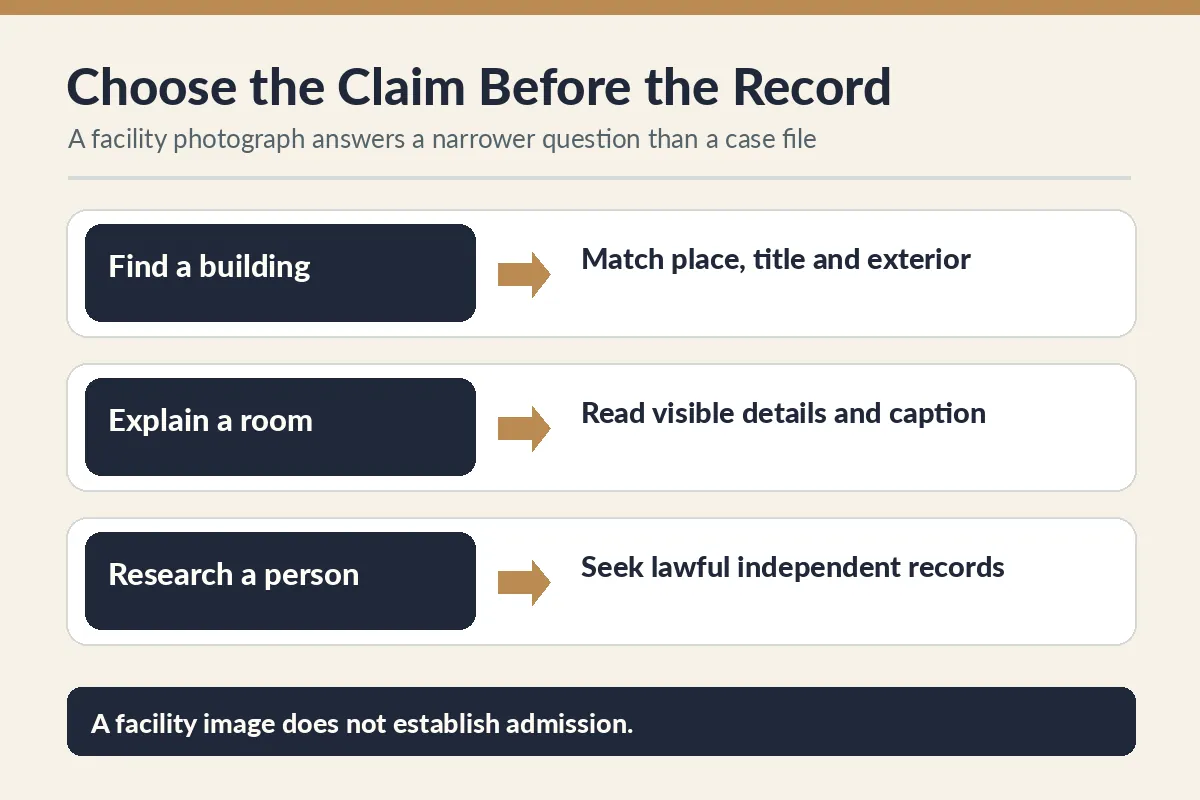
Read the Photograph as a Physical Source
Inspect the full image, not merely a cropped preview. Make notes on the external facade, room plan, signage, furniture, circulation space and landscape only when those features are visible. If the photographer, date or purpose is supplied in the archival description, quote it accurately and indicate its source. Do not infer medical treatment, an individual’s welfare status or official policy from the appearance of beds, desks or communal areas. The photograph is evidence of a scene at an uncertain moment, not automatically evidence of how it was used every day.
Keep photographic observations in one column and catalogued assertions in another. A handwritten title on the mount might identify the place, while a catalogue date could describe a file’s span rather than the shutter date. If two prints show similar rooms, avoid combining them into one site without a distinctive match. The useful result is an auditable identification of a room or facility and its limits, even if a family connection remains unproved.

Make a Two-Date Building and Service Timeline
An archive date range, 1977–1994, is a collection span rather than proof that every depicted facility operated continuously during those seventeen years. Capture the photograph’s own date, if supplied, and separately list opening, renaming, alteration or closure dates established by independent public records. A facility might have changed its functions while the exterior remained familiar. Conversely, modernization in a later image can make one documented institution look like two unrelated sites.
Use contemporaneous local authority papers, planning documentation, directories and historical maps to test the building identity. Where only a modern address is known, record it as a research lead rather than backdating it to the photograph. A sensible timeline includes three statuses—visually documented, externally corroborated and not yet checked. This is especially important in recent social history, where service terminology, administrative ownership and personal circumstances should not be reconstructed through speculation.
Handle Personal History and Recent Privacy Carefully
To research a named individual, first seek consent where relevant and establish whether any personal record is open to lawful access. The existence of a photograph of a unit does not reveal an admission, discharge, medical history, duration of stay or relationship among people who appear nearby. Avoid attempting to identify unnamed people by appearance. If an image includes a staff member or service user, captions and independent records may still be incomplete, and publication can have privacy implications.
Construct a fictional example: a relative recalls visiting a unit in a particular town in 1985. An AST 33 image showing a similar frontage supports only a possible location match until contemporary maps or signs connect the images. A dated letter from the relative might establish a visit, but would not establish residence without further evidence. This keeps the research human-centered without turning a sparse photographic collection into a list of individuals or their experiences.

Cite Every Image and Preserve Uncertainty
In the final citation give The National Archives, AST 33, exact piece reference, photograph title or description, stated photographer and dates where known, and the medium examined. Indicate whether you viewed the actual print, a catalogue entry or a reproduction. The National Archives photographic guide explains that most of its photographs are not freely viewable online; do not promise an instant digital download before checking the particular catalogue record and access options.
Finish the facility worksheet with the claim you can support, the clue still unverified and the next independent repository to consult. For example, write “the collection includes a photograph catalogued as a resettlement facility in this area,” rather than “my relative lived there.” Keep original scans and explanatory diagrams distinct. The value of AST 33 is its carefully bounded visual account of institutions, not a hidden substitute for individual case files.
A practical next search is to compare the agency photograph with two separate local references: a directory entry that places a named institution at a specific address and a dated planning or building file documenting a physical alteration. Neither record supplies resident identities. The useful cross-check is whether the same building is meant, whether the records use the same institutional name, and whether the dates actually overlap. When these points cannot be verified, retain both candidate addresses rather than forcing a match.
More House and Local History Guides
How We Research This Historical Collection
For this article we checked The National Archives subject guide and additional official guidance on November 8, 2026. Those guides establish the described archive series and research limitations; they do not prove the contents of a piece that has not been personally examined. Dates and examples identified as collection-level are treated as such. The procedures above are original evidence-audit methods, not claims that an undocumented ancestor or person has been discovered.
Our workflow records catalogue wording, original creator, full piece reference, format of the photograph or drawing, date of record creation when known, and the exact independent source that could test a proposed conclusion. We preserve unanswered questions rather than converting missing search results into negative proof. Editorial illustrations are not historical facsimiles. Read the affiliate disclosure; links here identify research resources and do not assert an affiliate partnership.
The National Archives photographs guide describes a discrete collection of 24 photographs.
The catalogue overview gives 1977–1994 for photographs of Resettlement Agency units and facilities.
No. Physical setting, admission, attendance and an individual’s history are separate claims.
No blanket online access is promised. Inspect the particular catalogue entry for viewing or copying options.
Record exact reference, caption, likely location, photo date if known and independent location evidence.