
Start with the Court Locality and the Name
If an ancestor appears in a Virginia equity dispute, search the Library of Virginia’s Chancery Records Index (CRI) by the county or independent city where the case was heard. The collection brings together indexed chancery causes and, for many places, scanned original court files. A name in this database identifies a person mentioned in a case; it does not by itself establish marriage, inheritance, kinship, legal title, or even which same-named individual is involved. First record the locality, party names, index number, and whether scanned papers can actually be opened.
Chancery concerns equitable disputes decided by a judge rather than a jury. Bills, depositions, responses, exhibits, and decrees can illuminate land divisions, estates, debts, business relationships, and the testimony of neighbors. The Library describes material spanning the early eighteenth century into the twentieth, but its current collection emphasis is pre-1913 cases; that is a program priority, not a promise of complete coverage for every locality. Set the family event date alongside historic boundaries and courts before searching. A modern address may fall in a different record-creating jurisdiction from the county of the historic lawsuit.
Distinguish Indexed Counties from Scanned Counties
The CRI information map separates three questions often collapsed into one: whether a locality contributes indexed cases, whether digital images exist, and whether originals are currently available during processing or conservation. A county may be searchable without every suit being digitized. Another county may have a long overall record range but scans covering a shorter span. Read the locality-specific record and digital-image date ranges before treating a failed image search as evidence that a case never existed.
In the map, check the locality’s current and former names, and record any active-status closure. Materials listed as closed for processing or conservation may be unavailable both to readers and for digital-copy requests. This affects what can be obtained now, not whether historical people filed suits. Note the search date and the access warning, then ask the Library of Virginia reference service or the circuit court clerk which unscanned originals or microfilms can be consulted. Never send the reader to an assumed online image simply because an index entry exists.

Decode Case Numbers and Search Fields
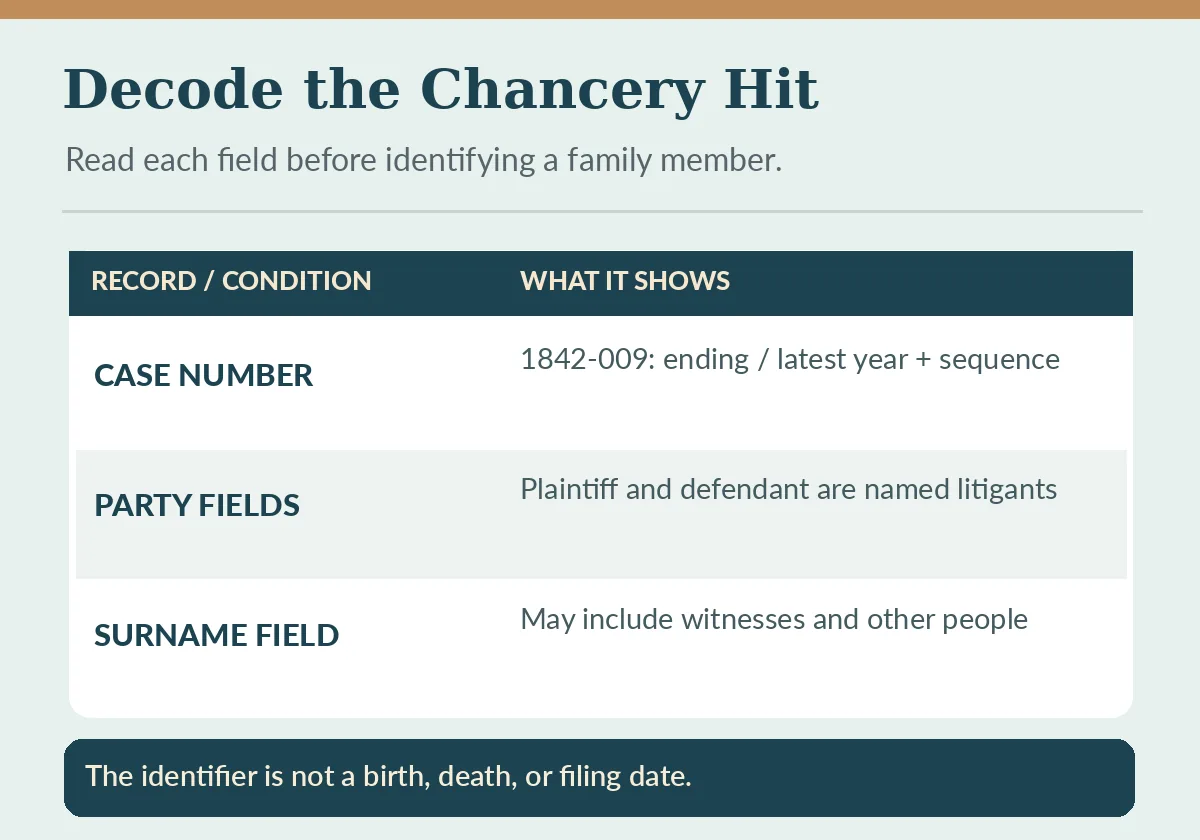
The official search guidance says that a CRI index number begins with a four-digit year, generally the year the case ended or the last known year, followed by a three-digit sequence assigned during processing. An illustrative 1842-009 is therefore not proof that a person sued or died in 1842. Store the case number exactly as displayed and retain the locality and style of suit, because the number alone is insufficient to distinguish cases in different places. The Library warns that identifiers may change when more files are processed.
Search initially by plaintiff or defendant surname, or the broader Surname field. The latter may include witnesses, deponents, additional parties, relatives, businesses, or organizations. Do not assume a match in Surname means the person was a litigant. The search allows EQUALS, STARTS WITH, and INCLUDES rather than conventional wildcard symbols. Broadening the field and limiting one locality at a time is often more reliable than combining too many filters. When a year is uncertain, avoid a strict date limit: the official guidance explains that undated cases use 1111 and may disappear from bounded-year searches.
Read Depositions as Claims, Not Birth Certificates
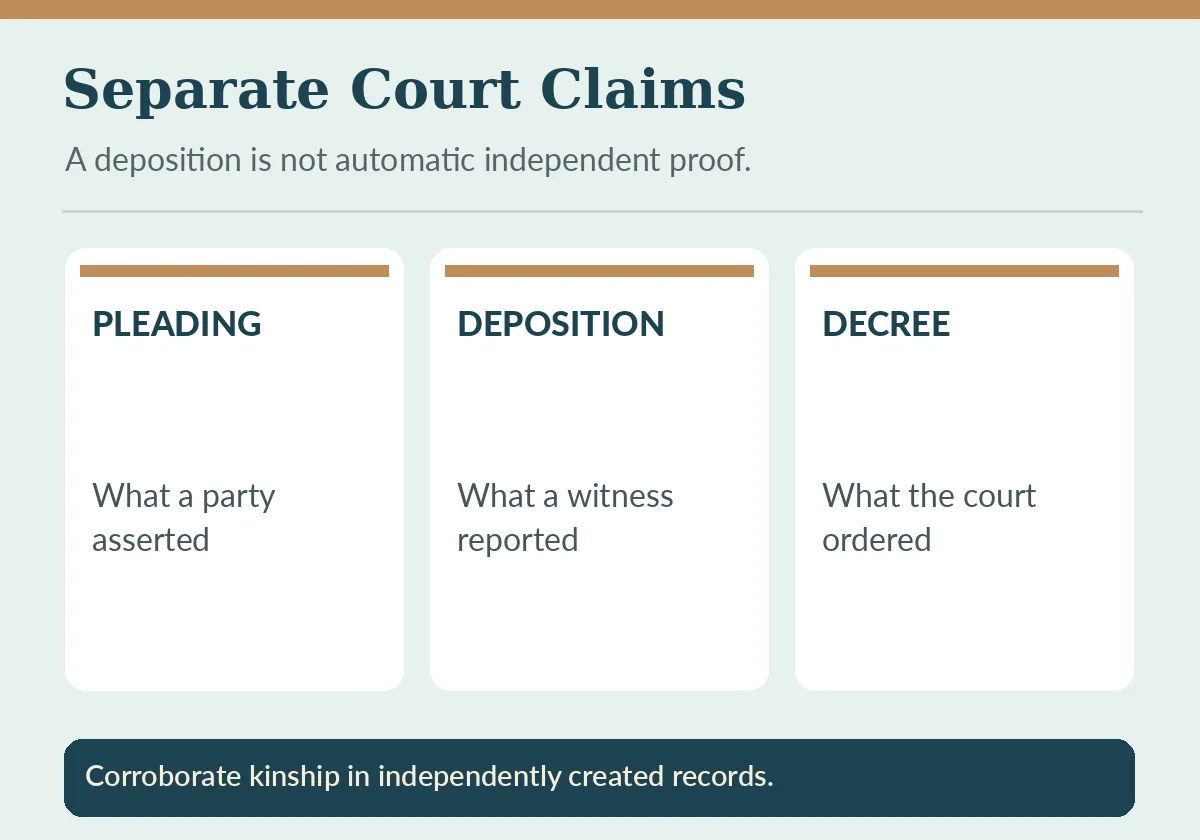
Open every accessible page, including the bill or petition, answers, depositions, exhibits, and decree. A pleading states what a party sought to establish; a sworn deposition records what a witness said; a court order shows the court’s action. These are different evidentiary layers. A witness may state that two people were brothers, yet the witness’s knowledge might derive from local reputation rather than firsthand observation. Transcribe the precise words, identify the speaker, capture the date, and look for an independently created register, deed, or probate record.
The index can flag wills and plats when processors encountered them, but indexing detail varies by locality and processing period. A missing will flag is not evidence of a will’s absence. Some counties do not comprehensively index the names of free and enslaved people. Search by known enslavers, localities, associated households, and court participants with particular care, preserving historical descriptions and the limits of the record. Where multiple same-named residents appear, compare dated residence, occupation, associates, and parcel descriptions before joining their events.
Build a Retraceable Citation and Conflict Log
A working citation should preserve the historic county or city, the exact styled parties, the date range if supplied, the CRI index number, the custodian, and specific file images consulted. The Library provides a model citing the locality chancery causes, style of suit and number, Local Government Records Collection, and Library of Virginia. Include individual image or page identifiers when visible and keep the index URL separate from any direct image address. The goal is for another reader to retrieve the very paper on which your claim depends.
Create a claim ledger with five columns: speaker or document, stated event, time of statement, independent comparison, and finding. If an heirship statement agrees with a probate inventory but conflicts with a dated marriage bond, document the conflict rather than selecting the most convenient account. A decree can resolve who received relief under that litigation without settling every historical identity question. For an unscanned file, record who holds the original and the exact access inquiry; do not silently replace it with a secondary abstract.
More Records and Archives Guides
How We Research Virginia Chancery Causes
Our collection audit begins with the Library of Virginia’s CRI description, map, and search and citation directions, not a copied surname tree. We test a broad surname against its locality, expand from named parties to other indexed surnames, and capture the entire case identifier before examining the underlying document sequence. We separately check the location-specific digitization range and active-status restriction. This prevents a negative search in a scanned subset from being presented as an absence from the historic court.
For publication, we classify each inference as quoted testimony, court finding, independently documented fact, or still unproved. A schematic example is always marked illustrative and never presented as a historical transcription. Repository descriptions can change as batches are indexed. Check their current availability at the time of consultation. The site’s affiliate disclosure explains our general linking policy; the Library links here are research references, not endorsements or paid placements.
No. The Surname field can index witnesses, deponents, family members, secondary parties, and organizations. Confirm the role in the actual papers.
Not necessarily. The four-digit component generally reflects the year the case ended or the latest known year, not an automatic date for every filing.
Digitization and indexing ranges differ by county or city. Check the locality map and current processing status for access to originals or microfilm.
No. Indexed descriptive detail varies across localities. Inspect the complete cause before inferring that an exhibit is absent.
A decree documents a judicial outcome in that case. Biological or legal kinship should be tested against independent contemporaneous evidence.