
To trace an English Court of Chancery equity suit dated 1558–1875, start with the named plaintiff or defendant and find the pleadings in The National Archives’ C 2–C 18 series. Do not treat the bill of complaint as a judicial finding: it presents one side’s allegations. Later depositions, affidavits, orders and decrees were filed in different series and may require on-site finding aids. The official Chancery research guide explains why a single lawsuit is not kept as one convenient family packet. See our affiliate disclosure.
Set the 1558–1875 Boundary and Locate the Parties
The archive’s post-1558 guide runs to the reorganization of the Court of Chancery in 1875. Earlier equity pleadings require the separate C 1 early Chancery guide, and later Chancery Division proceedings belong to a different judicial structure. Record a plausible event range before searching because a land dispute could continue for years and references may not be sorted by a single familiar event date. Distinguish dates on a bill, witness deposition, order and judgment. They are procedural events and may all differ from the incident the family remembers.
Equity proceedings concern subjects such as property, trusts, inheritances, debts, marriage settlements and business agreements. This makes them valuable for family historians, but it also means that a surname search can return unrelated litigants, lawyers and witnesses. Start with as many identifiers as survive: place, occupation, known associate, contested property, approximate year, and whether the ancestor brought or answered the suit. If the legend says an ancestor ‘won the estate,’ record that as a hypothesis until the later court papers substantiate an outcome. A lawsuit may have settled or stopped before a final decree.
Find a Bill of Complaint by Names and Short Title
Search the Discovery catalogue by plaintiff and defendant separately, adding the place and approximate period when possible. The National Archives says the main pleadings through 1875 can be searched online by at least party surnames. Catalogue descriptions vary: some provide full names or subject, whereas others contain only a ‘short title’ such as Reed v Smith. The short title may change within the same case if a different defendant appears. Log plausible variants instead of rejecting a file because its caption differs slightly from the family legend.

Recognize Pleadings as Competing Statements
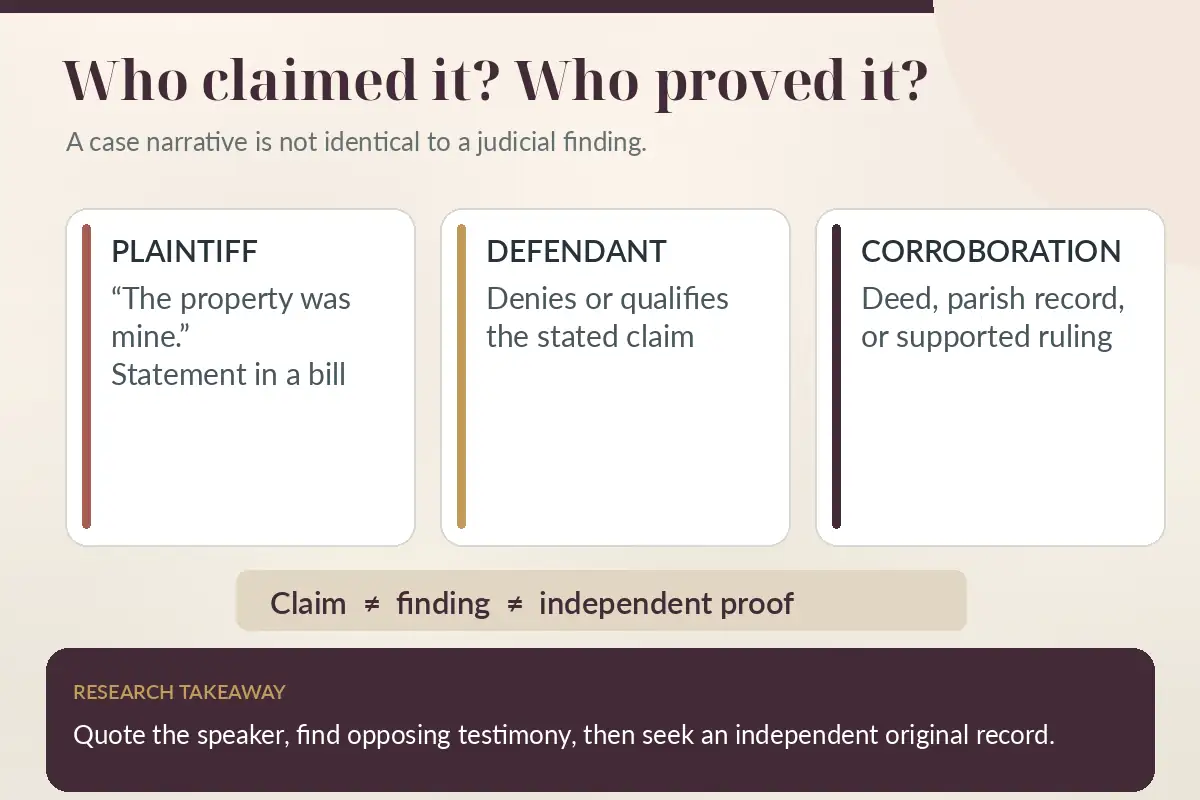
A bill of complaint is the plaintiff’s formal account of disputed events. An answer gives the defendant’s response; replication and rejoinder are additional exchanges if proceedings reached those stages. These are statements made by interested parties, not neutral documentary proof. A pleading may explicitly claim a marriage, pedigree, property ownership or debt, but an opposing pleading may deny it. Quote the specific claim, identify its speaker, and ask for independent parish, probate, land or financial evidence. If the initial bill is the only surviving item, state that no final outcome has been established from the inspected records.
Court papers can give personal names, stated relationships, places of abode, occupations and detailed descriptions of disputes. A relationship phrase within the plaintiff’s bill tells you what that litigant claimed, not necessarily what the court later accepted. Separate direct transcription from analysis: ‘complainant says X was his uncle’ is more defensible than ‘X was proved to be his uncle.’ Retain the exact source date and original reference because similarly named people may sue repeatedly. A lawyer’s name at the corner of a pleading must not be mistaken for the defendant or a relative.
Track Depositions and Orders in Separate Series
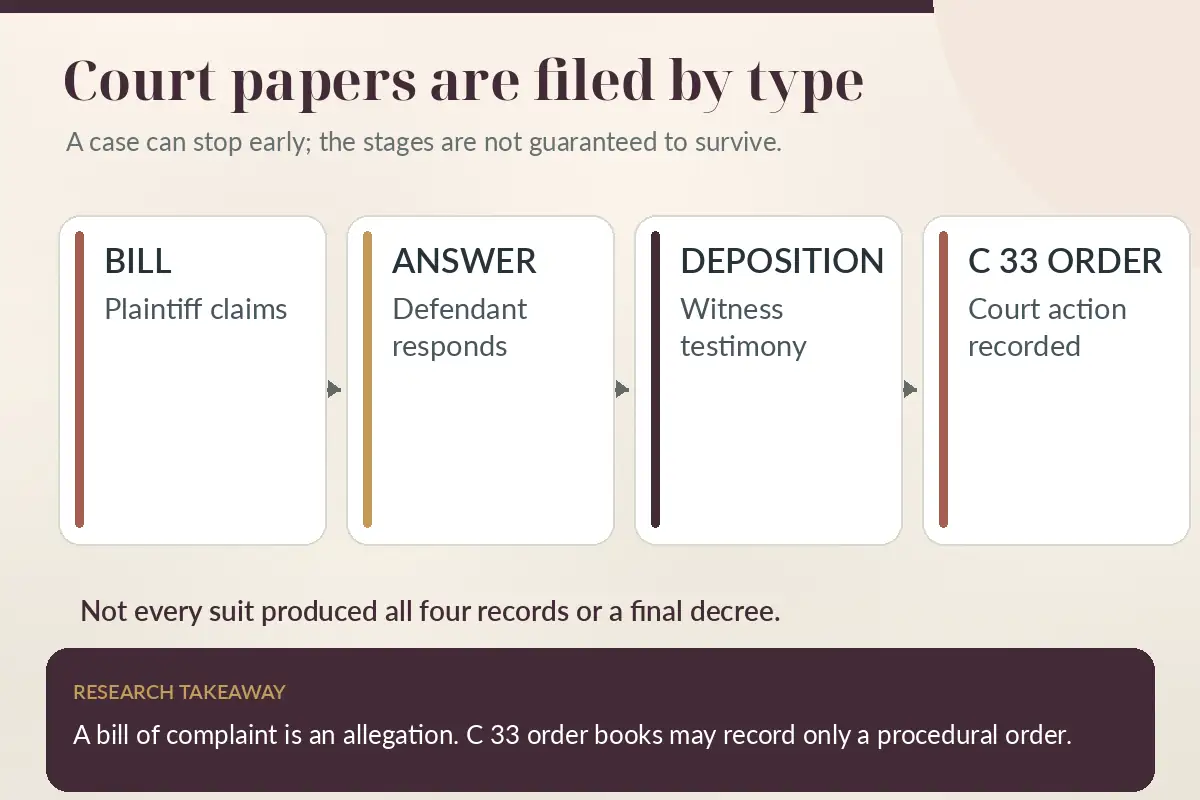
The archive warns that Chancery records were arranged by record type, not as one assembled court case. Depositions report witness answers to interrogatories; affidavits and Chancery Masters’ material require their own finding aids and series. C 33 contains decree and order entry books, but the related paper indexes are often consulted at Kew. An order does not always determine every issue, and a procedural entry might merely direct a hearing or evidence-gathering step. The source guide lists how to pursue different records. A catalogue hit for C 2–C 18 pleadings is a starting point, not a guarantee every later piece survives.
Make a document inventory using the short title, all named parties, date, type, reference and the particular issue addressed. Join later papers cautiously using parties and subject rather than only the first surname. If the same family appears in separate inheritance suits, create a separate case identifier for each. Build a chronology of bill, answer, testimony, orders and any final decree, then mark gaps. Explain when a search requires archival indexes unavailable from home. Do not claim that online catalog descriptions reproduce the original content or that no result proves that a lawsuit did not exist.
| CASE PAPER | WHAT IT CONTAINS | RESEARCH LIMIT |
|---|---|---|
| Bill of complaint | Plaintiff’s allegations | Not a court finding |
| Answer or deposition | Defense or witness testimony | May dispute earlier statements |
| C 33 order entry | A recorded court order | May not be a final decree |
Reconstruct a Case Without Assuming a Final Decree
An allegation-versus-evidence ledger is essential. Column one contains a verbatim or accurately paraphrased assertion. Column two names its author and procedural role. Column three gives independent corroboration or contradiction, plus the state of any judicial finding. A deponent’s sworn statement may be valuable and detailed yet still affected by memory and interest; it is not identical to a court’s finding. A later order might address just one question, leaving others unresolved. Present these distinctions plainly when incorporating the case into a family narrative or a genealogical proof argument.
The original guides also distinguish C 1 suits before 1558 from the later record arrangement. A single ancestor might be connected to a proceeding outside your chosen period, so do not force a candidate into the post-1558 series because the surname appears there. Conversely, a family event before 1558 could give rise to a suit filed afterward. Search by the proceeding’s own dated documents and check jurisdiction. Legal-language conventions and script change with time; request help with difficult handwriting rather than manufacture a modern-language sentence from an unclear line.
Test a Fictional Inheritance Dispute
Consider an entirely fictional 1690 suit in which Anne Ward alleges that her cousin Thomas concealed a deed. The bill names a relative and a disputed property; neither claim is automatically established. A responding answer might concede ownership of part of the estate but deny the alleged concealment. An independent parish record could clarify how Anne and Thomas were related while an enrolled property document tests title. If no judgment has been located, the accurate conclusion is that the surviving pleadings document a dispute, not that one party was found guilty or that a family relationship was judicially proved.
For each candidate, write a two-sentence source assessment: ‘This document is a bill submitted by…’ and ‘The claims remain confirmed, contradicted or unresolved because…’ Add a research trail naming the exact Discovery query, years, parties and supplementary series consulted. Consult local archive calendars where they cover a county, noting those calendars can be finding aids rather than complete evidence. Keep copies or stable references for the actual documents you inspected. The amount of detail in a pleading is no substitute for a reliable evaluation of who was speaking and why.
More Records and Archives Guides
How We Research Court of Chancery Papers
We compare The National Archives’ date-specific guidance for early and later Chancery suits, then trace the procedural role of every source used. Names and short titles are recorded as search keys, while allegations, testimony and decrees receive distinct evidentiary labels. We never turn a pleading’s stated pedigree into a verified kinship line without outside evidence. Our final case worksheet records sources found, records not yet searched at Kew, conflicts between parties and the precise conclusion that the documented stage of the proceedings supports.
The National Archives places post-1558 pleadings in C 2–C 18; consult its series and catalog guidance.
A brief caption using parties’ surnames; variations can refer to the same underlying suit.
No. It represents what the plaintiff asserted, not what was later established.
No. Chancery filed different classes of papers in separate series, making reconstruction necessary.
Not reliably. Orders and decrees often require additional series and paper indexes at Kew.