
Decide Whether You Need a Petition or a Decree
C 36 contains ordinary and appeal petitions for the Chancery court from 1774 to 1875. The National Archives distinguishes these from decrees and orders enrolled elsewhere. An ordinary petition might ask for a trustee appointment or the winding up of an association; an appeal petition can concern an earlier unenrolled decision. The fact that a party petitioned does not demonstrate the court granted the request, ruled on every allegation or accepted a stated family relationship.
Before searching, articulate a claim that a particular record can answer: who asked the court for relief, when the petition was filed, or what order was subsequently made. A bill of complaint, petition, enrolled decree and appeal are different kinds of documents. Their titles can refer to the same litigants, but they occur at different procedural stages and need independent citations.
If the question concerns title to a house or inheritance, copy the parties’ names and land description exactly, then mark their legal roles. A person may be described as a trustee, executor, respondent or claimant rather than a proven owner or descendant. Evidence of those roles may guide a genealogical search, but it cannot replace a deed, probate record or a final judgment.
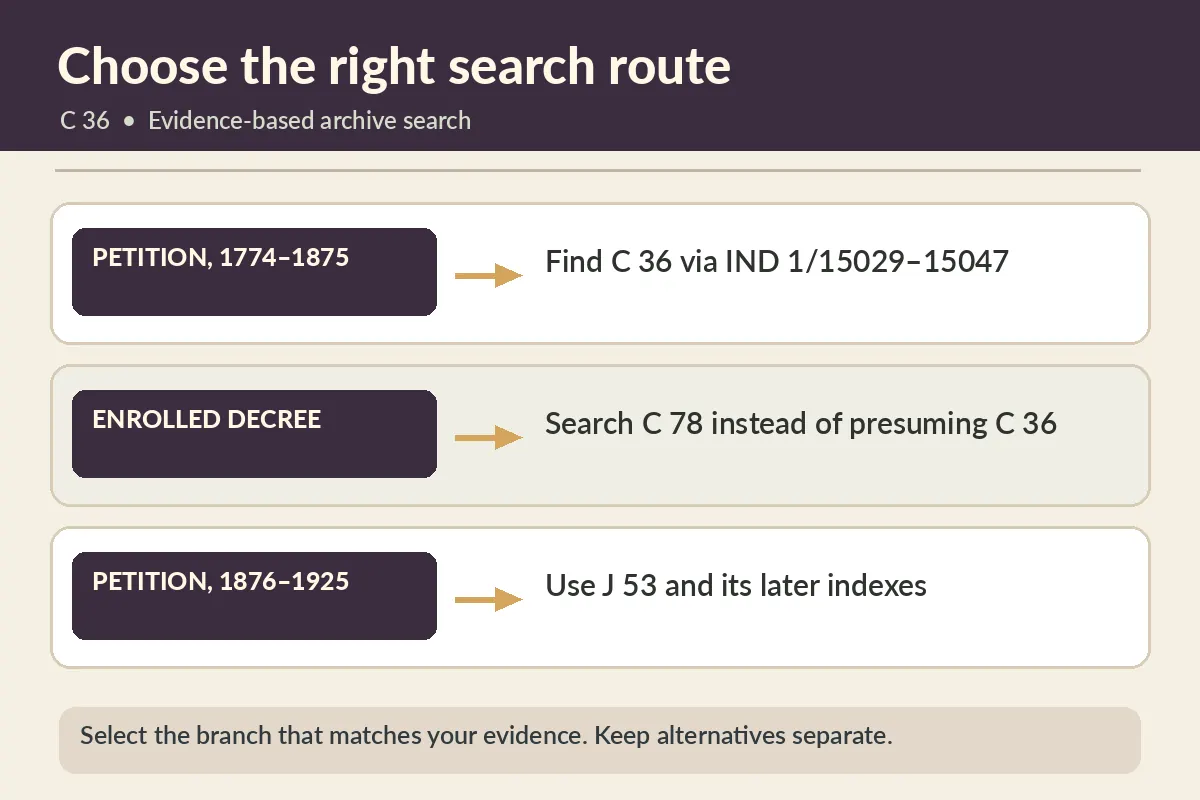
Use the C 36 Indexes and Preserve the Case Identity
The National Archives specifies indexes in IND 1/15029–15047 for C 36 ordinary and appeal petitions. Start with the litigant names and the broad event period; also search alternative surname spellings and case title forms. Record the index volume, page and exact C 36 reference supplied. A historical index is an access instrument, not the petition text itself.
Catalogue descriptions vary in detail. Some name litigants, others emphasize a document type or period. When a name search returns nothing, compare your transcription with the spelling in contemporaneous wills, deeds or newspapers and browse the relevant index range. A failed online keyword result is not evidence the petition was never filed, especially if the underlying catalogue is not fully name-indexed.
If several cases bear the same surname, identify them by opposing party, date, place and the specific procedural request. Do not merge a later petition with an earlier decree merely because both mention the same estate. Build a case register that records each reference, whether the record was inspected and which legal action it actually documents.

Separate Enrolled Decrees From Unenrolled Decisions
The National Archives describes C 78 as Chancery Decree Rolls for enrolled decrees and orders, covering 1534–1903. Enrolment was an extra step and could affect the route of appeal. For an unenrolled decree, the guide directs researchers toward decree and order books and petitions, where a case might be reopened before the Lord Chancellor. These alternative routes should never be presented as one mandatory sequence for every lawsuit.
An appeal against an enrolled decree proceeded by a different jurisdictional route, involving the House of Lords rather than simply another C 36 petition. Distinguish what the record itself says about procedural status; a label such as “appeal” does not automatically prove a judgment was reversed. Cite each dated step separately and check for a final disposal if your research question requires it.
If a matter was resolved through arbitration or private settlement, the available trace may be a report or award rather than an enrolled decree. The National Archives notes C 38 reports on Masters’ arbitrations and C 42 unenrolled awards as possible alternatives. These series are not appendices to every C 36 case, and absence from a decree index is not conclusive evidence that a dispute had no outcome.
Do Not Turn Pleadings Into Proven Family Facts
Legal parties often describe kinship, occupations, debts, rights or residences in language designed to support their legal position. Such statements can be useful historical leads but must be attributed to the party making them. A petitioner’s statement that someone was an heir remains an allegation unless the court record or independent documentary evidence resolves the claim.
Copy the exact distinction between a request for appointment, a complaint about management of an estate, an appeal from a prior order and the order that followed. Each may name trustees or beneficiaries in a different capacity. If the question is whether an ancestor lived in a property, a petition naming land or a manor does not establish actual occupancy. Check contemporary tax, parish or property records.
When a will, settlement or deed is mentioned, seek the underlying instrument where it survives. A petition may quote selectively or paraphrase a disputed clause. Documenting the original wording alongside the petition helps distinguish an inherited interest from a contested claim. Preserve conflict where sources disagree rather than allowing the court pleading to dictate the family tree.

Record the Outcome With Appropriate Qualifications
Write a research conclusion that states the exact proposition supported by each document: a petition was filed, an order was enrolled, or an additional appeal was made. If the final outcome has not been located, say that no final decree has yet been verified. This is more informative than assuming the petitioner won or lost because only one stage survives in the current research file.
For chronological accuracy separate the date of an event described in a petition, the date on the document and the date a court acted. A copied pleading or later index can compress those into a single apparent date. Record the source type next to each date and transcribe uncertainties such as partly illegible names and approximate periods.
Cite the complete C 36 piece reference, the IND 1 index used, and any related C 78 or decree-book entry. Explain whether each is based on a digitized image, inspected manuscript or catalogue description. The resulting case map will remain usable if another researcher later finds a settlement or a family deed that changes the interpretation.
More Records and Archives Guides
How We Research and Verify the Archival Record
For this guide we checked the official series and research descriptions for C 36 against the document categories, chronological boundaries and access limitations specified by the custodians. We separate series-wide statements from claims about a particular piece: the former establish a search route, while the latter require the piece itself. Our principal source descriptions are Chancery Equity Suits After 1558 Enclosure Awards Understanding Your Search Results. These sources support reference names and evidence limits; they do not certify an uninspected record as proof of an individual event.
Our verification worksheet records the claim, exact C 36 reference, creation date, nature of the entry, names and roles actually written, independent source used for comparison, and any unresolved alternative. The illustrated search routes are teaching reconstructions, not facsimiles of original records. Consult the affiliate disclosure for the site editorial and commercial policy. This article does not depend on an unverified paid provider or a claim of access to closed material.
The National Archives lists ordinary and appeal petitions in C 36 for 1774–1875.
Use IND 1/15029–15047, recording the index entry and the reference to the underlying petition.
No. It records a request or procedural step; locate any order or decree separately.
C 78 contains enrolled Chancery decrees and orders, whereas C 36 holds petitions.
The Archives guide points to J 53 Chancery Division petitions for 1876–1925.