
C 81 preserves medieval Chancery warrants associated with instructions for the Great Seal, not a ready-made register of completed grants. A warrant can show that the Crown authorized a document to be prepared; it cannot by itself establish that a sealed instrument was delivered or that its intended recipient took possession of an estate. Begin with reign, regnal year, named beneficiary, office and purpose. The National Archives identifies the printed Calendar of Chancery Warrants for 1244–1326, covering C 81 and PSO 1, as an important route into early material. Read the wording of the surviving warrant before announcing any legal result. For official series scope, consult The National Archives research guide.
Determine whether the document is a warrant or a grant
The first distinction is administrative. A warrant was an authenticated instruction moving government action toward an instrument under the Great Seal; a patent or charter was a different document in that chain. The official guide to royal grants notes that warrants in C 81–83 may survive for grants that were never enrolled. In turn, an enrolled text could be altered or canceled, and enrolment did not always mean that the grant was formally issued. Thus neither a warrant nor an enrolment alone automatically proves a benefit was enjoyed.
Transcribe the actual operative verb, addressee and conditions. Did the king order someone to draw up letters, protect an envoy, consider a petition, issue a safe-conduct or release an instruction to another official? Do not translate every form of royal direction into ‘the king gave land.’ Keep a separate column for the proposed instrument and a third for independent evidence of issue or performance. This matters especially when family narratives rest on a single brief catalogue description rather than the diplomatic language of the document.
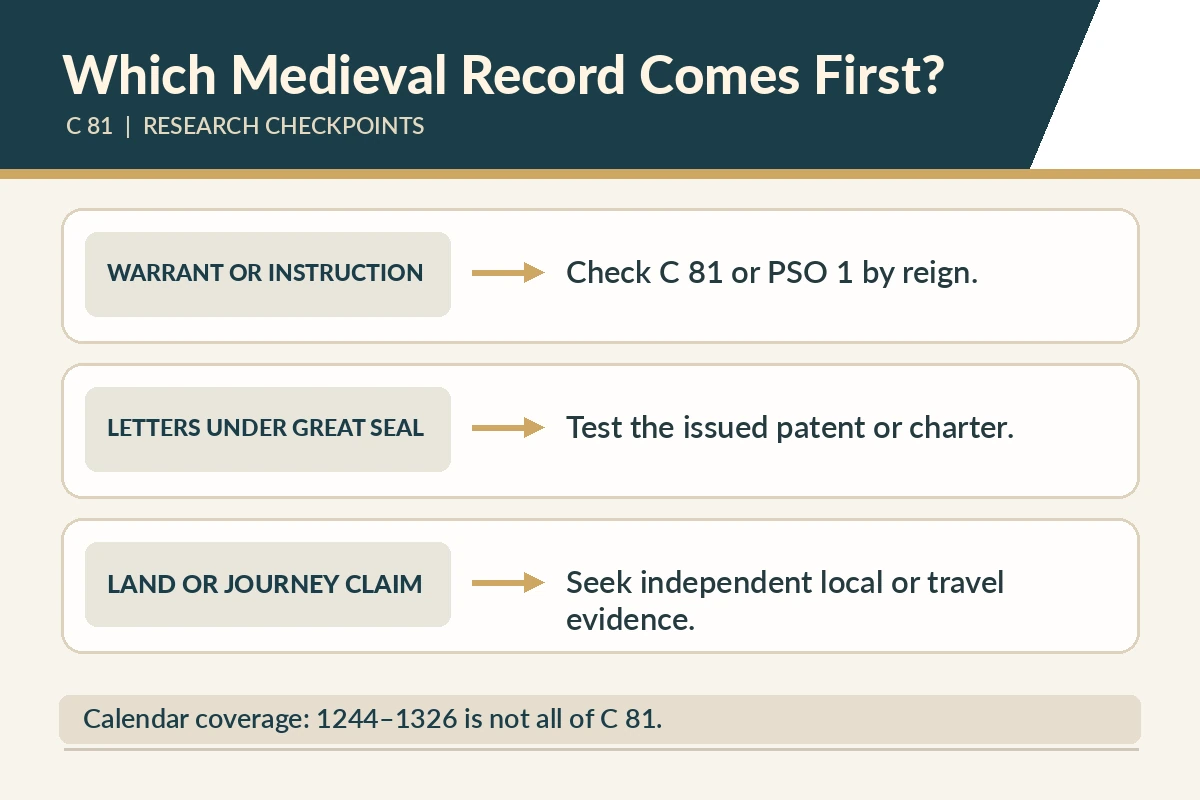
Use the 1244–1326 calendar without extending its coverage
The National Archives identifies the Calendar of Chancery Warrants preserved in the Public Record Office, 1244–1326, published in 1927, as a route to summarized C 81 and PSO 1 documents. The calendar includes examples involving foreign envoys, protections, commissions and the preparation of letters under the Great Seal. It is not a name index to all warrants throughout C 81’s whole lifetime. If the event falls outside 1244–1326, the sensible next step is to inspect the relevant series description and alternative finding aids rather than forcing a calendar reference.
When a calendar entry appears promising, note its printed page, date as published, any regnal year, document class and precise citation. Then look up the modern piece and item reference in Discovery. The calendar may summarize or regularize a medieval clerk’s wording; it is a lead to the underlying record, not a substitute for examining it. If a calendar gives a shortened personal name, compare its Latin form, title and place with the original rather than selecting the modern family member whose surname looks closest.
Navigate parallel C 81 and PSO 1 evidence
The early warrants calendar spans both C 81 and PSO 1. Their inclusion in one published guide should not lead to conflating their custody or physical form. Record exactly which series and piece the entry points to. If a document’s reference contains more than one number or a folio or item suffix, preserve it intact. Searching the wrong series can falsely suggest a loss when the warrant survives but was filed in an allied body of records. Search by reign and administrative purpose as well as by personal name.
For grants, test whether a related letter patent or other instrument appears in C 66 or in an independent local or family archive. For diplomatic instructions, surviving incoming correspondence or records of the intended recipient may provide the next layer. An instruction to prepare a safe-conduct demonstrates a governmental act; an actual journey requires contemporary travel evidence. The researcher should chart these as alternative kinds of corroboration, not a compulsory sequence that every historical case must have followed.

Check seals, dates and medieval naming conventions
A description saying ‘warrant for the Great Seal’ is not itself proof that an original sealed grant survives in the same bundle. Examine the document type, any endorsement and the presence or absence of a seal as a separate observation. Do not interpret a drawn or damaged seal impression in a modern illustration as documentary evidence. Similarly, a regnal-year date may straddle two modern calendar years. Convert it cautiously and preserve the medieval date in the citation so other researchers can check the conversion.
People may be described by an office, an inherited title, a Latinized name or a place of origin. A warrant naming a steward or envoy can relate to duties of an office, not the steward’s family residence. Record the exact form of the name and the capacity in which the individual appears. When more than one man used the same name, use dated offices, associated locations, witnesses or other external identifiers before asserting identity. An identical surname is never a substitute for that identity test.
Reconstruct a grant claim without inventing possession
Imagine a family tradition that a medieval ancestor received a royal estate. The C 81 warrant may show that preparation of a grant was ordered, but this is only the first defensible proposition. Search for a corresponding grant’s final text, check whether it was altered or canceled and seek local property records recording occupation, rent, homage, conveyance or litigation. If no such evidence survives, the conclusion should say ‘a warrant concerned a proposed grant’ and should not supply a fictional residence or direct line of descent.
A protection or safe-conduct presents a similar problem. The Crown could authorize security for an envoy without showing the envoy reached the destination. A later record referring to a mission may be a useful confirmation, but only if date, office and identity agree. Include failed searches in the research log: years, calendars and series examined, not merely ‘no record found.’ This helps future work focus on genuine gaps rather than repeating incomplete catalogue searches.
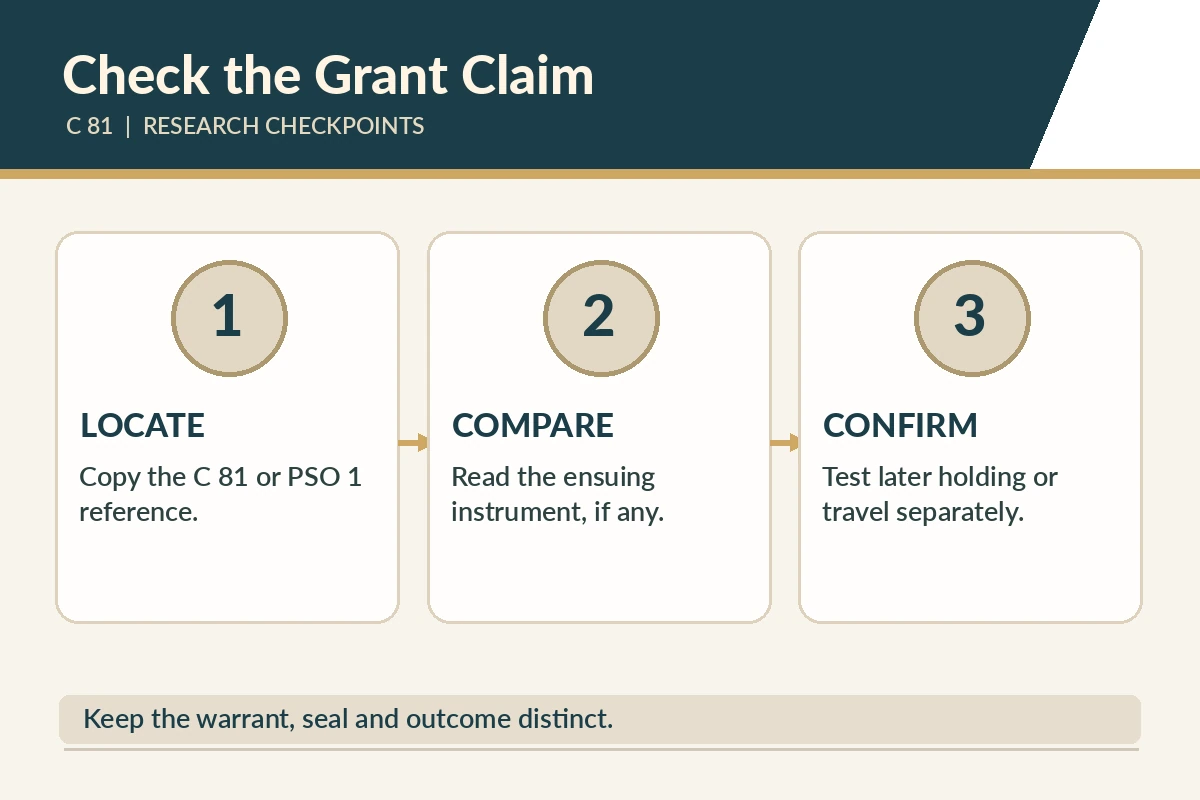
Build a citable warrant-to-outcome ledger
Write a citation that identifies archive, series, complete item reference, regnal date, person as named, claimed action and document type. Add the calendar volume or printed page separately from the original’s locator. A second column should record the proposition being tested, such as ‘letters were issued,’ ‘property was held’ or ‘envoy traveled.’ Link each proposition to its own source rather than presenting several later facts as if all were written into the medieval warrant.
Before publication, compare spelling against the best available image or original, and describe damage or missing words. Treat a later calendar and a much later family pedigree as interpretive layers, not independent eyewitnesses. When a grant or official mission remains unconfirmed, that limit should appear in the article’s opening conclusion as well as its notes. A narrow, reproducible finding has real historical value even if it disappoints a dramatic family story.
More Records and Archives Guides
How We Research C 81 Records
We start with The National Archives’ warrant and royal-grant guidance, establish whether the date falls inside the 1244–1326 calendar, then check the precise C 81 or PSO 1 document. We compare any purported Great Seal grant with its separate enrolment and seek evidence of execution independently. We cite the medieval wording and editorial calendar as different layers, record regnal-date conversions and avoid deriving kinship from an official title. For information on linked resources, read our affiliate disclosure.
No. It may show an instruction toward a grant; issue and possession require additional evidence.
Start with the published Calendar of Chancery Warrants, then trace the entry to C 81 or PSO 1.
No. Its stated 1244–1326 date coverage should not be projected onto later documents.
No. Permission or protection is distinct from proof that the journey occurred.
The full series and piece reference, document type, medieval date and any calendar page.