
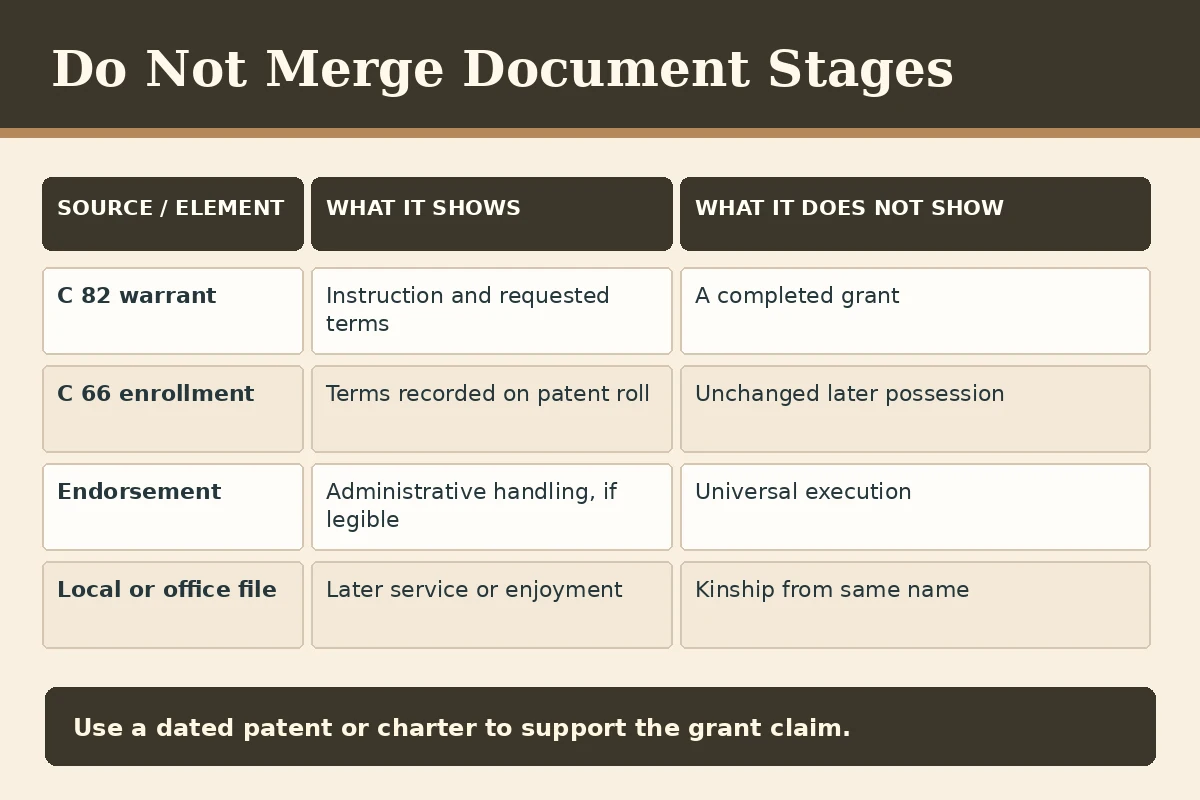
C 82 is a Chancery series of warrants for use of the Great Seal in the Tudor and Stuart period, 1485–1714. It can show that an instruction was prepared or authorized in relation to a royal grant, office or other business. It does not automatically prove that the intended grant was sealed, enrolled, delivered or later enjoyed by the proposed recipient. The National Archives treats warrants in C 81–83 as supplementary evidence to patent rolls and charters, not as interchangeable copies of a completed grant.
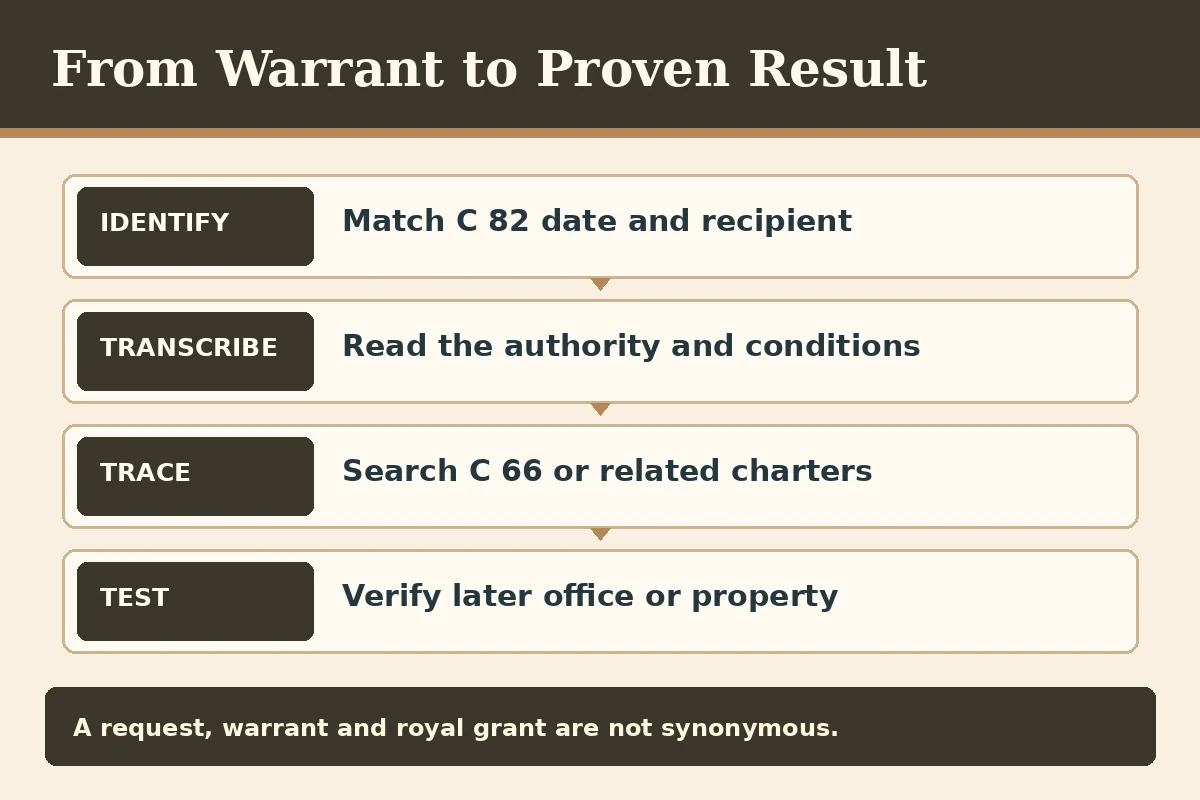
For genealogists, a warrant naming an ancestor can be an important lead, especially if a family tradition mentions a royal appointment or a land benefit. The safe route is from warrant to the relevant patent or other grant record and then to independent evidence of the person exercising the office or possessing the property. Every stage needs its own date and source.
Set the correct Chancery date range and search target
The National Archives’ royal-household guide places Great Seal warrants in C 81 for 1230–1485 and C 82 for 1485–1714. Begin by establishing the reign, rough date and type of business. A Tudor or Stuart warrant should not be forced into the earlier series because a family name appears in a medieval calendar. Search Discovery for C 82 plus the relevant person, place or subject where catalogue detail allows.
Record the full C 82 reference before interpreting the document. Warrant papers may contain names of officials, recipients, petitioners or intermediaries who performed different roles. An official signing or transmitting an instruction should not automatically be treated as the person receiving the grant. Read marginal notes and endorsements as carefully as the central text, and distinguish their dates when possible.
The absence of a name from a simple keyword search is not conclusive. The National Archives points researchers to the publication notes in the series descriptions for proper search methods. A name can appear in variant spellings, titles or Latin formulas; catalogue descriptions may not expose every manuscript name. Record the unsuccessful search terms and switch to a reference or period-led approach.

Separate authority to seal from the grant itself
Ask what the warrant orders: preparation of letters patent, use of the seal, appointment, pardon or another specific act. Such wording documents an instruction within an administrative workflow. It does not always establish that the intended instrument was completed. The National Archives notes that some grants were enrolled but never formally issued, while others were amended or cancelled. A surviving warrant can therefore lead to a genuine grant or to an incomplete paper trail.
Check whether the paper has a later endorsement indicating it was processed, returned or superseded. Do not assume every abbreviated notation is an approval mark. Translate only what is legible and preserve uncertainty. Dates on the petition, warrant, seal and enrollment may differ. If the chronology looks impossible, first consider different dating conventions or multiple stages of authorization.
Avoid confusing a warrant authorizing an office with proof of a career. Even an issued royal patent might appoint someone for a term, under conditions or subject to removal. A subsequent account, officeholder list, court entry or payment could show activity, but each record proves only its own statement. A claimed lifetime appointment needs more than one preliminary warrant.
Trace the patent roll or charter without assuming survival
Royal grants of offices and many other benefits were entered on patent rolls in C 66. Search by recipient, date and subject, and compare the precise terms with those in C 82. The National Archives warns that private recipients sometimes did not pay to enroll a grant; a failure to find a patent-roll entry is therefore not absolute proof that an instrument was never issued.
Where an enrollment is located, record its official date, the words of grant, limitations and any alterations. A calendar of patent rolls is a useful finding aid, but it may compress technical qualifications. Inspect a copy of the original or a reliable full transcript when the distinction matters. One grant may refer to an earlier cancelled grant or involve multiple named beneficiaries; do not flatten those histories into a single event.
If the research concerns land, check later deeds, surveys and legal disputes for actual possession. If it concerns a household or court office, seek dated administrative or payment records showing exercise of the role. Neither the C 82 warrant nor the C 66 enrollment alone proves that a modern family descends from the named recipient. A genealogical identity bridge needs separate evidence.
Write a defensible royal-grant citation
Separate the statement “a warrant instructed the use of the Great Seal” from “letters patent were issued” and “the person held this land or office.” Cite C 82 for the first statement, C 66 or the relevant charter for the second, and contemporary independent records for the third. Include the repository reference, reign or calendar date and the original name spelling.
Distinguish the document you actually read from a published calendar or online catalogue summary. If the warrant mentions a condition, reproduce that limitation in your interpretation. Where there is no matching enrollment, the historically responsible conclusion may be that the intended outcome remains uncertain—not that the Crown either certainly granted or certainly refused the request.
A negative search log should include the dates and spellings tried, nearby C 82 entries and relevant C 66 or charter ranges. Record amendments and cancellations as events with their own dates. Doing so turns an attractive royal-family story into a testable documentary sequence, without making the archive promise more than it preserves.
More Records and Archives Guides
How We Research C 82 Records
We use The National Archives household and wardrobe guide for the C 82 and C 66 series boundaries. Its royal grants guide explains why warrant, enrolment and issue must be separated.
We do not infer genealogy, completed officeholding or legal possession from an instruction alone. Our affiliate disclosure is supplied for transparency about external research links.
The National Archives identifies C 82 Great Seal warrants for 1485–1714.
No. It is evidence of the administrative instruction; search for the grant and its later history.
C 66 is the key series for many royal grants, including grants of offices.
Some grants were not enrolled; report the search as inconclusive unless further evidence resolves it.
No. It can identify a named contemporary person, but kinship requires separate dated evidence.