
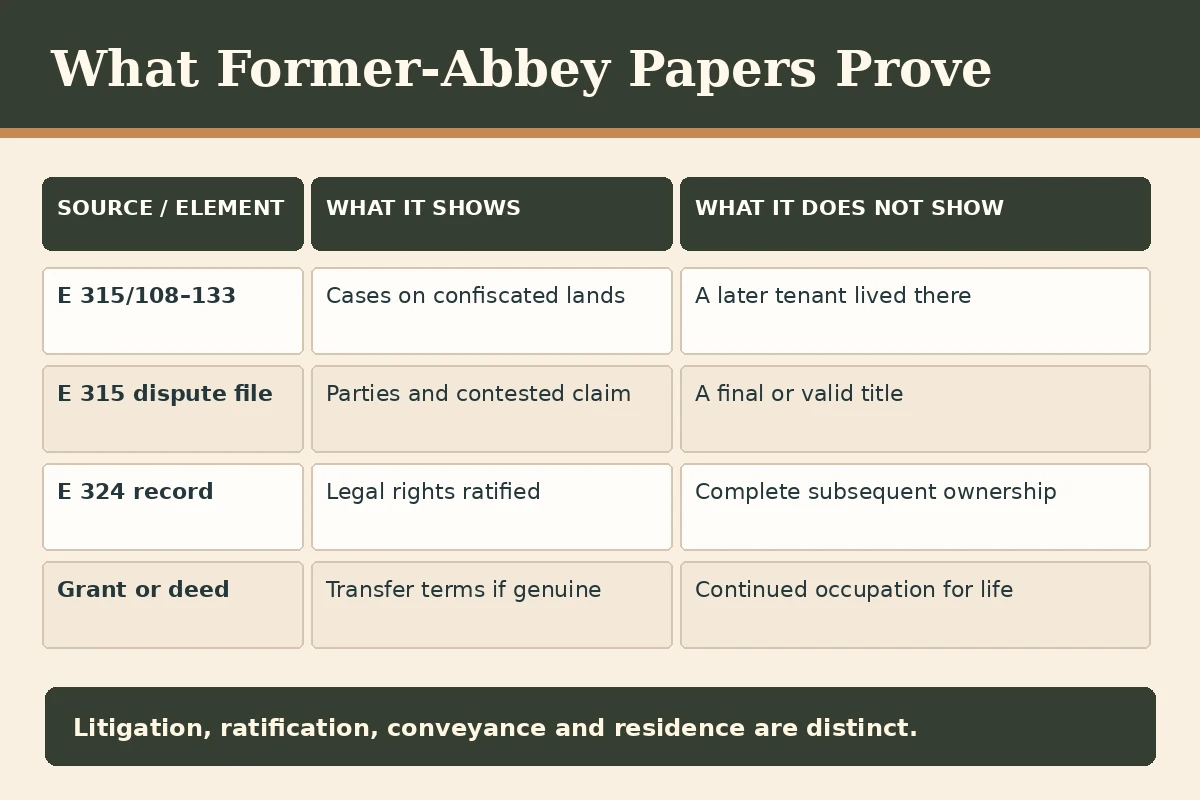
Records in E 315 can help reconstruct legal disputes and administrative changes affecting former monastic land after the English dissolution of the monasteries. The label is not, however, a single complete register of every property bought by Tudor families. The National Archives distinguishes E 315/108–133 for court records concerning land confiscated because abbots were convicted of treason, other E 315 groups for settling disputes over former monastic lands, and E 315/2 for copies of dissolution acts. These document types answer different questions.
Start with the religious house and the parcel, not with an attractive surname in a dispute. A complaint about an estate may prove that someone asserted a right; a court record may document arguments or administrative proceedings; a ratification, grant or conveyance may establish a distinct legal transaction. None automatically proves that a named party lived in a particular room, inherited a manor or retained ownership for life. That distinction matters when a single estate passes through several hands after confiscation.
Identify the monastery, parcel and legal stage
Find the institution’s medieval and sixteenth-century names and any alternative parish or county description. After suppression, the Crown could manage former ecclesiastical property through various courts and offices. The same estate may appear under the religious house, a manor name, a lessee or a later grantee. Keep those aliases in your search record instead of choosing one modern place label and declaring the others unrelated.
The National Archives points to E 315/108–133 for court records of certain monastic lands confiscated following treason proceedings against their abbots. Those files are not generic witness lists for all houses. Other identified E 315 references, including /19–23, /165, /516 and /522, concern settlements of disputes over former monastic land. E 315/2 contains copies of acts related to the dissolution. Use the precise purpose, rather than simply searching the whole series under “land ownership.”
Record the estate interest at issue: rent, lease, fee, patronage, a particular parcel or jurisdictional right. A monastery’s “lands” can encompass several properties and tenures, and a lordship name need not identify one inhabited house. If a document lacks boundaries or a parcel description, make that omission explicit before drawing a map or linking the dispute to a modern address.

Distinguish a litigant from a grantee or tenant
A plaintiff or defendant may appear because they claimed a right, owed money, defended a lease or acted for an institution. That role does not establish ownership. Read the legal verbs and whether the record is a complaint, order, copy, account or recorded settlement. If you encounter an allegation about prior possession, describe it as one party’s assertion unless the document separately establishes an adjudicated fact.
The National Archives identifies E 324 as a related body of records ratifying new owners’ legal rights to former monastic properties. That is a more direct place to investigate the official recognition of title than a bare E 315 complaint. Even a ratification should be checked for parties, land description, dates and the particular interest conveyed; a confirmation can be limited by earlier leases or other obligations.
Compare Crown grants or enrolled documents with private deeds when available. Different dates can refer to suppression, seizure, lease, purchase and confirmation. Do not compress them into a single moment of transfer, and never assume someone inherited a parcel merely because a will later names the same place. A title chain is made of separate transactions, each requiring its own evidence.
Use financial and local records to test possession
A property dispute can lead to rents, surveys, ministers’ accounts or later manorial material. Those records may reveal who collected money, who was charged and what part of an estate was productive. An account entry showing a person paid rent does not by itself prove freehold ownership, and a leaseholder is not automatically the resident. Each record describes a particular relationship to property for a defined period.
Period place names and boundaries change. A listed manor could contain several settlements or parcels, and a modern street cannot safely be projected backward without map, survey or conveyancing support. Keep a parcel worksheet showing original words, area if specified, neighboring lands, tenant names and each known transfer or dispute. Mark uncertain identification rather than drawing a confident line across a map.
Be cautious with a fictional example: a 1540s dispute naming Edward Hall as a tenant could coexist with a grant to an entirely different Hall family in the same county. The surname alone connects neither record. A lease date, property boundary, witness or subsequent rent account may help establish an identity, but the result should remain conditional until at least one meaningful distinctive detail aligns.
Document the evidence chain and acknowledge loss
An appropriate final claim might say that a dated E 315 record concerns a dispute over a named former monastic parcel, identifying each recorded party and the kind of right at issue. If you have verified an E 324 ratification or original deed, describe that separately with its exact reference and date. Be explicit about whether you have read an original, a published calendar or only a catalogue summary. Calendars can abbreviate legal conditions.
A missing record may reflect historical destruction, transfer of custody or the fact that a different office handled the estate. The dissolution produced numerous administrative record types across series such as E 321, E 314 and E 134 as well as E 315; they are choices driven by period and question, not a mandatory filing sequence for every manor. Never claim a family held no property merely because one E 315 range lacked its surname.
End with a property-evidence table: religious house, parish, parcel wording, dispute reference, claimed right, outcome if directly recorded, independent transaction and later occupancy evidence. This permits future researchers to verify each link. The strongest story is often about how ownership was contested rather than an imaginary uninterrupted descent.

More House and Local History Guides
How We Research E 315 Records
We use The National Archives’ dissolution of the monasteries guide to distinguish the E 315 subdivisions and E 324 from grants, petitions and accounts. Its Henry VIII records guide explains calendars and related state papers.
Our tables separate disputed interest, recorded decision, legal transfer and personal residence. We also provide an affiliate disclosure; the official sources do not imply an affiliate relationship.
No. It contains different administrative and court records, not one comprehensive owner register.
The National Archives identifies court records about certain former monastic lands confiscated following abbots’ treason.
E 324 is identified for records ratifying new owners’ legal rights to former monastic land.
No. The named party may be asserting or defending only a specific interest.
Record the historical names, boundaries and dates, and confirm the parcel before matching a modern location.