
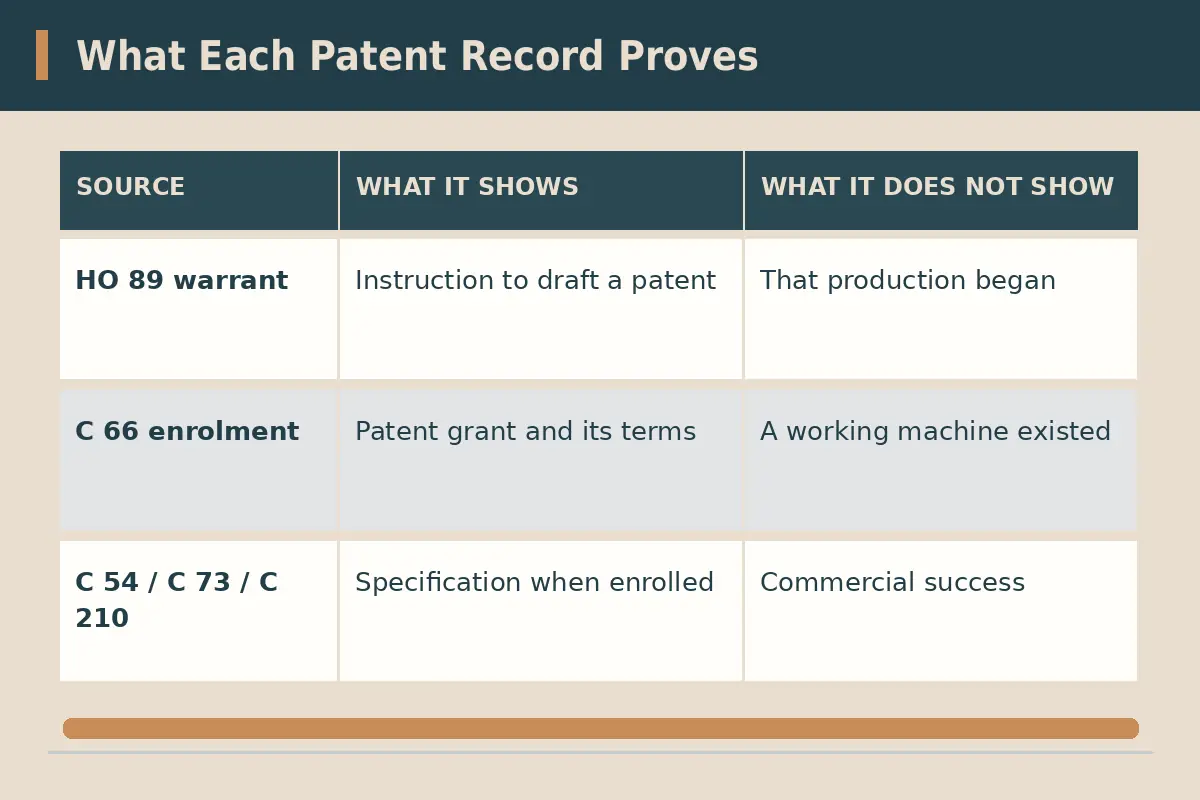
The HO 89 warrants concern instructions to law officers to draft patents of invention in 1783–1834. A warrant is a step in the granting procedure, not a working model, a technical specification, proof that goods were made, or even by itself the enrolled patent. This guide gives a precise source route, identifies what the archive can and cannot show, and names the independent documents needed before a personal or geographic conclusion becomes defensible.
Identify the Administrative Step Before Looking for a Machine
A nineteenth-century family story may say an ancestor “patented” a tool, furnace, or mechanical improvement. The first question is what original paper survives. The National Archives guide to patents of invention identifies HO 89 as warrants to law officers to draft patents during 1783–1834. Those documents belong to the administrative sequence leading toward legal protection. They are not a universal list of working prototypes. Record the exact person named, date, language describing the device, and office named on the document before assuming that every subsequent step was completed.
Separate a petitioner, an agent, a named patentee, the maker of a machine, and the person selling it. One person could fill more than one role, but the roles are not interchangeable. A warrant addressed to a legal officer might mention an invention in the prospective terms of a grant. That does not guarantee an enrolled patent, technical performance, marketability, or exclusive rights lasting to a later date. A useful initial research question is narrow: did the named applicant appear in an HO 89 warrant, and can that paper be connected to a later enrolled grant?

Use the Patent Indexes Without Confusing Their Numbers
For early English and Welsh patents, published nineteenth-century patent indexes are an important gateway. The Woodcroft indexes identify patentees, subjects and dates and assign a progressive patent number. That index number is not automatically a document shelf mark or the physical location of the original parchment roll. Write the indexed spelling, invention phrase, year and number into a retrieval log. Check whether the index entry names the same person as HO 89, accounting for initials, trading partnerships and changes in how occupations are described.
The guide notes that original records often require in-person investigation in the reading room because enrolments and specifications are stored on separate rolls. A later printed patent copy may be easier to locate at the British Library, but it is still useful to distinguish an edited or printed version from the original enrolment. Record every reference as a source-to-document trail. A failed name search does not mean no warrant exists: test period, spelling and the applicable office, and record when the catalogue describes a whole roll rather than the people named within it.
Try a fictional comparison: Henry Carter appears as a named petitioner in a warrant, while an H. Carter is listed in a printed patent index three years later. Treat this as a candidate match. Only the document language, addresses or other identifying details can connect them; sharing a surname and a broad industry does not. Log both records with their distinct dates and leave an explicit identity-status cell.
Check C 66 and the Technical Specification Separately
The enrolled letters patent are generally found among Chancery Patent Rolls in C 66. Their language can establish a grant, its named grantee, territory and stated subject, rather than every detail of a finished invention. Specifications were enrolled separately, including on Close Rolls C 54, Rolls Chapel rolls C 73 and Petty Bag Office rolls C 210. From 1734 patentees were required to provide specifications, but the timing of enrolment could be later than the grant. A later specification should not silently inherit the date of an earlier warrant.
Build a three-date comparison: HO 89 warrant, patent enrolment, and specification enrolment. If one is absent, preserve that gap. A technical drawing may explain an intended mechanism without verifying that any identical machine was built. Conversely, a surviving product advertised under an inventor’s surname does not automatically match the formula in an old specification. Compare technical details, addresses, partners and the relevant dates. The original documents can support a strong legal-history narrative, but an industrial-history narrative requires additional sources about manufacture, procurement or sale.
Keep Scotland, Ireland, and Designs on Their Own Routes
The geographical boundary matters. Scotland and Ireland had distinct patent arrangements before the mid-nineteenth-century reorganization. An English warrant or enrolment should not be asserted to cover workshops in every part of the British Isles. If the supposed invention belongs in Scotland or Ireland, establish which jurisdiction granted protection at the relevant time before treating HO 89 as the decisive series. The National Archives patent guide identifies separate Scottish and Irish routes and related Home Office correspondence that may be useful for cross-jurisdiction inquiries.
A registered design is not necessarily a patent for the operation of a machine. Design records can register the appearance of an object and name a proprietor who may be a retailer or manufacturer rather than the inventor. Do not turn a design number into a patent number or claim that design registration proves mechanical novelty. If a surviving object bears a registration mark, consult design registers and representations as a separate evidence pathway. Keep labels for invention, appearance, ownership of rights, actual production and the marketed product in distinct columns.

Write the Result as a Chain of Dated Claims
A source-grounded conclusion might say that HO 89 records a warrant connected with a named invention, while C 66 independently establishes whether a grant was enrolled. A separate technical specification may clarify what was described on paper. None of those findings, without additional documents, proves how many machines were manufactured or whether the invention improved a working process. State “not yet located” where there is no supported finding, rather than suggesting failure or abandonment simply because a single archive search returned no image.
Finish with one next-action table: identify the outstanding grant or specification, the precise archive reference, and the independent industrial source that could test use. A business directory, surviving advertisement, production account or contemporary exhibition report may help, but each has its own claim limits. If two people share an inventor’s surname, use business addresses and business partnerships rather than presumed kinship. Record the full citation and the relationship between records so another researcher can reproduce every link.
A useful end-of-search worksheet has separate columns for the applicant, law officer, patent grant, specification, and external evidence of manufacture. In the outcome field write “warrant located,” “grant located,” or “specification located” only when the cited record warrants it. This prevents an attractive family story from being upgraded to a proven factory history without evidence.
More Records and Archives Guides
How We Research This Archive Series
This guide starts with the official description in The National Archives’ research guidance, not a claim that we have inspected a particular person’s private file or a specific original piece. The archival statements here concern the series or research method. A hypothetical example is labelled as such; it is not a newly discovered historical event. We use the Discovery search guidance to distinguish keyword matches from archive holdings and document contents, because catalogue descriptions do not transcribe every word of an original.
For every real candidate, record its historical place or person’s name, the creator, document type, date, full HO 89 piece or item reference, access restrictions, and the exact claim being tested. The official citation guide explains how to document those references so another researcher can retrace them. An unread document remains a catalogue lead, never proof of imagined details. If a record is missing, preserve the searched terms and dates and examine survival and alternate custodians before interpreting the gap.
Before sharing a conclusion, audit the difference between original source wording and your interpretation. Require independent evidence for any further claim about an individual, property owner, legal effect, or completed action. Respect archival access limits and living people’s privacy. This website also provides an affiliate disclosure; no paid partnership or commercial access is implied by these archival references.
No. It is a specific warrant series for 1783–1834 and is not a universal inventor register.
No. Check the corresponding enrolment, normally in C 66, before concluding that a grant was recorded.
Specifications may be in C 54, C 73 or C 210, depending on the office and date; drawings are not guaranteed.
No. A specification documents what was described. Actual making or sale requires other evidence.
Not automatically. Establish the patent jurisdiction and use its own surviving sources.