
CO 389 contains Board of Trade colonial entry books dated 1660–1803. An entry book is an administrative record of a text or action recorded by an office; it is not automatically a witness account of what happened in a North American or Caribbean colony. Start with the colony or subject, approximate date, the office that generated the entry and whether the surviving item is a copy, abstract or recorded instruction. The National Archives places CO 389 alongside CO 388 original correspondence, CO 324 Colonial Office entry books and CO 391 Board of Trade minutes. Those distinctions determine what the material can establish. For official series scope, consult The National Archives research guide.
Separate Board of Trade entry books from incoming letters
The National Archives lists CO 389 as Board of Trade entry books covering 1660–1803; CO 388 holds Board of Trade original correspondence, and CO 324 is a separate Colonial Office entry-book series. These are distinct bodies of material, even when they discuss the same dispute or colony. A copied order may have been recorded for institutional memory, while the original despatch and local reply survived elsewhere. Do not replace an entry-book citation with the reference of a nearby outgoing letter simply because their texts look similar in a published calendar.
Begin by describing the document’s voice: who wrote or approved the words, to whom were they addressed and who later copied them? A copied despatch should be cited as a copy unless an original has been examined. A secretary’s summary can omit enclosures and names, particularly those of ordinary residents. When the research question concerns an individual migrant, indigenous community, enslaved person or local official, a Board entry may establish administrative attention rather than direct evidence of that person’s location or actions.

Use colony and date as the search anchors
An entry book is often easier to approach by jurisdiction, office and date than by an exact modern surname. The relevant colony might be recorded under an older name or grouped administratively with another territory. A single person might be named under a title rather than a family name, and a colonial complaint could be addressed to the Board from London rather than its place of origin. Record the historical colony and corresponding modern geography separately, and preserve contemporary place spellings in the citation.
The guide to American and West Indian colonies before 1782 recommends starting with the Colonial State Papers where appropriate, then using catalogue references to reach original records. A keyword result is useful only within the description detail it exposes. A blank name search does not prove the clerk omitted the person. Browsing by date range and entry-book topic may be required. Record both what was searched and what could not be inspected before making statements about the absence of correspondence.
Convert published calendar references to modern pieces
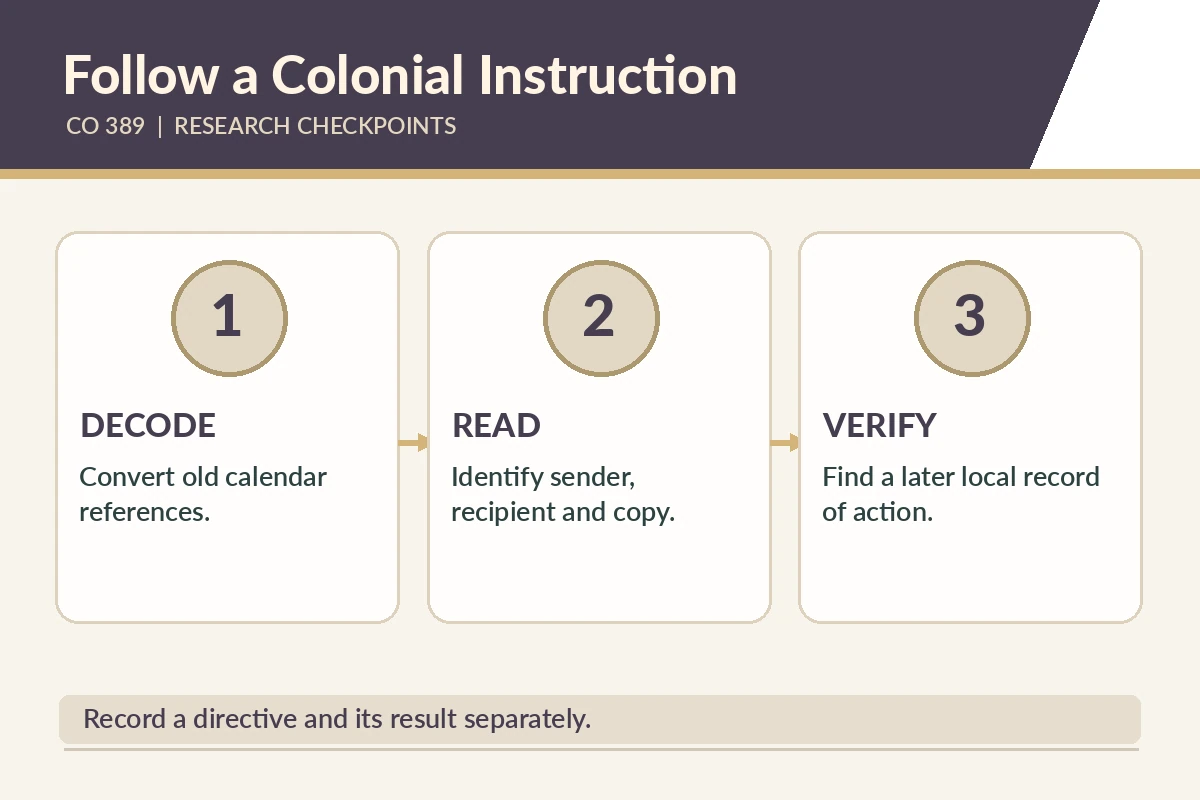
Earlier published calendars use historical archive groupings that do not always map directly onto present series labels. The National Archives has a specialized guide for translating old references from the Calendar of State Papers Colonial, America and the West Indies, 1573–1739. A reference to ‘Board of Trade’ in that calendar requires attention to its specific subseries and page or volume. It does not imply that every Board-related text belongs in CO 389; the key distinguishes entry books, original correspondence and other categories.
Keep two citation fields when using a printed calendar: the exact historical citation as printed and the modern archival reference identified through the conversion key. A volume number expressed in the old finding aid is not necessarily a modern piece number. If the new reference leads to CO 5, CO 388 or another series instead of CO 389, follow the correct archival trail. The point is to identify a specific record, not force all copies onto one planned topic page.
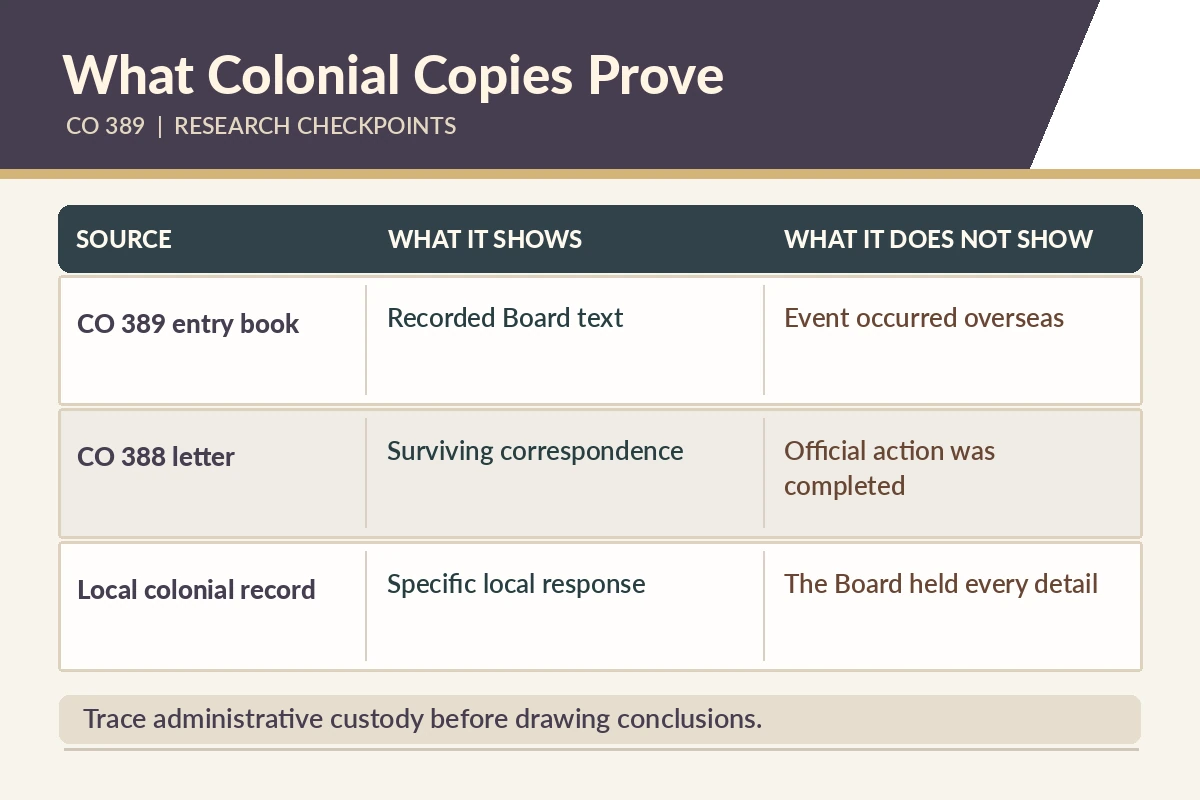
Distinguish Board recommendations from colonial implementation
An office might recommend a change in trade rules, ask a governor for information, approve a draft instruction or transmit a decision. These are different stages. A copied Board text can prove that particular words were recorded in London, but it does not prove the receiving colonial authority carried out the order, that a settlement was founded or that a petitioner received relief. Local assembly journals, council minutes, land records, court proceedings and further replies may be necessary to test what happened next.
Suppose an entry calls for an investigation of a land dispute. It is not evidence that the investigator reached the disputed property or that the claimants’ title was confirmed. Look for the governor’s subsequent despatch, colonial law, commission’s report and independent records from the locality. Colonial documents often reflect the perspective and legal categories of an imperial administration, and may omit or distort indigenous and enslaved people’s experiences. Attribute assertions to their authors rather than repeating biased labels as proven facts.
Read copies and minutes as different layers
The Board of Trade’s recorded meeting business also survives in CO 391. Minutes can help establish that a matter was discussed, while entry books preserve copies or recorded forms of communications. Original incoming material may fall in CO 388, and secretary-of-state correspondence in other CO series. These are complementary but not interchangeable sources. A minute authorizing a letter and the text of a later outgoing order should be linked only when date, subject, recipient and references support that relationship.
A modern catalogue can provide the office, piece and date range but may not reproduce the relevant text. If the original cannot be viewed remotely, describe the finding aid honestly rather than treating its general title as evidence of a named decision. The right scholarly conclusion may be that records of the Board’s attention exist for a particular issue; further reading must determine whether they contain an operative instruction or an opinion. This is especially important in family-history articles built from one search result.
Create a colony-to-original evidence map
In the research ledger enter original calendar citation, modern CO reference, type of book or letter, authoring body, destination, date of copy and date of any separate event. Add a column indicating whether you have consulted the text, a calendar summary or only the catalogue description. This prevents later readers from assuming that a modern translated paragraph is verbatim from a seventeenth-century clerk. Use a separate link for any local source documenting execution or residence.
Before publishing, verify that the colonial jurisdiction matches the period and that the Board of Trade existed in its contemporary administrative form. Search for competing or contrary communications rather than selecting only the document supporting a family tradition. A copied text may be valuable precisely because it reveals what London officials believed or ordered, while providing limited knowledge of circumstances on the ground. Make that limited but rigorous finding the article’s conclusion.
More Place and Jurisdiction Guides
How We Research CO 389 Records
We use the National Archives’ colonial research guide to place CO 389 among the relevant administrative series. We then decode older Calendar of State Papers references through the official conversion guide rather than guessing a modern piece number. We distinguish copied text, Board minute, received correspondence and locally implemented action, recording the provenance and colonial jurisdiction for each. Our affiliate disclosure describes our external links.
The National Archives lists Board of Trade entry books in CO 389 for 1660–1803.
No. Both concern entry books, but they are different series and administrative custodians.
No. Look for subsequent correspondence or local colonial records of action.
Use the official conversion guide to identify the matching modern CO piece first.
CO 388 contains Board original correspondence; CO 391 contains Board minutes.