
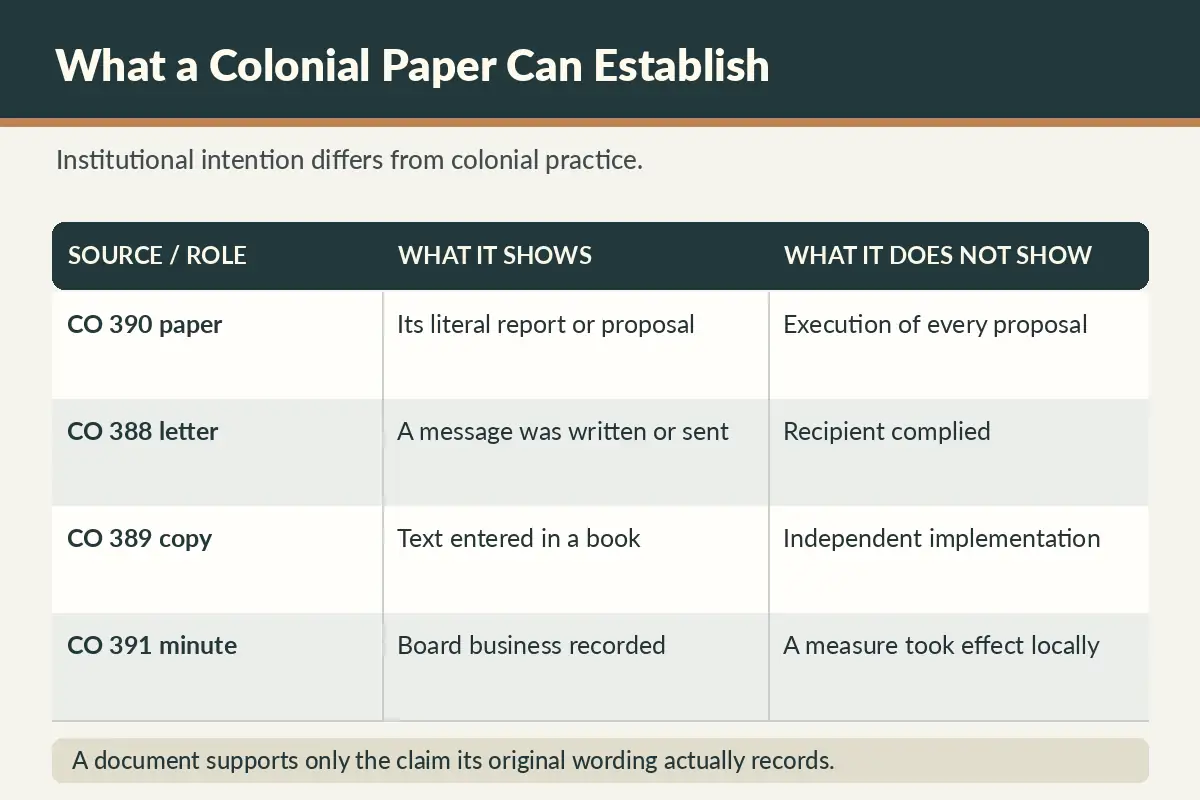
CO 390 is The National Archives’ series for Board of Trade miscellaneous material, dated 1654–1799 in the official guide to British America and the West Indies. “Miscellaneous” is a warning to inspect the item description, not permission to assume each paper is a governor’s original letter or an enacted policy. The most useful search begins with place, document type, date and administrative role, then compares CO 390 with correspondence in CO 388, entry books in CO 389 or minutes in CO 391 as the question requires.
Classify the Paper Before Reading It as an Order
A historical repository can group unrelated administrative forms under a single series. The National Archives lists CO 390 alongside Board of Trade correspondence, entry books and minutes; those neighboring series have distinct functions. A memorandum describing a proposal, a draft instruction, a copied petition and an official minute are not interchangeable witnesses to an executed decision. First record how the catalogue titles the actual piece.
Begin with a colonial place and a fixed historical period. A territory might appear under a colony’s contemporary jurisdiction, a wider West Indian heading or the Board’s general business. Keep both historical and modern place names in your search notebook, but do not assume that a colonial administrative label implies modern citizenship or that one island’s records were consistently maintained under the same office throughout the period.
Capture document genre, author or maker, recipient if stated, exact date or approximate range, and whether the record is original, copy or compilation. If the item contains several papers, catalogued dates may span years. Cite the particular leaf or section carrying the relevant assertion rather than attributing an entire volume’s scope to one individual.

Map CO 390 to Correspondence and Entry Books
The National Archives’ guide identifies CO 388 as Board of Trade original correspondence and CO 389 as Board of Trade entry books. These are alternatives or complementary records, not automatic stages of one paperwork route. If a CO 390 paper summarizes someone’s letter, seek the original correspondence when the question turns on exact wording or authorship.
If a copied decision or instruction appears in an entry book, ask when it was entered and who received the direction. The date of an entry can differ from the date of a reported event or an earlier draft. A copy may faithfully preserve a document that no longer survives, but its existence does not independently establish that the recipient complied with its terms.
Make a one-page comparison with columns for paper type, source reference, literal action recorded and unanswered outcome. For example, a proposal for a harbor survey in miscellanea might need a separate survey plan or expenditure record to prove work was done. A recommendation to grant land must be compared with the actual grant and later local tenure rather than reported as established ownership.
Treat Colonial Calendars as Finding Aids
The Calendar of State Papers, Colonial provides chronological transcripts and abstracts drawn from multiple archival record groups. The National Archives explains that the published calendar can combine papers from CO 1, CO 5 and other series. A modern keyword hit therefore does not necessarily correspond to CO 390, and a calendar paragraph is not a facsimile of the document from which it was compiled.
When a calendar is relevant, record its volume, entry date, number or page, and the original reference it gives. Then compare the summary with the item in Discovery and, where possible, the manuscript. Calendars may compress introductions, omit routine enclosures or regularize place spellings. A discrepancy should trigger a check of the archival source before drawing a conclusion about an individual’s role.
Be cautious with statements about Indigenous nations, enslaved people and colonial subjects. An official report reflects the administrative perspective of the person who prepared it; the record may describe a petition, accusation or policy without recording the affected people’s own testimony. Where a claim is contested, seek locally held records and scholarship that explain the limits and bias of the surviving colonial paperwork.
Separate a Board Discussion from an Outcome
The Board of Trade discussed colonial matters, but not every discussion became a regulation or direct instruction. The National Archives lists the Board’s minutes in CO 391. Use those minutes for evidence about what was considered at a meeting; use an issued instruction or recorded act for the next administrative step, and an implementation record for activity in a colony.
A loose note in CO 390 may contain words such as “recommended,” “proposed,” or “to be considered.” Preserve those verbs, including conditions. Replacing them with “authorized” or “ordered” silently changes the level of proof. Also keep the official’s office separate from a personal identity claim; a governor, commissioner or clerk named in a document may be acting in an institutional rather than a family capacity.
If an ancestor is named as a petitioner, merchant or witness, that role is a record-specific observation. It does not establish residence, kinship or that the requested benefit was delivered. Compare the person’s occupation and locality with dated parish, court, tax, business or other independent records and explicitly identify any competing person with the same name.

Build a Place-and-Record Evidence Ledger
Use a ledger with six columns: place as written, normalized place, original reference, document type, stated claim, and independent corroboration needed. A seventeenth-century place spelling may vary even within a single file. Preserve the wording in the source column so that a modern place identification remains testable instead of being embedded into the transcription as an assumed fact.
A no-result search may reflect the wrong series rather than documentary silence. If a matter concerns a governor’s letter, look in appropriate original correspondence; if an official instruction, check entry books; if a board meeting, check minutes. The official catalog’s “held by” and piece notes matter because access conditions and digitization differ. Do not promise that every manuscript is available as a free online image.
A defensible conclusion might be: “CO 390 contains a memorandum proposing a measure affecting this port.” A stronger statement that the Board adopted the proposal requires a minute or instruction, while a claim that the colony implemented it requires local evidence. Keeping these layers apart protects both historical accuracy and genealogical interpretation.
More Place and Jurisdiction Guides
How We Research Board of Trade Miscellanea
The National Archives’ American and West Indian colonies guide provides the CO 390 date range and differentiates original correspondence, entry books and minutes. Its calendar guide explains how published abstracts bring together papers from several series. We use these sources for navigation, not as substitutes for manuscript-level verification of an event.
For every proposed colonial claim we preserve the document’s genre, author, place, date, original wording and the next administrative record to inspect. We do not infer compliance from circulation or identity from a shared surname. The colonial vocabulary is reproduced only when needed to explain what officials recorded, with a warning that historical administrative descriptions may be incomplete or biased.
Authoritative repository guidance used for this article: The National Archives: American And West Indian Colonies Before 1782. The National Archives: America West Indies Calendar State Papers Colonial 1573 1739. Confirm current piece-level access restrictions and ordering routes in Discovery before making a research visit or requesting a copy. The original record—not a search hit or a printed summary—must support every contested detail.
For our editorial and affiliate-policy statement, see the affiliate disclosure. This research plan does not require paid services; archive and document-copy costs depend on the repository and the material requested.
A Board of Trade miscellaneous-record series, listed for 1654–1799 in The National Archives guide.
No. Determine the item’s actual type, such as a memorandum, draft, report or other paper.
The guide identifies CO 388 for Board of Trade original correspondence.
No. Check a board minute, issued instruction and any local implementation evidence separately.
It is a useful edited lead, but original wording and context may require the manuscript.