
Why a Colonial Office Register Is Not the Letter
For Colonial Office correspondence dated 1820–1850, begin with the register when a keyword search for a person or event returns little. CO 326 contains working registers of incoming correspondence, recording such details as sender, date, subject and registry number. The register can tell a researcher which communication to request; it is not itself the original letter or independent verification of the event described. Write your question as “Which letter did the office receive?” before asking whether a report was accurate.
The National Archives explains that catalog descriptions of individual correspondence are often too broad for keyword-only retrieval. Different colonies and office divisions sent overlapping types of letters. A correspondent’s name, a colony, and an approximate year are therefore more valuable together than a surname alone. A register entry may be short, and its topical summary is an administrative description rather than the full wording of a petition, despatch or witness statement.
An ancestor may be mentioned in a report without having been a direct correspondent. An official report can describe local circumstances from the perspective of its author, and that perspective may be incomplete or contested. Before treating a name as an ancestral match, record the office, place, sender, received date, subject, and whether the person was writing the letter or merely mentioned in it. This protects against identifying two people from one surname.
Choose the Colony, Sender and Register Volume
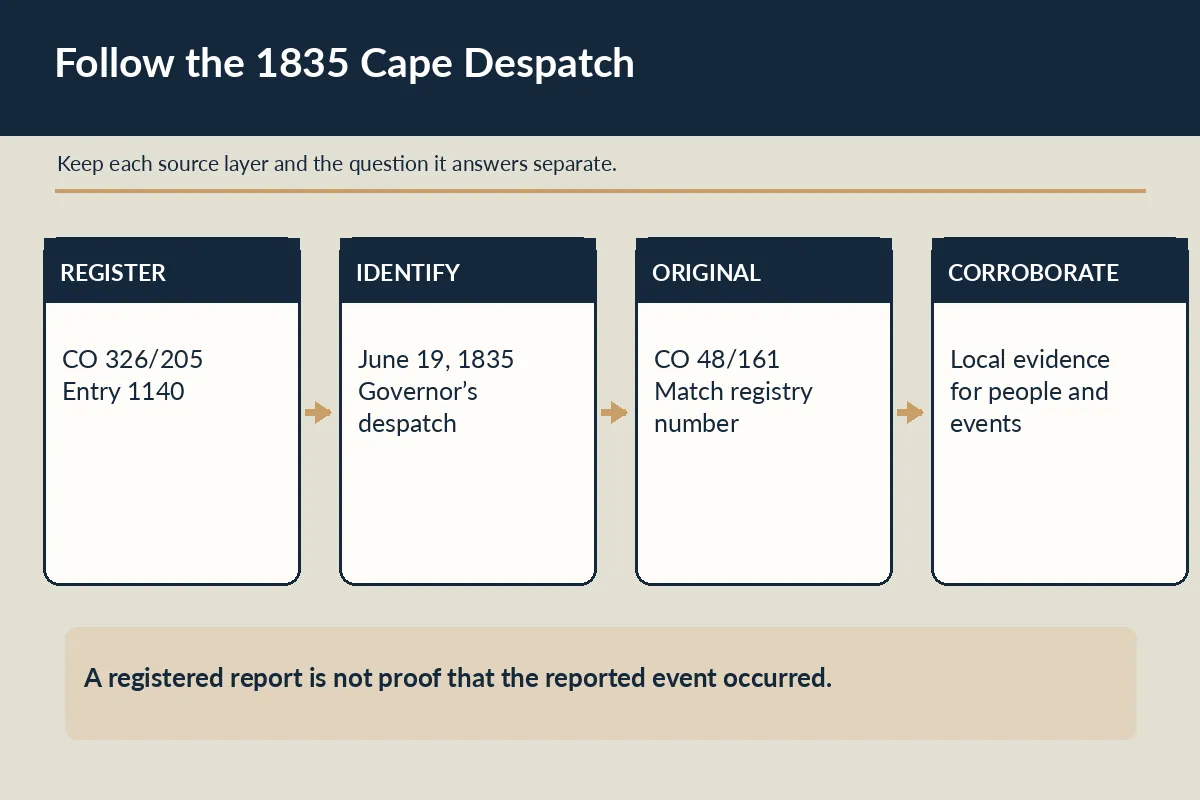
For the specific 1835 Cape of Good Hope example in the official guide, the register covering governor’s despatches is CO 326/205, while CO 326/206 concerns communications from offices and individuals. These are alternative types of incoming correspondence, not consecutive steps of the same document. First choose the historical colony and which kind of sender could plausibly have originated the communication. Next select the register volume for the date and the sender category.
The National Archives’ worked example concerns the Cape frontier and a communication sent by Governor Sir Benjamin D’Urban on June 19, 1835. The register entry is numbered 1140. Keep that number with the date and the sender because it distinguishes the specific letter from nearby dispatches. The office’s date received may differ from the date written; copy both if present, rather than converting one to the other without explanation.
Catalogue results may label a group by region, such as Africa or the West Indies, instead of the modern place name you searched. Browse CO 326 by year and reference order when the expected volume does not appear. Original contemporary spellings and administrative jurisdictions should be quoted exactly in the research log. Later political borders, renamed territories and modern country names are useful search aids, but they must not overwrite the period jurisdiction in a citation.

Convert Registry Number 1140 Into the Original Despatch
The official worked example follows registry number 1140, dated June 19, 1835, into the Cape of Good Hope original correspondence in CO 48/161. A useful crosswalk therefore reads CO 326/205 → entry 1140 → governor’s despatch dated June 19 → CO 48/161. This is a documented example, not a universal formula mapping every CO 326 item to CO 48. Other colonies have different original correspondence series.
Locate the target correspondence volume by searching the original correspondence for the same colony and date, then consider sender type. The National Archives says the despatch in the Cape example is in a volume covering the appropriate dates and stamped with the matching registry number. When reading the original, inspect endorsements, enclosures and any follow-up direction. A registered summary could omit qualifications or names that are crucial to a family-history claim.
An entry in CO 326 demonstrates that a paper was registered with the office; the surviving original reveals what the writer actually claimed. Neither one alone proves that the described incident took place exactly as stated. If a report cites a land grant, appointment, arrest or migration, seek the appropriate local administrative record, contemporary newspaper, original grant, court record or civil register before assigning that event to an individual.
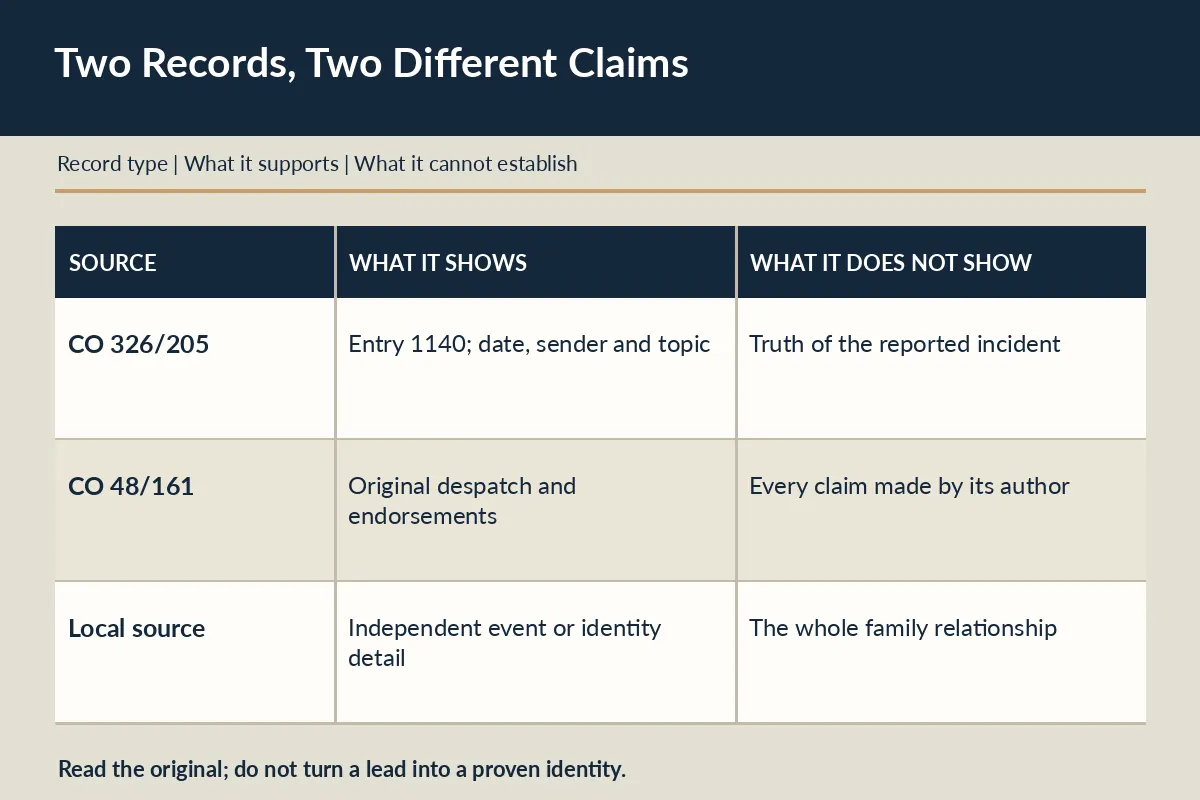
Separate a Register Index From Its Survival Gaps
An original register and a topical index serve different searches. The guide explains that indexes covering 1815–1870 group correspondence by topics, while registers arrange incoming communications by date or sender. An index may reveal a likely subject heading even if the person’s surname is absent. Conversely, an index can be incomplete or classified under an unexpected heading. A missing index entry should not be recorded as proof no letter ever existed.
If the keyword “mining” produces a lead, inspect all plausible subject labels, including a place, a department and the class of sender. A grievance might be filed under public works, police, land, immigration or miscellaneous. Keep each search attempt in a log with the exact series, phrase, years and result. Searches of the printed or digital catalog alone cannot fully test the existence of a paper whose individual description was never indexed.
If the document itself is absent, record the level of uncertainty. A register can show a letter was entered while failing to establish that every enclosure remains intact. State whether the reference was verified in the catalog, read in the register, or matched to the original piece. This three-status model avoids making absence of a modern online image into a claim that no historical correspondence survives.
Work a Careful Name and Place Evidence Test
Imagine a family story that a person named Thomas Reed was involved in a Cape frontier dispute in 1835. Treat this as a hypothetical research problem, not as an assertion about an actual colonial resident. Begin with the location and date, then retrieve the original correspondence identified through the register. Transcribe the person’s role only if the letter names him; a governor’s report about a district is not a list of everyone living in it.
Build an evidence table with columns for exact words, person or institution named, source creator, date written, date received and inference. A report mentioning a property dispute could suggest another search, but cannot establish a family relationship. Compare local deeds or court papers for occupation and land claims and use independent civil or parish records for kinship. If the same surname appears twice, do not merge identities without distinguishing evidence.
Always make the reader-facing conclusion narrower than the documents. “Governor’s despatch registered as number 1140” is a traceable observation in the example. “My ancestor participated in the events described” requires a named statement and independent identity proof. An efficient research log lists the next piece to consult and the factual question it could answer, not merely another website to browse.
More Place and Jurisdiction Guides
How We Research and Cite These Records
This guide uses the National Archives research guidance for the principal series, date ranges and retrieval workflow. The second archival guide supplies comparative context and cautions about record type or personal interpretation. We distinguish a finding aid from an original record, a dated institutional statement from an individual event, and a plausible identity from a proved one. We have not examined any particular family’s archival file or claimed that an illustrative example identifies a real ancestor.
For a reusable citation, record the institution, full series and piece number, item or folio if available, original document date, creator, database or catalog consulted and access date. Quote uncertain names exactly and keep a separate transcription of the document from your conclusion. An online summary may be narrower than the original and a register can point to a document that requires reading-room consultation; verify access options with the repository before ordering copies.
Before following a commercial research recommendation, review our affiliate disclosure. No paid partner or purchase is necessary for the reasoning in this guide. The next practical action is to test one named question against the specific original source, preserve the result whether positive or negative, and identify the independent record needed to confirm the conclusion.
No. CO 326 contains registers used to locate correspondence; the original letter is normally in the relevant colony’s original correspondence series.
The National Archives example runs from CO 326/205, entry 1140, to CO 48/161 for the June 19, 1835 despatch.
No. Many catalog descriptions lack item-level detail; period registers and indexes are still essential.
No. They can help by subject but may omit papers or use unexpected classifications.
No. It reports an official communication. Person-level residence and identity require separate local records.