
Read WO 27 as a Unit-Level Source
The National Archives classifies WO 27 as British Army inspection returns covering 1750–1912. That makes the series useful for researching a regiment’s condition, inspections and institutional context within a defined period. It does not turn the inspection of a regiment into proof that a particular ancestor belonged to it. Begin with an identified regiment or formation and a year range, then search for the relevant surviving returns rather than beginning with a common surname.
An inspection return can help place a unit in an administrative context when combined with other sources, but the category of record alone does not promise a named list of every soldier. Always inspect the actual headings and contents before reporting strength figures, staffing or station locations. The fact that a unit existed in a particular year is an institutional finding, not an individual enlistment fact.
If a family account says a soldier served with a named regiment, write that as a hypothesis. A match between the supposed unit and an inspection return provides context only after independent evidence links the person to the unit. Preserve the distinction in your notes by having separate lines for “unit documented” and “individual attached to unit.” This prevents the dramatic detail of a military return from substituting for a missing service record.
Select the Correct Series for the Question
The National Archives guide lists WO 27 inspection returns for 1750–1912, whereas WO 17 contains monthly returns for 1754–1866 and WO 73 has monthly returns for 1859–1950. These are not a single series split by an arbitrary boundary. Their dates overlap because they served different reporting functions. Choose WO 27 when inspection is the question, and the appropriate monthly series when strength or station at regular reporting intervals is the issue.
For establishment and unit organization, the same guide lists WO 24 from 1661–1846; for marching orders it identifies WO 5 for 1683–1852. These are useful comparison routes, not mandatory evidence that a named soldier marched, was inspected or remained with the regiment throughout the period. A return dated in one month should not be described as an unbroken year-long chronology.
Keep the historical spelling of the regiment, date of inspection and piece reference together. Regimental titles and numbering changed, sometimes creating apparently separate catalog results for the same historical formation. Verify the naming history from reliable military sources before merging them. The strongest unit chronology is a dated sequence with explicit gaps, not a narrative patched together by assuming every name change implies continuous deployment.

Separate Inspection Facts From Personnel Facts
When a WO 27 piece is located, record exactly which inspection, unit or command it represents. A return might provide administrative observations or a snapshot of unit status, but do not claim it contains an individual soldier until you see that name in the actual document. Even a precise station reference does not show who was present on inspection day. Soldiers could be detached, absent, sick, transferred or attached elsewhere.
The National Archives recommends muster rolls and pay lists for tracing soldiers. Its guide identifies WO 16 for the period 1878–1898 and explains that musters can document enlistment, movements and discharge when service papers are absent. Earlier periods require the appropriate muster-and-pay-list series and date. These individual-level records provide a more defensible basis for testing a soldier’s connection to the regiment than a general inspection.
Avoid equating regimental location with personal residence or an ancestor’s home. A soldier was not necessarily stationed with the main unit on each date, and later census residence may have no direct connection to a military posting. Use service number, rank, date and other particulars from musters or pension and discharge records to distinguish namesakes before linking one person to a WO 27 contextual observation.
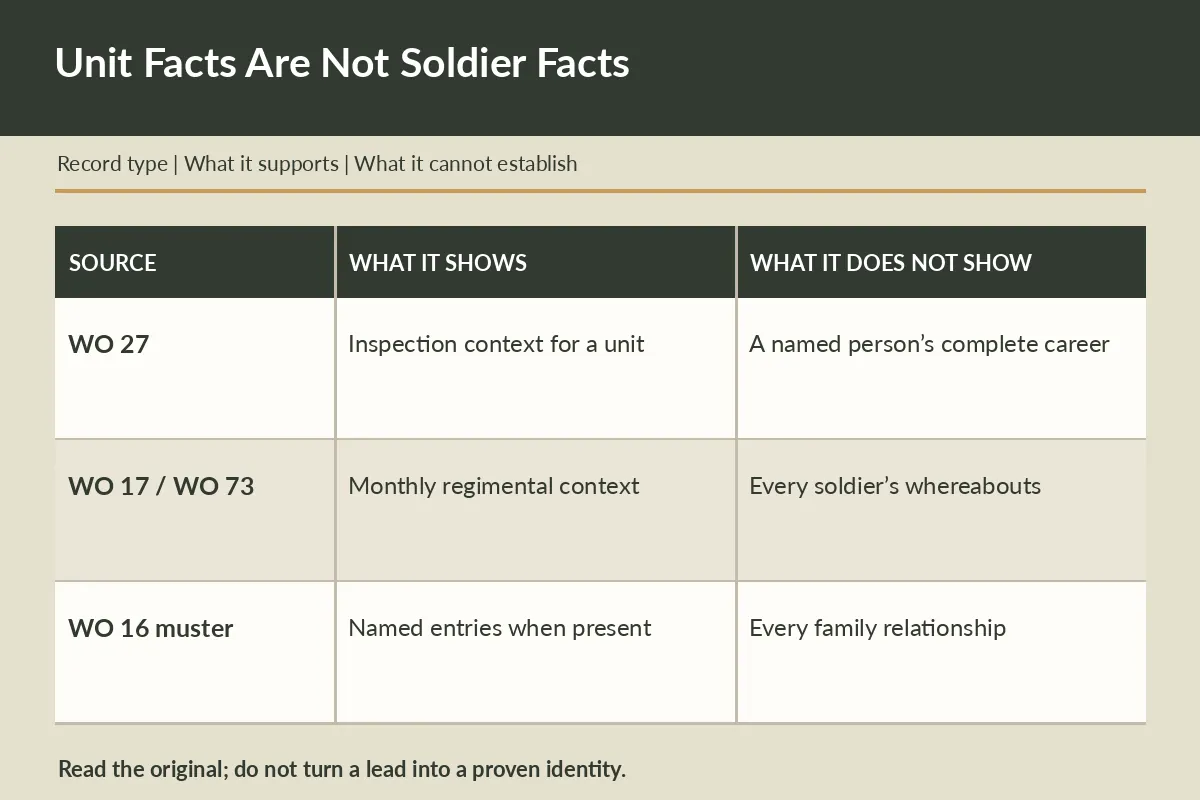
Create a Dated Unit-and-Person Comparison
Make a two-column timeline: one for the regiment, one for the person. Enter dated WO 27 inspections only in the unit column and muster or service-record references in the person column. Draw a connection only when an appropriate personal entry supports membership at the relevant time. When the two sources do not cover the same month, label the gap rather than silently assuming uninterrupted service.
A useful test scenario is a hypothetical family claim that James Carter served in a regiment inspected in 1884. First find a relevant WO 27 return. Next examine suitable WO 16 muster rolls for that regiment and period. If a James Carter appears, compare number, rank, birthplace where available, age and chronology with independent family records. The inspection can enrich the narrative only after the identity linkage survives those checks.
The same principle applies to a unit movement. A dated return or a monthly station report could describe the regiment’s position without showing that an ancestor participated in a specific battle, deployment or inspection. For event claims, consult war diaries, operational correspondence, medals and the individual’s own records appropriate to the date. Keep recorded fact, plausible inference and unproved family tradition in separate paragraphs.

Account for Coverage and Record Survival
WO 27’s published outer date span does not promise an inspection for every regiment in every year. Search within the series by historical unit name and dates, inspect the individual catalog piece and document any missing interval. Some relevant records may be grouped under a formation or command instead of a single regiment. A search result with only a generic title needs item-level inspection before it can support a claim.
When the inspection cannot be located, explore distinct record types rather than repeating the same query. WO 17 or WO 73 may provide monthly unit context for suitable years; WO 24 may supply establishment information for an earlier period. None is guaranteed to be an exact substitute for an inspection report. Record why each series is appropriate and whether it represents the unit, its administrators or its soldiers.
Prepare a concluding research note with a full citation, exact inspection date, unit title, observed information and a sentence describing what remains unknown about the person. If no personal link was found, say so plainly. A well-sourced absence of a particular name from one selected record is not a claim that the person never served in the Army. Different record types were created for different purposes.
More Records and Archives Guides
How We Research and Cite These Records
This guide uses the National Archives research guidance for the principal series, date ranges and retrieval workflow. The second archival guide supplies comparative context and cautions about record type or personal interpretation. We distinguish a finding aid from an original record, a dated institutional statement from an individual event, and a plausible identity from a proved one. We have not examined any particular family’s archival file or claimed that an illustrative example identifies a real ancestor.
For a reusable citation, record the institution, full series and piece number, item or folio if available, original document date, creator, database or catalog consulted and access date. Quote uncertain names exactly and keep a separate transcription of the document from your conclusion. An online summary may be narrower than the original and a register can point to a document that requires reading-room consultation; verify access options with the repository before ordering copies.
Before following a commercial research recommendation, review our affiliate disclosure. No paid partner or purchase is necessary for the reasoning in this guide. The next practical action is to test one named question against the specific original source, preserve the result whether positive or negative, and identify the independent record needed to confirm the conclusion.
The National Archives identifies WO 27 inspection returns for 1750–1912; individual piece coverage must still be checked.
No. They primarily support research into units and inspection context, not a named soldier’s full career.
WO 27 comprises inspection returns; WO 17 contains monthly unit returns for 1754–1866.
Use appropriate individual-level muster and pay-list material, including WO 16 for 1878–1898, alongside other identity evidence.
No. Establish the person’s attachment and relevant dates in an independent individual source.