
A colonial photograph can be a remarkable clue to a place, but its caption is not a deed, census or reliable list of everyone shown. CO 1069 contains visual works collected under British government administrations overseas. Researchers should identify the underlying album and object, inspect any caption’s historical origin, and compare the place with independent local evidence before making family claims. The most productive first question concerns a scene’s provenance rather than a guessed ancestor.
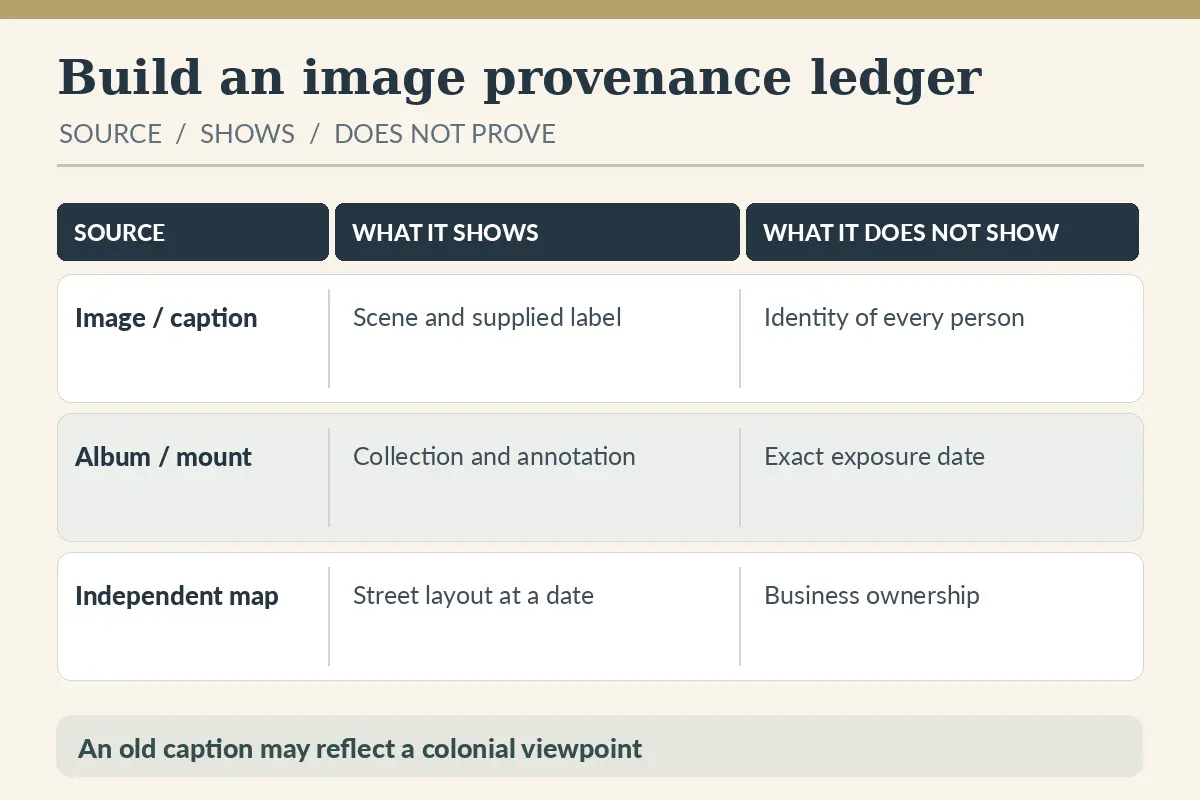
Treat the image as an object with layers: original exposure or artwork, later print, collector’s album, handwritten caption, archive catalogue and modern online reproduction. These layers are often created at different times by different people. A careful evidence table records each separately and flags any uncertainty. With that foundation, the photograph can illuminate a neighborhood or building without falsely attributing a business, property or residence to a person.
What the CO 1069 Collection Can Show
CO 1069 is a major collection of photographs and related visual material accumulated by the Colonial Office and successor departments. It includes views of buildings, landscapes, ports, events and sometimes people in former British territories. The photographs were gathered for official purposes across a long span; collection custody does not prove that a British government photographer exposed the original plate. A descriptive caption may reflect a colonial administrator’s viewpoint rather than the vocabulary local residents used.
For family and place history, CO 1069 is often more useful for reconstructing a streetscape than for proving a named ancestor’s presence. A photograph of a railway station can demonstrate a visible building at the moment represented by the image, but it cannot tell you who worked every shift or lived nearby. Begin with an exact locality or building name, not with the assumption that a particular person appears in the scene.

Search by Geography, Album and Reference
The National Archives photographic guide recommends searching its catalogue using subject, place, date and collection reference. With CO 1069, try historic place-name spellings and administrative names, then examine the full item and album description. Keep the recorded reference, for example CO 1069 followed by the particular piece number, not merely a link copied from an image-sharing site. An album may contain several related views taken at different times.
A useful place ledger has fields for modern name, historical place label, colony or territory at the date, album heading, individual photo caption, series and piece reference, and date attributed. Do not silently modernize a colonial caption in your transcription. Instead, quote it where necessary, explain its provenance and add a clearly labelled modern geographic identification supported by contemporary local records. The act of renaming a place is itself a historical question.
Distinguish Image Date from Collection Date
A catalogue’s broad series dates describe a body of records, not the moment each photograph was taken. A print might be mounted or copied decades after the original exposure. Likewise, a later label on an album is not necessarily written by the photographer. On the original, look for physical clues such as a mount, printed title, manuscript annotation and numbering. Enter “undated” when the evidence does not justify a precise year.
Check whether a print is a later reproduction of an older drawing or photograph. If the object is a painting or an artistic view rather than a camera image, label it accordingly. The National Archives specifically notes that CO 1069 encompasses photographic and other visual works. Distinguish an official filing date from a photographer attribution, and flag interpretations inferred from architecture or clothing as provisional rather than hard dates.
Use a Cross-Archive Provenance Test
Some CO 1069 albums were copied by heritage repositories outside the United Kingdom. The Hong Kong Government Records Service, for example, describes selected photographic albums reproduced from CO 1069, including views of Hong Kong over a broad period. A local digital copy can help viewing, but the copy’s accession number and the UK original reference are separate identifiers. Preserve both rather than replacing the archival citation with a thumbnail URL.
To identify a street or building, seek a dated map, directory, municipal file or contemporary newspaper photograph that independently locates it. Matching a distinctive tower or shoreline is a useful hypothesis, but one similar-looking façade is weak proof. A local archive may supply the building’s earlier name; the photographic record tells you what appears, not who owned the land under it. Ownership, occupancy and image subject are different claims.
Example: An Album View of a Harbor
Imagine a family story about a shop beside a nineteenth-century colonial waterfront. An album caption describes a port district, and a building in the image seems familiar. Before claiming it is the family shop, record which buildings are actually labelled and whether the picture’s date is specific or approximate. Then compare an independently dated city plan with the horizon, street alignment and neighboring structures. If the shop has no visible sign, the photograph may establish only the general setting.
Suppose a later family memoir calls the same road by a different name. Keep two place-name columns with their source dates. If the alignment is secure but the business cannot be distinguished, describe the photograph as contextual evidence, not as an ancestor portrait or proof of residence. Sensitivity is also important: colonial images often carry imposed classifications of people and communities that should be recognized as historical descriptions, not repeated as unqualified modern facts.

More Place and Jurisdiction Guides
How We Research Colonial Images
We begin with the original catalogue’s hierarchy, then inspect album context and captions before searching secondary reposts. We record who made the assertion about a location or identity: photographer, collector, later archivist or modern researcher. We separate visual observation from identification and place a question mark beside every unsupported personal name. When a repository supplies a digital surrogate, we cite the underlying original and the surrogate repository distinctly.
The foundation is the National Archives research guide on photographs. For a cross-repository example we also consult the Hong Kong Government Records Service album description. Every place conclusion is accompanied by its map or comparable second source, not by the image alone.
Editorial disclosure: Our reference links point to archival catalogues and research guidance, not paid endorsements. Read our affiliate disclosure. When a third-party scan requires a subscription or an archive record requires a copy order, check the access terms before paying; a search snippet alone is not the original document.
No. The collection also includes other artistic or visual works; check the object type.
No. Check who wrote it, when, and whether independent evidence identifies the person.
Not automatically. Album, mount, copy and exposure dates can differ.
It identifies the archival source even when the image is viewed through a different online copy.
It can establish visual context, but residence needs person-specific records.