
Recognize the RG 27 PH Rehabilitation Albums
The National Archives still-picture guide describes RG 27 PH as photographic prints, some arranged in albums, showing rehabilitation of weather stations in the Philippine Islands from 1947 through 1950. These pictures are valuable evidence about the physical rebuilding of a meteorological network after World War II. They are not a complete personnel roster and do not establish that an illustrated station transmitted regular observations on the day a picture was made. Begin by identifying the precise site, any original station name and the individual print number before using a picture to support an operational history.
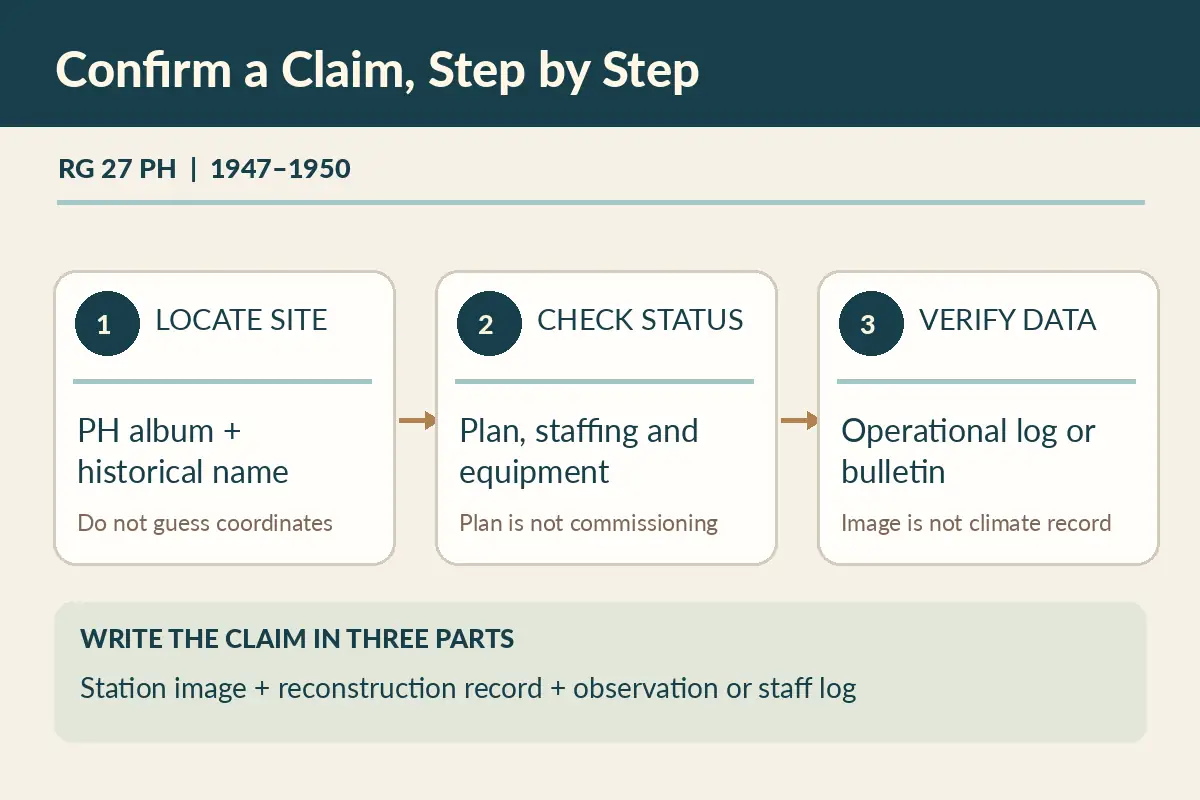
Create a station-first ledger. For each image, copy the original caption, series identifier, location, apparent equipment, physical condition and stated date. Preserve historical spelling and distinguish island, province, municipality and station. Place names may have changed, and some captions may describe a nearby district rather than an exact building location. Modern coordinates should be recorded as a separate interpretation, never smuggled into a historical caption. The photograph can show an instrument mast or repair crew, but a caption naming a station must be opened to verify which station appears.
The series dates 1947–1950 relate to a specific rebuilding project. They do not describe every earlier Filipino or American meteorological operation and are not equivalent to all Weather Bureau photographs in RG 27. Another GenHis topic treats 1939 cloud sequences from Charleston, South Carolina; here the research unit is a postwar Philippine station and its transition to service. Search the PH designation first to avoid receiving unrelated pictures of clouds, U.S. observation towers or other atmospheric events cataloged in the larger record group.

Separate Station Buildings From Operational Weather Service
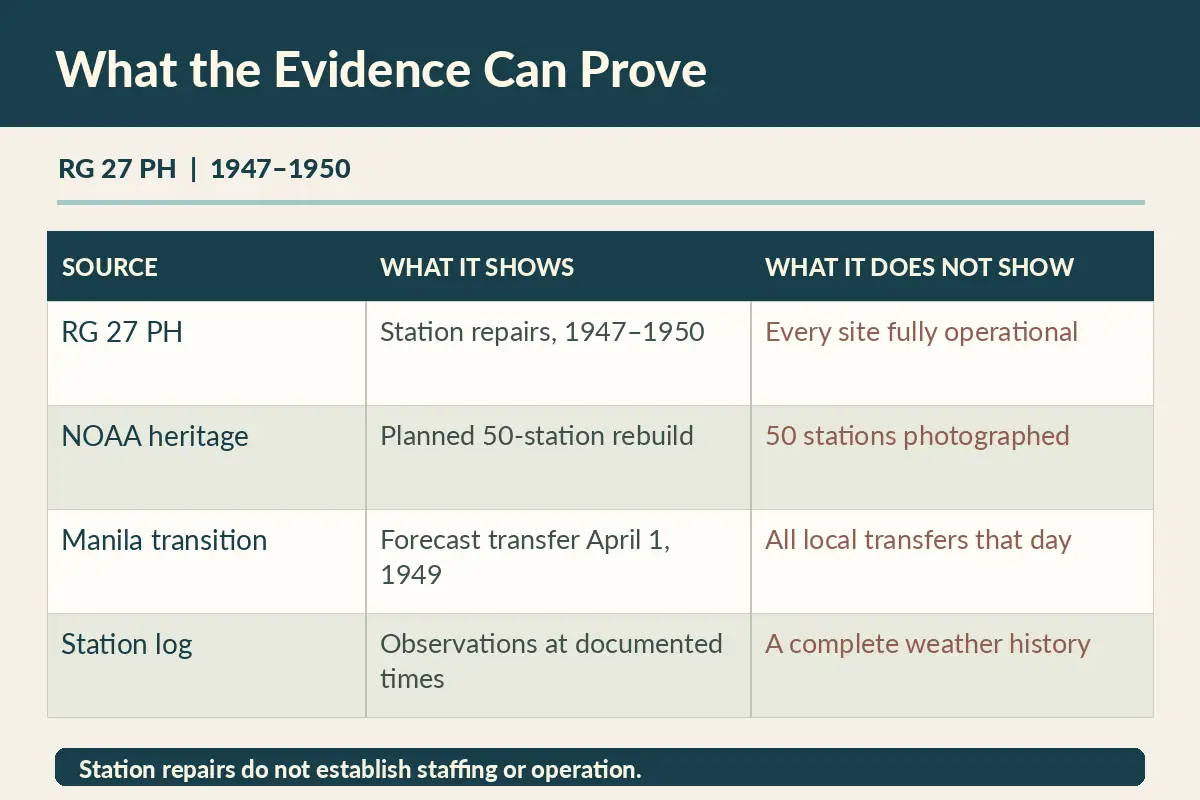
NOAA’s National Weather Service heritage account describes plans to establish a 50-station network and to train local observers. This planned number is important context, not proof that exactly 50 stations were photographed or simultaneously operating. A location in a planning list may have received a survey, equipment, training or a later upgrade at different times. In your station ledger, make separate columns for “planned,” “pictured,” “equipped,” “staffed” and “operational,” filling a status only when a dated source actually confirms it.
The rebuilding campaign involved training as well as construction. NOAA describes an observers’ school in Manila and a program through which selected personnel trained on the U.S. mainland. A photograph of a group by instruments may show students, visiting officials or workers, but does not assign their professional credentials. Search a dated class list, official correspondence or institutional staff register before naming an observer. If a caption names one individual, do not extend that identification to everyone in the frame. Training authorization is likewise not proof of course completion for a particular person.
A critical administrative anchor is April 1, 1949. NOAA states that forecasting work at the Manila forecast center transferred back to the Philippine Weather Bureau on that date and that the remaining U.S. Weather Bureau role became advisory. This does not date every photograph to April 1949, nor does it imply that every remote station changed hands on exactly the same day. Record the difference between a national operational transition and site-specific equipment delivery, commissioning or staffing evidence.
Verify Personnel and Place Names With Dated Records
Examine the image carefully for the kind of work shown. A roof or louver repair, installation of a wind instrument, building painting and replacement of observing equipment are different stages. Use a descriptive caption such as “workers repairing the roof of a station building” when that is directly visible. Do not upgrade it to “station reopened” without a documented reopening date. A completed-looking exterior may conceal missing telegraph links, power, spare parts or trained observers. A later photograph of the same compound may show another project phase rather than the outcome of the first.
Maps can help when two stations have similar names. Start with the island and province in the official caption and compare it with period weather-station directories, administrative maps and local topography. Do not infer an exact site from a nearby modern airport if the station historically occupied a different location. The weather service network and municipal boundaries may have changed substantially. When an original site cannot be resolved, retain a region-level location and a list of alternatives, with the reasoning behind each candidate.
For a climate-data claim, a station photograph is only the beginning. Evidence that an instrument existed does not establish the continuous survival, quality or completeness of its observations. Search dated observation logs, monthly weather summaries, station history forms and instrument calibration notes where such records are available. If the question involves an extreme weather event, compare contemporary bulletins and observations from more than one location. A rebuilt enclosure is physical infrastructure; a validated temperature or rainfall series is a different archival product.
Build a Reproducible Station History
Where family history is involved, resist attaching employment to an unnamed worker in a photograph. A relative may remember service in meteorology, or a family letter may mention Manila. Seek an appointment paper, payroll entry, training list or other person-level record that places the individual at the relevant station and time. If a person is named in a print caption, transcribe exactly the given role and spelling. A photograph of a building standing in a relative’s hometown does not place that relative inside it.
Keep provenance distinct. The U.S. National Archives can preserve photographs of a Philippine weather service activity without having created the Philippine institution itself. Custody, photographer, supervising office and local station operator may differ. Record who made the photograph when an item label identifies the maker, and who later assembled the album when that is documented. Album order is sometimes topical rather than chronological. Do not claim a construction sequence simply because pages appear in a convenient before-and-after order.
For an archival inquiry, supply RG 27, PH, the place name, 1947–1950 range and any item number or original album reference. Ask whether the caption, verso, or adjacent pages provide a precise date or staff name. Digitization cannot be assumed from a series-level description, and printed reproductions may have cropped equipment or annotations. Keep an unchanged reference image and separate annotated comparison images. Verify publication conditions rather than assuming every print can be freely reused under one rule.
A good final account distinguishes “pictured in RG 27 PH,” “listed in a reconstruction plan,” “documented as staffed” and “operational as of a stated date.” Link those statements to their separate official records. A caption can truthfully say, “Rehabilitation at a Philippine weather station, RG 27 PH, collection dated 1947–1950; station staff and operational status not established by this photograph.” This phrasing preserves the history of rebuilding while avoiding a false personnel identification or an unearned claim that a photographed repair finished the national network.
More Place and Jurisdiction Guides
How We Research This Evidence
We started with the exact National Archives record-group guide and verified the series code, format, described quantity and date span. We compared its historical framing with an official contextual source and a second archival or institutional reference. NARA’s still-picture reference instructions explain why the complete local identifier matters. A general archival guide does not establish that every item is digitized, individually named or correctly dated in a third-party reproduction. For every claim, we separate observable content, original archival wording and independent documentation. The historical and source review was completed November 15, 2026. No sponsored route or unverified product recommendation is implied; see our affiliate disclosure.
NARA describes photographs and albums of rehabilitation of Philippine weather stations, 1947–1950.
It is a photographic grouping, not a personnel register. Seek named staffing records separately.
NOAA describes a planned 50-station network; do not treat the plan as proof of each station’s status.
NOAA dates the transfer of Manila forecasting responsibilities back to the Philippine Weather Bureau to that day.
No. Check original meteorological observations, logs and instrument records.