
Start With the Station and Its Date, Not a Familiar Building
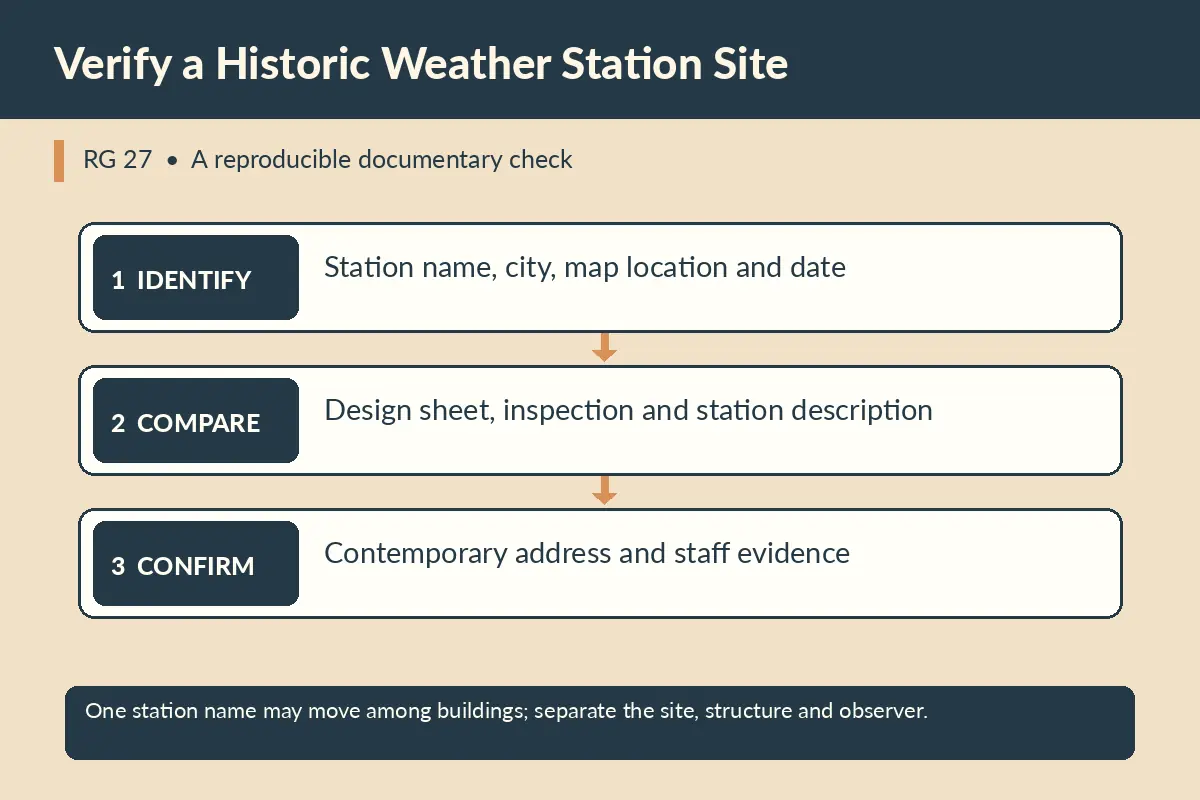
Record Group 27 preserves federal Weather Bureau and related meteorological records. The NARA guide identifies 280 architectural and engineering plans of Weather Bureau station buildings for 1894–1896. These are a valuable lead for architectural and neighborhood research, but their existence is not proof that any individual design was built in precisely the form drawn. Begin by identifying the station name, municipality, possible street address, date of interest and creating office. Names and locations may change during a station’s working life.
The same guide lists station inspection reports for 1871–1930 and descriptions of weather stations for 1883–1904 in section 27.5.2. Those administrative series serve a different purpose from plans. An inspection is anchored to a particular reporting event; a station description may indicate location or equipment at the time it was compiled. A building plan records an intended or documented physical arrangement according to the sheet’s own title and revisions. Treat the three as independent evidence categories.
A useful question is whether a weather service occupied a particular building in a specific year. That is not the same as identifying a meteorological observer, proving a construction completion date or interpreting historical climate readings. NWS’s history of its Key West station demonstrates a practical caution: observations may follow the station name across multiple buildings. The identity of an office cannot therefore be reduced to a single photographed facade or a modern address.

Route to Plans, Inspections and Station Descriptions
Choose the architectural series when the question concerns the drawn arrangement of a station building in the 1894–1896 plan set. Request the record group, building or place identifier, individual drawing title, sheet number if available and all visible dates. Look for floor plans, elevations, site indications and annotations, without assuming every sheet contains all of those features. A revision can be a later response to construction or operational needs, not necessarily part of the first design.
Choose inspection reports when the question concerns the state of the station at a documented visit within the 1871–1930 span listed by NARA. An inspector could describe deficiencies, apparatus or maintenance, if such observations are present in the particular report. Do not substitute an inspection date for the day a structure opened. Nor does one report establish uninterrupted occupation over decades; station moves, repairs and administrative reorganizations require a dated series of sources.
Choose the 1883–1904 station descriptions when researching the locality or identity of the site. Also check the NARA-listed annual reports of stations for 1888–1896 and personnel rosters or directories for their stated periods where needed. A description might help distinguish two same-named stations or identify a changing street context. Its level of detail must be judged from the actual page. A catalog paragraph describing the class does not guarantee an individual building’s address will be recorded.

Read Drawing Dates and Physical Features Critically
Inspect the original drawing title, scale, plan orientation, architectural features and any explicit status label. Words such as proposed, approved, altered or existing change what may be inferred. Enter every date in its own column: creation of the plan, revised drawing, inspection, and independently dated use of the site. A drawing created in 1895 does not by itself establish that brickwork existed in 1895. Likewise, a later photograph of a similar structure cannot safely prove the original design was executed.
Compare the dimensions and orientation against maps of the period. A window position or roof shape may help recognize a surviving building, but similar government designs can be reused and altered. Record mismatches rather than smoothing them away. A station might have used leased rooms before moving into a purpose-built office; the local NWS Key West chronology offers a concrete example of successive observing sites. Keep the administrative continuity of observations separate from physical continuity of structures.
If a plan is in NARA’s Cartographic holdings, follow the repository guidance for record group, series and individual file notation. The online National Archives Catalog often does not describe each large drawing separately. Make the request with the fullest available location and series information, and say whether you viewed a high-resolution image, a reading-room copy or only the inventory. It is misleading to illustrate a specific station with a generic period drawing and label it an original archival scan.
Prove Personnel and Observations With Separate Records
A station’s presence does not establish that a named ancestor worked there. RG 27 includes staff rosters and directories in administrative records for 1901–1960, and earlier Signal Office rosters and personnel material elsewhere in the record group. Identify the historical agency and year before choosing a personnel source. A name in an office roster is evidence of a listed administrative association, not proof that the person staffed every daily observation or lived in the weather building.
A dated observation ledger may help establish that measurements were taken under a station name, but the person entering the reading and the individual officially responsible may differ. Check names, initials, printed headings and changes in handwriting on the actual record before making an attribution. If an observer appears in a city directory or census, compare occupation and address, but do not treat a neighboring household as conclusive simply because the station is close to that street.
Where the desired claim concerns an extreme storm, locate the appropriate weather observations, period newspapers and other dated reports rather than using the building plan as weather evidence. A site’s exposure, instrument position and relocation can matter when comparing observations from different decades. Retain the location history as a caveat. For family history, the most defensible linkage combines a person-specific employment record with a separately verified station and period.
Write a Building History That Shows Uncertainty
Prepare a site timeline with columns for the administrative station name, physical location, document date, stated source purpose and conclusion supported. Tag each entry as design, inspection, description, measured observation or personnel evidence. This enables a reader to see why a planned structure might differ from the building shown years later. If the chronology lacks a completion or opening document, leave that event unproved instead of filling the gap from the existence of an architectural plan.
Cite Record Group 27 and the specific series, drawing or report, its date, sheet or page, and the repository or image consulted. For comparison, cite the independent map or directory rather than giving only a broad archive landing page. NARA’s 27.5.2 description verifies that the relevant classes exist, not that a particular ancestor or exact street address appears in every file. The Key West history is an example of migration between station buildings, not a substitute for a different city’s original evidence.
If no station drawing appears in a catalog search, document the station name variants, date window, record class, repository and methods searched. Some drawings are accessible only through series descriptions and staff reference help. A useful final claim might be that the agency retained station building plans within 1894–1896 and that a specific inspection or directory establishes occupation of a named location at another date. State what remains unknown about approval, construction and staffing.
More House and Local History Guides
How We Research and Verify the Original Records
We reviewed the official National Archives RG 27 guide and checked section 27.5.2 for specific record classes, dates and custody. We compared the evidence limit with a second institutional source about the relevant historical context or research method. A published archival inventory supports the existence and stated scope of a class of records; it does not authenticate details of an individual item that we have not inspected.
Our recommended method separates three levels: the archive catalog or institutional guidance, the exact original document and an independent dated confirmation. Search failures are recorded with terms, jurisdiction, years and access method rather than represented as proof that an event did not happen. The site’s affiliate disclosure describes relationships; the official record links here are informational research sources, not statements of sponsorship.
No. Look for independent completion, inspection, occupancy or dated photographic evidence.
NARA lists the 280 architectural and engineering plans under section 27.5.2.
A dated inspection may describe a station condition or issue, but its contents must be checked item by item.
Yes. Official station histories document moves; identify the physical site for the year being researched.
Not without person-level evidence such as a staff roster, service record or authenticated signed report.