
Identify the Light Station Before Searching a Keeper
The National Archives groups historic lighthouse operations in Record Group 26, which includes predecessor lighthouse agencies as well as the Coast Guard. Its guide lists logbooks of lighthouses, light stations, tenders and light vessels for 1872–1944 under section 26.2.2. A logbook is a daily operational source: it may help establish what was recorded at a particular station on a particular day, but it is not automatically a list of everyone employed there.
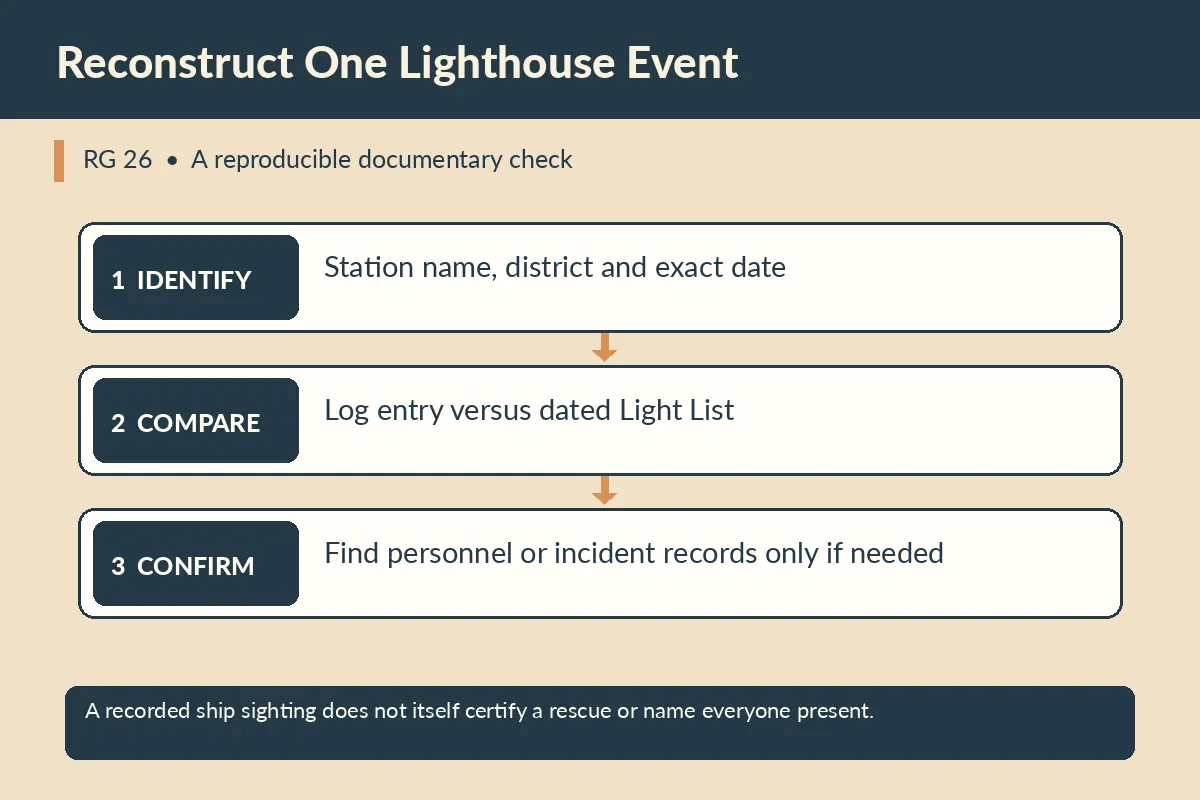
Start with the station name, state or coast, nearby waterway, and an approximate event date. Note that lighthouse station and light vessel names may be reused, renamed or confused with the district that administered them. A family account such as “grandfather was at the light during the storm” must be divided into the date, the operational event and the person’s service. The first two may be supported by a log; the last requires independent staff evidence.
Do not treat a missing online image as evidence that the log does not survive. The NARA inventory describes extensive volumes and also identifies some logs in regional facilities. Use the record-group description, station name and date span to locate the likely holding, then check access conditions and whether a digitized copy is available before claiming an exhaustive search.

Read a Daily Entry as Operations Evidence
When viewing a daily page, transcribe the calendar date exactly and separate handwritten observations from printed column labels. Weather, equipment condition, boats, visitors or passing vessels may appear in different places in different books. A blank cell is not proof of calm weather, and a brief notation should not be expanded into a narrative about a disaster unless another contemporary source establishes the event.
The guide explicitly lists logbooks of lighthouses and light vessels under one operational description, but a fixed aid and a floating station are different physical settings. Check what object generated the log before using an observation as evidence of a shoreline building. For example, a light vessel can change location; a named coastal light may have been moved, rebuilt or replaced even when its traditional name stayed the same.
If a log refers to damage or a repair, distinguish the reported malfunction, the request for work and a later inspection confirming condition. RG 26 also holds inspection, physical-condition and repair reports for 1871–1907, plus lighthouse site files beginning in 1790. These administrative sources can explain whether a planned improvement was actually accomplished. An operational remark alone is not a completed-work certificate.

Pair the Log With the Correct Light List
NARA describes record sets of Light Lists for 1838–1940 and Notices to Mariners for 1852–1941 within the same operational section. A dated Light List can identify the public navigation aid as described in an edition; it is not a minute-by-minute log of operations. A Notice to Mariners may signal a reported navigational change, but its publication and effective dates should be recorded separately rather than collapsed into a single event day.
In a useful comparison worksheet, put the logbook date next to the Light List edition and a column for later notices. Record the station’s identifying characteristics as those sources state them and flag any conflict. If a listed light characteristic differs from a journal entry, consider an equipment change, a temporary fault or a mistake before assuming one source must be fraudulent.
For local history, add a period map and, where available, RG 26 plans or photographs. NARA lists lighthouse architectural plans and specifications dating from 1805–1939. A plan documents a proposed or recorded arrangement, not necessarily the exact structure standing on the logbook date. A dated photograph may provide a better check on physical appearance, though its caption should be independently assessed.
Prove Personnel With the Separate Staff Record
A keeper’s name can be absent from a daybook even when an appointment is documented elsewhere. RG 26 section 26.2.3 describes correspondence concerning keepers and assistants for 1821–1902 and appointment and salary registers for 1801–1912. Those records should be searched for the person, place and period in question. They answer an employment question, whereas a station log asks what happened to the aid to navigation.
A matching surname at the same station is only a candidate. Check initials, appointment dates, transfers, assistant status and other records of residence. Do not assume that a spouse, child or visitor named in a private family story lived at the station because a keeper with that surname was employed there. Separate household records and local census entries may help, but each document has its own reporting date and completeness limits.
For a claimed rescue, compare a dated log entry with the Life-Saving Service records that NARA describes elsewhere in RG 26, or with a specific rescue report if one survives. The Coast Guard record group incorporates different predecessor agencies. That administrative history explains why a maritime incident may appear in a different organizational series, not why every rescuer must have belonged to the lighthouse staff.
Create a Station History Without Overclaiming
Write an evidence ledger with four columns: event claimed, exact record and page, what the record says, and another document required. One row might say a log notes rough seas; a second row may cite a published notice about an extinguished light. Avoid combining them into a single dramatic event unless dates and place identity line up. Differences deserve explicit discussion rather than silent reconciliation.
When the question is purely local history, a fully sourced operational chronology can be useful without naming a single resident. Identify the station’s successive designations, surviving logbook periods, dated equipment references and independently confirmed construction changes. If the goal is genealogy, make the personnel link a separate section with appointments and residence proof before attaching the station story to an ancestor.
A defensible final statement tells readers whether the conclusion concerns a station, a navigational aid, a named employee or an incident. Include archival reference, date range, page or image identifier and unresolved gaps. This prevents a vivid lighthouse anecdote from becoming more certain each time it is copied to a family tree or local-history page.
More House and Local History Guides
How We Research and Verify the Evidence
For this guide, we checked the National Archives record-group description for RG 26 and its specific subsection 26.2.2. We also examined the official research guidance for access and source-locating limits. The date ranges describe archival series and should not be converted into claims about every locality or individual item. Our examples are research methods, not assertions that a particular named family or property appears in the collection.
Our method separates (1) the inventory statement, (2) the particular original record when consulted, (3) the narrow claim its contents can directly support, and (4) independent confirmation. A missing search result is logged with the search terms, consulted date ranges and repository instead of being described as proof of absence. This website’s affiliate disclosure is available for transparency; the research links here do not assert a commercial relationship.
No. RG 26 operational logbooks record station or vessel activity; personnel files and registers serve a different purpose.
NARA lists logbooks for lighthouses, light stations, tenders and light vessels in 1872–1944.
Not by itself. It identifies navigation aids in a dated publication, not a complete staff attendance list.
Not necessarily. Examine the literal entry and seek incident or Life-Saving Service corroboration.
The RG 26 inventory describes geographically dispersed holdings; a record-group guide is not a promise of online images.