
The NARA guide to RG 26 identifies 800 bound drawings of lighthouse illuminating apparatus, 1839–1881, under Architectural and Engineering Plans. These historical technical illustrations can reveal what a lens, lamp, support or optical assembly was designed to do. They do not, without separate records, prove that the exact apparatus was built, delivered to a named station, operated there in a particular year, or maintained by a particular keeper. Start with the engineering object and its original drawing identifier.
To make a reliable station-history claim, use three separate sources: a drawing that identifies a design, a station or equipment document tying that design to a particular location, and a dated operational or inspection record when the claim concerns actual service. This avoids treating standardized engineering material as a unique photograph of an installed beacon. It also helps descendants of lighthouse workers distinguish the history of a station from evidence of an individual’s employment.
Read the Apparatus Drawing as a Design Document
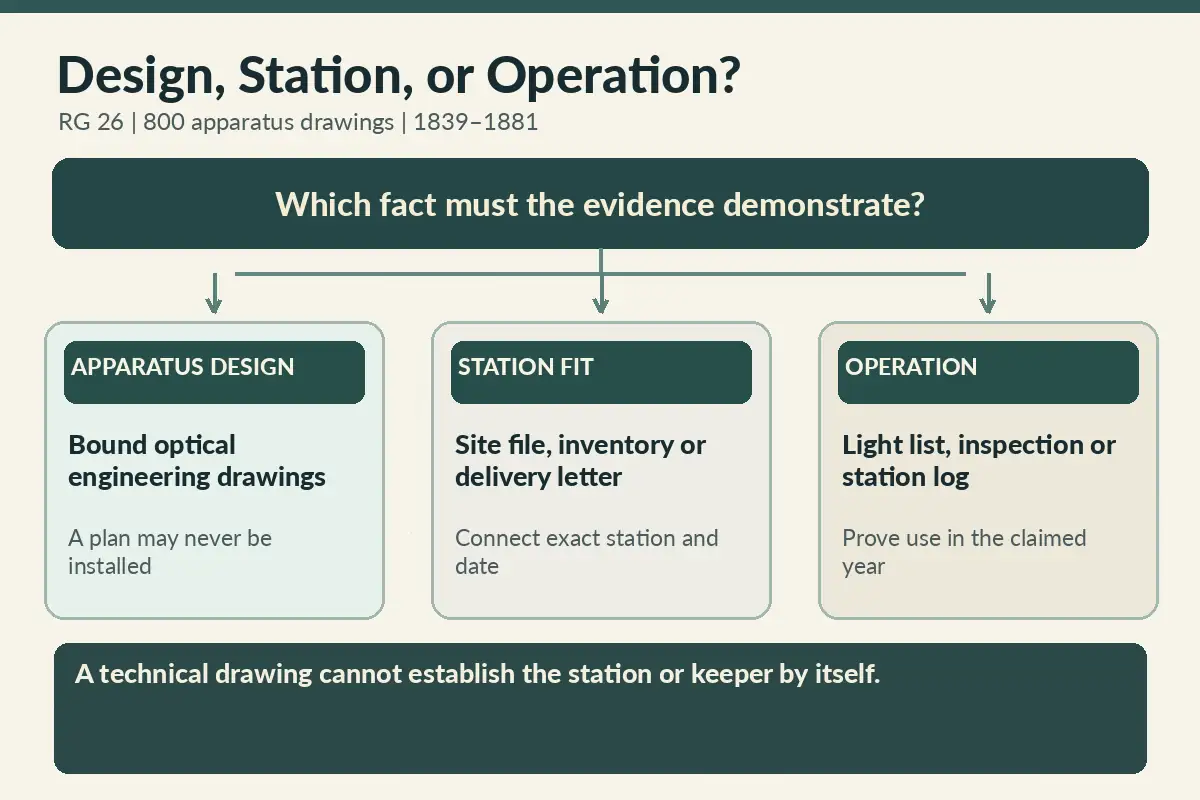
Start with the title, sheet number, scale, date, drawing number, engineering annotations and type of apparatus. Look for section views, elevations and plan views that describe different aspects of the same object. A technical plate may illustrate an intended component or general specification rather than an actual installed assembly. The RG 26 listing identifies the bound-drawing group by period, but it does not say that every one of its 800 sheets corresponds to a unique lighthouse or that all sheets show a distinct machine. Preserve the exact item designation before classifying what appears.
Separate three dates if possible: design or first issue, revision, and later reproduction or archival binding. An undated sheet stored among nineteenth-century plans may have been copied later. Read labels in their historic technical sense, and avoid upgrading a sketch of an arrangement into an approved construction order. When a diagram names a manufacturer or engineer, it may document authorship of a design; it does not by itself establish that the person worked at the site you are researching.
Determine Whether a Specific Station Used It
Next identify the station’s name and historical lighthouse district. RG 26 separately lists lighthouse site files, station descriptions, inspections and repair reports, and keeper records. Search these for an equipment inventory, contract, delivery correspondence, service report, or change of apparatus. A generic lens drawing and a station photograph can be compared visually, but visual similarity does not provide a dated installation date. Equipment may be moved, modified or replaced, and two stations may use closely related designs.
When finding aids provide a station history, put each equipment claim in a table: cited document, station, type, dated action and uncertainty. “Selected for installation,” “shipped,” “installed,” and “reported operating” are distinct actions. Look for contemporary inspection or operational records before saying a light was in service. If the paperwork documents only a request for repairs, it shows a reported condition or administrative action, not necessarily when the physical repair took place.
Use Light Lists and Inspections as Independent Checks

The RG 26 guide lists historic Light Lists and Notices to Mariners as separate publication sets as well as inspection records. Those can help establish a station’s operational characteristics for a relevant year. A notice announcing a planned change differs from an inspection stating a condition observed after work. Compare the publication date, effective date and any later correction. Be cautious when a light list summarizes a type without naming a manufacturer or explaining internal construction; do not pretend it verifies every detail of a drawing.
For a station operating across decades, construct a timeline with apparatus description, recorded character of the light, associated building alterations and cited source. The same station name can cover rebuilt structures or repositioned lights; identify the physical feature before comparing its equipment through time. If an exhibit label says an old lens came from the station, check documented accession and removal details rather than relying on its current display location as evidence of an earlier operating date.
Keep a Keeper’s Career Separate From a Lens History
The National Archives lighthouse research guide identifies keeper registers and personnel correspondence with their own chronological and alphabetical arrangements. A keeper employed at a station in 1875 may have worked with a particular apparatus, but that connection needs the station’s equipment and service dates to be tested. A drawing does not name the crew who polished a lens or lit a lamp. Moreover, a salary register or appointment notice proves a documented personnel event, not that the employee personally installed the optical equipment.
To support a family story, compare the keeper’s appointment and transfer dates, station logbooks, local residence records, and engineering timeline. If a lens arrived after the keeper transferred, do not associate that person with its operation. If service periods overlap, phrase the conclusion carefully: the keeper was assigned to the station while the apparatus was reported there, not necessarily that the person assembled, designed or individually tended the specified component on a particular night.
Create a Reproducible Engineering Citation
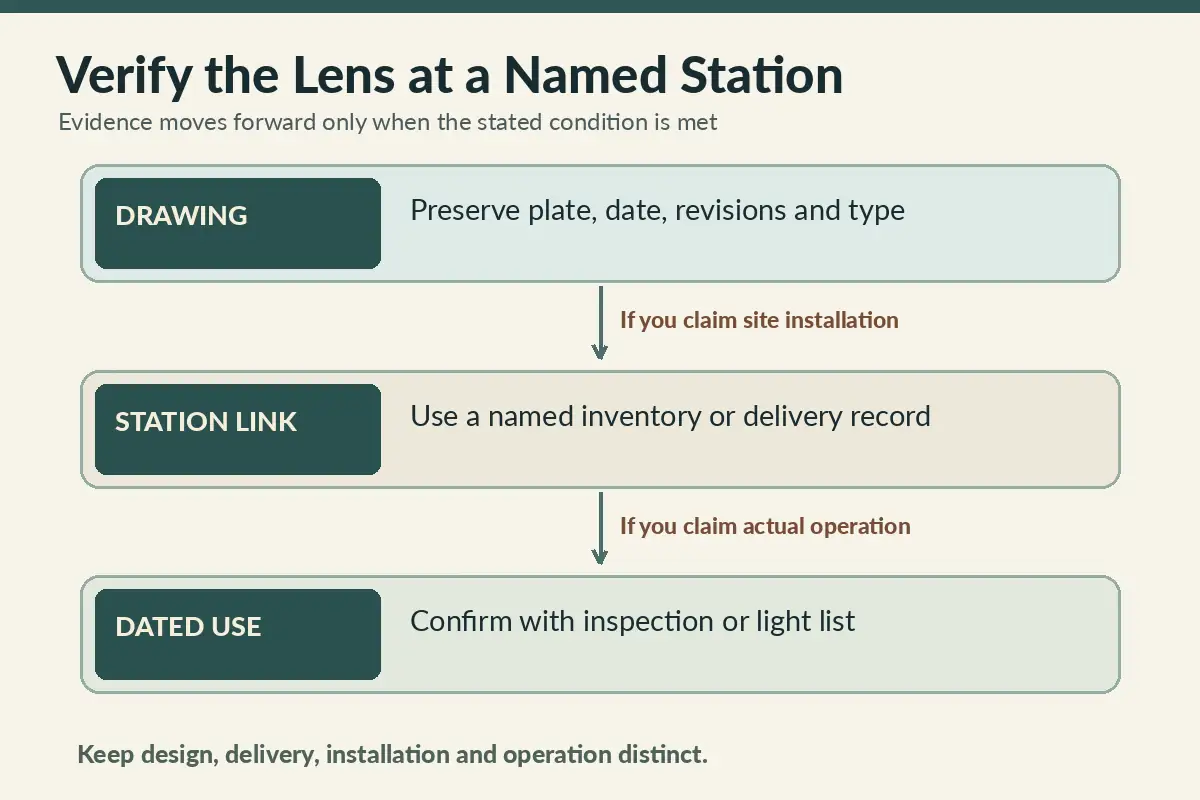
Use NARA’s Cartographic Research Room instructions to request drawings by record group, series and individual file notation. Ask the archivist whether the sheet is part of the 1839–1881 bound drawings or another lighthouse-plan series. Record dimensions, page or plate identifier, repository, title, every visible revision, and whether you saw the original, a scan, or a later reproduction. Do not claim online availability for all 800 drawings merely because the collection is described on the web.
A useful illustrated conclusion states precisely what is proved: “An RG 26 bound technical drawing depicts an illuminating apparatus design,” then names the independent station record if installation is supported. If the station match remains unresolved, present the drawing as a period example of technology. That still helps readers understand their family’s maritime setting without turning a design, order, photograph and operating log into the same record.
More House and Local History Guides
How We Research This Archive Series
We used NARA’s RG 26 engineering-plan inventory, the separate lighthouse personnel research path and Cartographic Research Room requirements. We considered drawing date, station inventory, installation and operation independent propositions. We did not infer a named keeper, construction contract or complete online digitization from a generic apparatus plate. Read our affiliate disclosure; this guide does not assume any paid relationship with the archives.
The RG 26 guide lists 800 bound drawings of lighthouse illuminating apparatus dated 1839–1881.
No. Match the design to dated station, delivery, installation or inspection records.
No. NARA describes separate personnel and appointment registers, including microfilm M1373.
Not by itself. It shows an appearance at the photographic date, if properly identified.
Provide RG 26, the drawing series, station or apparatus, and an individual sheet or file notation.