
The National Archives RG 85 guide lists 78 sound-recording items sponsored by the Immigration and Naturalization Service (INS) and the Department of Justice, dated 1940–1945. The programs addressed issues facing noncitizens, explained rights and responsibilities, and included dramatic presentations about border patrol work. These recordings are unusually useful for reconstructing the information environment that people encountered during World War II. However, a surviving recording documents a program or recorded production; it does not establish which station carried it, whether it aired in a particular town, or which immigrant listened.
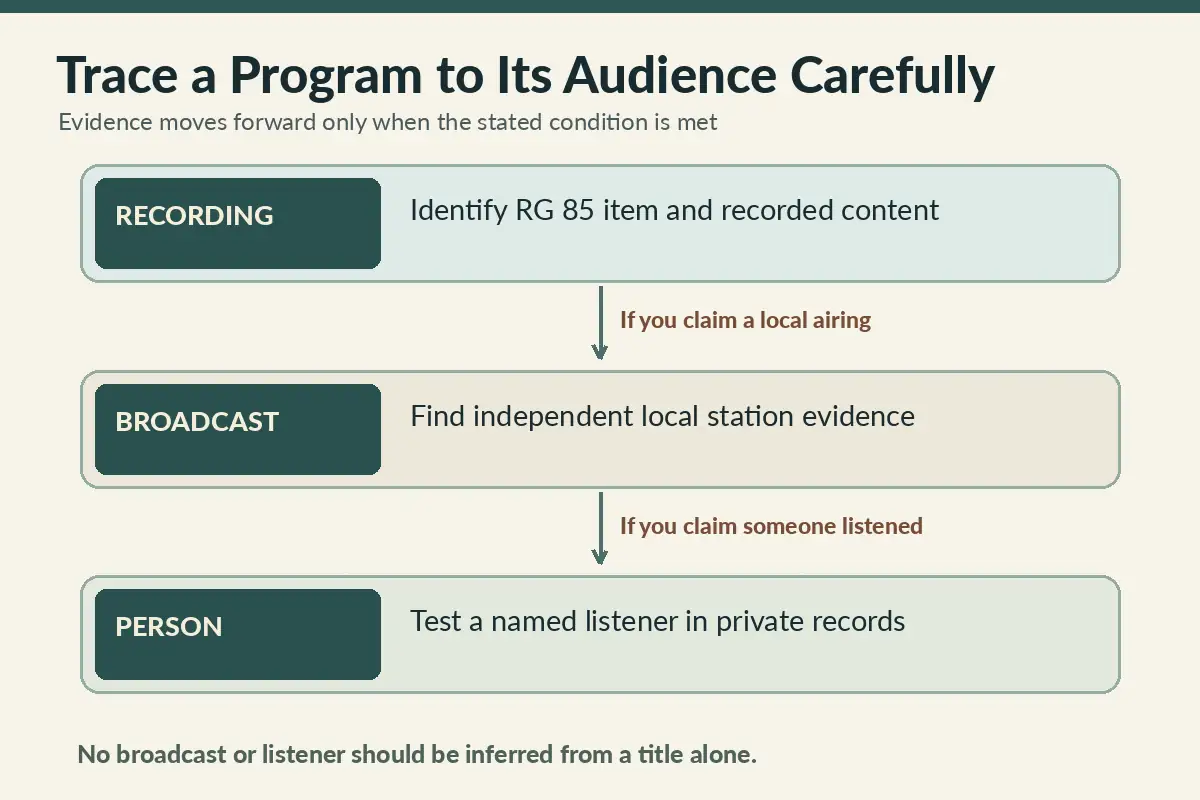
Search first for the recording identity: RG 85, a program title or episode, approximate date, original medium, and any item-level identifier. Then test three separate propositions: the program existed in recorded form; it was transmitted at a documented time and place; and a named individual encountered it. Each step requires different evidence, so no single finding-aid entry should be treated as proof of all three.
Identify the INS Program Before Looking for a Listener

Begin in the RG 85 general-records description, which places the broadcasts among INS headquarters materials rather than among alien registration cards or individual case files. Note the precise 1940–1945 range and avoid assuming that every one of the 78 recordings has the same topic. Some programs concern immigrant rights and responsibilities; others dramatize border patrol activities. In your research notebook make columns for recording number, title, documented sponsor, apparent production date, carrier, duration if supplied, and whether a transcript is known. Leave unknown fields blank instead of filling them from plausible station schedules.
A family story about a relative learning English through radio is only a reason to investigate these programs, not evidence the person heard one. A title found in NARA may lead to publicity or a newspaper program listing, but local broadcasts depended on station schedules and distribution. Search nearby historical newspapers by the person’s town, station call sign, date and exact program name. Even an accurate schedule establishes a planned or announced broadcast, not necessarily actual reception in that household.
Distinguish the Recorded Program From Its Broadcast
Sound holdings can preserve a transcription disc, recording session, master copy or later transfer. Identify which object the catalog describes and whether the audio represents a complete episode or a fragment. Consult the NARA audio-format guidance to understand why a physical disc is not interchangeable with a tape, digital transfer or published transcript. Carrier and generation affect dating, completeness and audible quality. Do not assign an episode to a precise air date merely because a later archival copy has a written date on its sleeve.
To build a broadcast timeline, use contemporaneous station logs, newspaper radio columns, agency publicity files, or dated program announcements where available. Record the document type beside every time and station. A surviving script may show intended wording, while a recording shows words actually preserved; neither necessarily reveals what a local audience heard over interference, edits, or interruptions. If no contemporaneous broadcast evidence survives, describe the recording as an INS-sponsored program in NARA holdings and stop short of a transmission claim.
Read the Message in Its Wartime Administrative Context

The period 1940–1945 spans major changes in INS oversight and immigration administration. The RG 85 guide describes the agency’s transfer from Labor to Justice in 1940. An episode aimed at noncitizens should therefore be dated and attributed to its actual sponsoring agency, rather than loosely called a modern immigration service announcement. Identify the program’s exact language before stating what legal rights or duties it represented. Government messaging is evidence of what an institution presented, not an exhaustive statement of the law or the treatment that an individual received.
When analyzing a dramatization about border patrol work, separate narrator, fictional characters, official policy, and historical practice. A dramatized arrest scene does not identify an actual detained person. If a contemporary law or registration requirement is discussed, trace the dated statute and administrative directive separately; the script may simplify or emphasize points for its intended audience. Family historians should quote the program sparingly, cite the recording, and explicitly distinguish institutional messaging from the lived experiences captured in private letters, oral histories, or personal documents.
Build an Evidence Grid for the Family Claim
A useful grid tests three questions. First, does the audio or finding aid support the program’s existence and content? Second, do station records or period newspapers identify a local broadcast? Third, is there independent evidence that your relative listened, discussed the episode, or had access to that station? Private correspondence, a diary, or a later attributed oral history may address the final point, although memory and retrospective dates still need evaluation. Residence near the station’s market area does not establish listening, and a shared surname in a script is not a family link.
Write your conclusion with bounded verbs: “NARA holds a program addressing immigrant responsibilities”; “a newspaper announced a broadcast at 7 p.m.”; or “a dated letter says the family discussed the broadcast.” These sentences have different strengths. Do not substitute a modern transcription for the contemporaneous carrier without noting the derivative status, and preserve any discrepancy between original label, archive metadata and reported airing dates. This small ledger prevents a vivid cultural artifact from becoming an invented biographical event.
Request a Specific Recording and Cite Its Provenance
Check the National Archives Catalog for an RG 85 series or item record and collect the title, date span, local identifier, media description and repository before submitting a question. The NARA citation guidance shows why a full reference includes title, date, series, record group and custody. Ask whether the described recording has a publicly accessible listening copy, transcript or restriction. A guide stating that the agency holds 78 items is not a promise that all 78 have downloadable audio or searchable transcripts.
For preservation, keep a research log with any playback notes, exact timestamps for passages discussed, missing portions and the recording version consulted. Where sound quality leaves a word uncertain, mark the uncertainty rather than silently normalizing the sentence. If a relative’s experience remains unproved, the broadcast can still enrich a contextual family-history paragraph: it shows one official message available in that period, not that the relative endorsed, understood or ever heard it.
More Research Method Guides
How We Research This Archive Series
We compared the RG 85 record-group description with NARA guidance on audio formats and catalog citation. We treated recorded content, a contemporaneous transmission and a personal listening event as three non-equivalent claims. We did not infer a station, transcript, audience identity, or unrestricted online playback from a series-level entry. Read our affiliate disclosure; this guide does not assume any paid relationship with the archives.
NARA lists 78 INS- and Justice Department-sponsored sound recordings from 1940–1945.
No. A local air date and station require a contemporaneous station log or another independent source.
No. A dramatization is program content, not identification of an actual detained person.
Only when reliable person-specific evidence, such as a dated letter, supports that connection.
The record-group description does not establish item-by-item digitization or playback access.