
The National Archives guide to RG 233 describes 200 photographic prints in grouping WE relating to the women of the Board of Lady Managers and fine arts exhibits at Chicago’s World’s Columbian Exposition. The exposition itself was held in 1893, while NARA’s listing associates the photographic group with 1896. These dates should not be collapsed into an assumption that every portrait was taken at the fair in 1893. The photographs can be valuable evidence of women’s institutional roles and exhibition culture, but do not automatically identify an unknown visitor or family member.
For each candidate image, separate the fair’s event date, the date of the photograph or its reproduction when identifiable, the catalog arrangement date, and the name actually supplied by a reliable caption. A portrait resembling a family photograph is a visual lead, not proof of identity. Start with the WE series and available local image identifiers, then connect a named subject to independent board, newspaper or biographical documentation.
Find the WE Photo Cards, Not Just a Fair Photograph

The RG 233 guide places the WE cards among the general still-picture records of the U.S. House of Representatives. Its description refers both to the Board of Lady Managers and to some fine arts exhibits. Those are two different kinds of subject matter. Search the catalog using “RG 233,” “WE,” the board’s name, “World’s Columbian Exposition,” and an exhibit or person name when known. Maintain the entire item reference, because a keyword hit for “Chicago fair” could belong to a very different repository, photographic process, or year.
The Still Picture Branch holdings guide independently identifies the WE group as card photographs and confirms its broader theme. Ask whether a card has a contemporaneous caption, a photographer’s imprint, a later handwritten annotation, or a modern catalog title. Record each layer as a separate statement. Reproduced captions can repeat earlier mistakes; they are useful clues but not automatically independent witnesses for a subject’s identity.
Keep 1893 and 1896 in Separate Date Fields
Chicago’s exposition is usually identified with 1893, but NARA’s WE description uses 1896 for the photographs. That is a cataloging fact to preserve, not a license to assign an 1896 sitting to every person. A portrait may have been made before, during or after the exhibition and then assembled or described later. If the original card contains a dated photographer’s studio address or printed dedication, transcribe it exactly and compare it with the finding aid before adopting a more specific date.
Build a four-field date audit: event commemorated, exposure or sitting, production or printing, and later archival description. If only the latter is known, write “photographic card in the WE group, described by NARA with date 1896,” rather than “taken in 1896.” This approach also prevents a common genealogical error: treating the existence of a fair-related portrait as proof that its subject physically attended an opening ceremony or appeared on the fairgrounds on a particular day.
Tell a Board Member From an Exhibit or Visitor
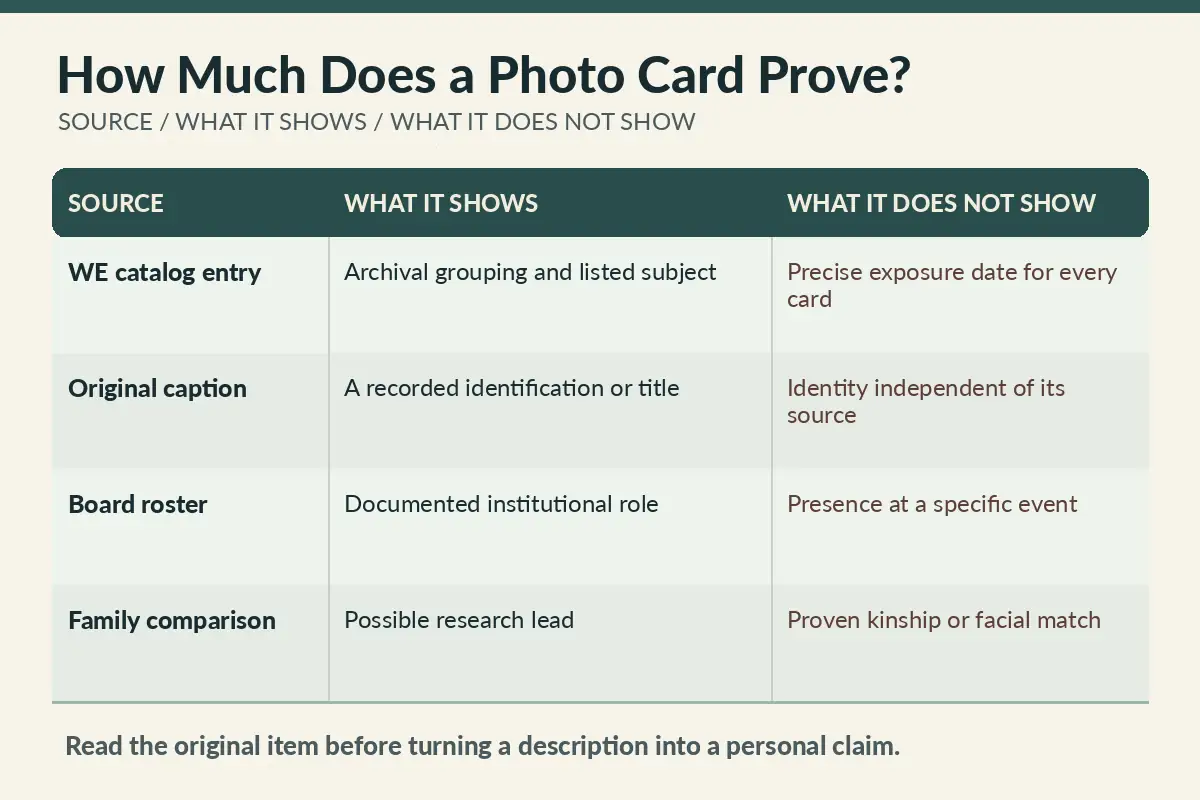
The Board of Lady Managers was an institutional body associated with the exposition’s work concerning women. A labeled member’s portrait can help establish an image attribution, subject to checking the original caption and corroborating records. A photographed painting or art display is not itself evidence of the board member pictured in another card. Nor is every photographed woman in a fair collection automatically a board official. Check whether the description labels an official portrait, an exhibition object, or a scene of public activity.
To evaluate a family story about a woman at the exposition, determine the exact role claimed: board manager, organizer, exhibitor, artist, employee or visitor. Then seek records that can establish that role, such as official publications, exhibition lists, correspondence, period newspapers or a documented personal diary. A family surname matching an official name is an invitation to test dates, residence and identity, not proof of kinship. Do not infer an occupation merely from period clothing, a photographic pose or the apparent status of a studio backdrop.
Read the Caption as Evidence With a Provenance
A reliable identification depends on who wrote a caption, when it was written and whether another contemporary source agrees. Keep original spelling, initials, married names, and variant forms in your notes. Later catalogs may normalize a name, while newspapers use an earlier surname. Before merging two records, compare locations, dates, organizational roles and, if possible, the complete photograph rather than a cropped digital preview. Do not identify a person solely through facial resemblance to a modern family portrait.
Record how much of the picture is actually visible. The margin of a card can contain a studio imprint, handwriting or an accession note that is missing from a cropped reproduction. A caption naming “Mrs.” followed by a surname is not enough by itself to establish birth identity or parentage. If several women share a married surname, use board rosters and local contemporary materials to identify the appropriate individual. An artist’s signed work can also document the artwork without proving who arranged or personally supervised the exhibit.
Request, Cite, and Explain a Single Photograph

Do not cite only “World’s Columbian Exposition pictures.” Use record group 233, WE grouping, exact card or item description, any local identifier, date evidence, and the holding repository. NARA’s still-picture research guidance explains how catalog searching and staff inquiries help establish those identifiers. Confirm whether the actual item is digitized before promising that the reader can view or download it immediately. A series inventory of 200 images is not an item-by-item access statement.
A responsible family-history caption might say that a photograph preserved in the WE collection is identified by NARA as a Board of Lady Managers portrait, while the precise exposure date is unresolved. If you have corroborated a subject’s identity, name the independent reference in the same sentence or footnote. If the identification remains unproved, present the photo as institutional context without assigning it to an ancestor. The boundary between documented subject and conjectural visitor makes this collection valuable instead of misleading.
More Family Story and Preservation Guides
How We Research This Archive Series
We compared RG 233’s general still-picture listing with the specialized NARA Still Picture Branch guide and still-image inquiry rules. We keep the 1893 fair, the 1896 catalog description, a photograph’s possible production date, and a captioned individual distinct. We reject facial resemblance and membership-by-association as identity evidence. Read our affiliate disclosure; this guide does not assume any paid relationship with the archives.
The guide lists 200 WE photographic prints that include Board of Lady Managers subjects and fine arts exhibits.
No such item-by-item conclusion follows from the guide; NARA associates the WE grouping with 1896.
No. A studio portrait or group attribution does not establish a dated visit.
Use a named reliable caption and independent records; resemblance alone is inadequate.
No. NARA explicitly includes photographs of fine arts exhibits in the grouping.