
The NARA RG 77 guide lists the “Cape Cod Canal Case,” 1890–1940, among records of the Office of the Chief of Engineers, New England Division, in Boston. This archival case is a route into the history of surveys, plans, negotiations and federal administration of the Cape Cod Canal. It is not a single blueprint of a completed waterway or a complete list of construction workers. To reconstruct a canal-side family or property story, distinguish a proposed route, privately opened channel, federal acquisition, and later redesign.
The Army Corps history describes private construction beginning in 1909 and the canal’s July 1914 opening, followed by federal acquisition in 1928 and major improvements in the 1930s. Those dates help organize the file, but a historical summary does not substitute for a particular deed, engineering drawing or named payroll record. The strongest workflow begins with the place or event, then selects the relevant phase and checks the original documents.
Sort the Canal Case Into Four Historical Phases

The 1890–1940 case date range extends beyond a single construction campaign. First separate preliminary surveys, charters and proposals from private financing and excavation. Next identify the early operating period after the 1914 opening. Then place the federal acquisition and Army Corps responsibility in the late 1920s. Finally, identify the extensive redesign and bridge works of the 1930s. A dated plan made for an unrealized proposal should never be captioned as the final canal layout simply because the drawing survived in the same record group.
The Corps’ public history supplies the key timeline, while RG 77 describes where archival case material may be located. Mark the function of each document as proposal, legal negotiation, measurement, contract, inspection or finished-work report. A memorandum written in 1936 about earlier events carries at least two dates: the event it discusses and the document’s own creation. This distinction is essential when a map has later annotation or a document describes an abandoned engineering plan.
Check Who Owned or Operated the Waterway
A private opening in 1914 did not mean that the federal government owned the canal on that date. The Corps records the 1928 acquisition as the decisive federal transition. Separate title, operating authority, wartime control, engineering responsibility and day-to-day management; those concepts need not switch at the same moment. When writing a narrative about access, tolls or maintenance, use the legal and administrative status of the relevant year rather than projecting present-day USACE authority backward across the entire history.
For a family claim involving compensation for a parcel, locate a deed or acquisition instrument that names that specific tract. A case file about general canal negotiations does not prove that a particular household was paid or forced to move. Check county deeds, local tax records, contemporary plats and grantor or grantee identities. Be careful with parcels whose modern address or road alignment changed after widening; compare historical legal descriptions before transferring present-day boundary lines onto an early plan.
Compare Original Works With the 1930s Improvements

In the private period the channel was narrower and presented problems that later works addressed. USACE describes major federal reconstruction, including wider channel and replacement bridge infrastructure in the 1930s. Do not use an image of a modern bridge to identify a structure appearing on a 1914 plan. Compare contemporaneous drawings, named bridge or reach, construction dates, and contract references. A photograph of a completed bridge can help date a visible feature but is not automatically proof that every planned approach road was built as drawn.
A strong site-history table has columns for feature, dated proposal, contract or authorization, observed work, and later alterations. For a lock, bridge, embankment or basin, require a distinct completion or inspection source before asserting that a proposal became physical infrastructure. Keep the precise period of a survey map visible in the caption. A later Corps summary may condense years of change into a short phrase; use project records to avoid accidental false precision about individual structures.
Find Workers Through Their Own Record Trail
Family recollections may say an ancestor “built the Cape Cod Canal.” That can refer to private excavation, federal reconstruction, bridge contracting, transport work, survey employment or administrative service. Begin by determining which phase and employer the claim concerns. A corporate contractor may have kept payrolls separately from federal engineers. Search labor records, city directories, occupational entries in census schedules, employment correspondence and company archives where they survive. RG 77 construction documents provide project context, not an automatic person-by-person hiring register.
If a letter names an engineer or property owner, identify the document’s author, recipient and role rather than interpreting every appearance as employment at the site. A worker could be mentioned in a complaint without having been on a payroll; an official may sign a contract without visiting the work. Treat these claims separately and cite dated direct evidence. Where no individual record survives, a responsible article can establish that the canal works operated near the family’s community during a stated period, without turning that context into undocumented work history.
Request the Correct RG 77 File and Local Papers
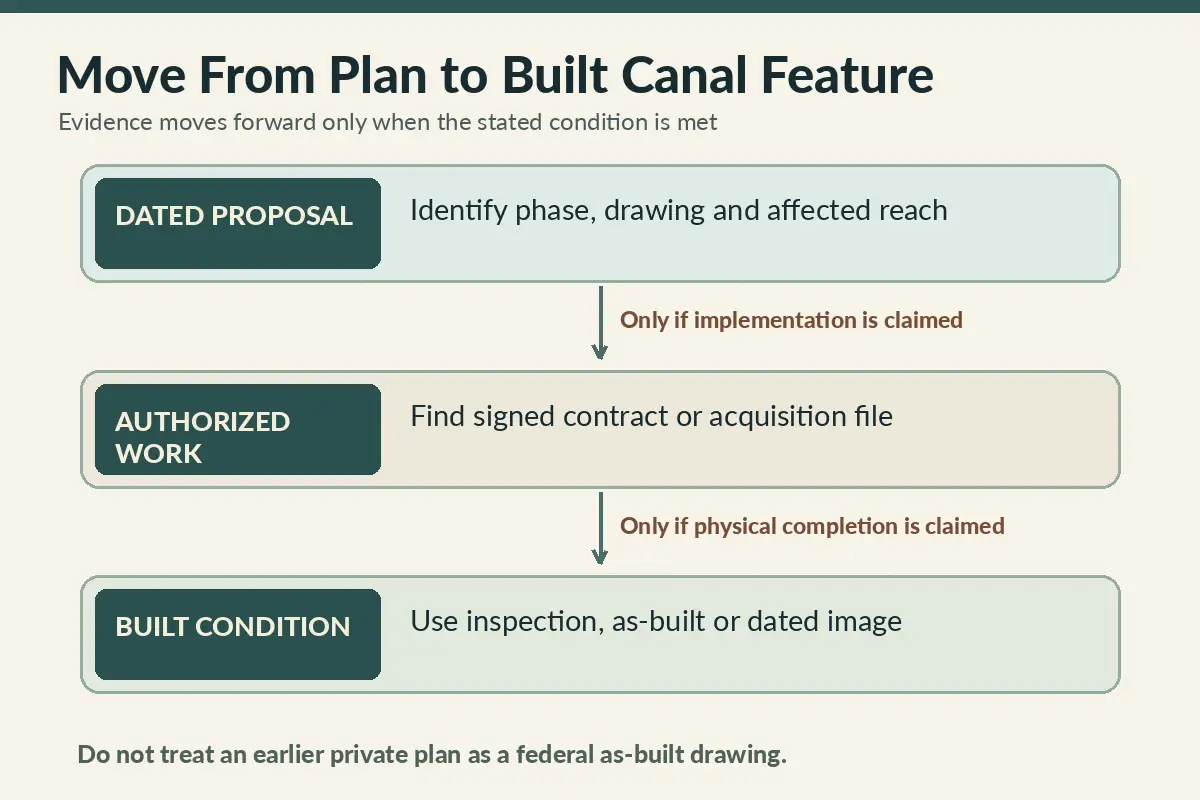
Start with NARA’s Boston-location reference for the New England Division and use “Cape Cod Canal Case,” 1890–1940 as the initial series description. Provide an approximate phase, organization, named feature, date, and any correspondence or drawing identifier to reference staff. Not every folder can be assumed to contain plans or ownership papers. Ask about detailed indexes and whether relevant drawings are in a separately held cartographic series. The guide’s broad date range does not establish complete file survival for every year.
Consult the USACE project account for institutional continuity, then confirm property claims through local records. Record the source of each stage of the narrative. If you can demonstrate the 1914 opening and 1928 federal acquisition but not a household’s participation, say exactly that. Archival humility protects both family stories and the engineering history from speculation about who lived, worked or owned land beside the channel.
More House and Local History Guides
How We Research This Archive Series
We compared NARA’s narrowly named 1890–1940 case listing with the Corps’ dated history and current project background. Our timeline separates preliminary planning, private operations, federal title, and 1930s reconstruction. We did not infer a completed structure, land taking, payroll listing or family residence from the existence of case files. Read our affiliate disclosure; this guide does not assume any paid relationship with the archives.
An RG 77 New England Division group described by NARA as records relating to the canal, 1890–1940.
No. The 1914 opening was privately financed and operated; the federal purchase was in 1928.
No. Completion requires later construction, inspection or dated photographic evidence.
No. A project case description is not a comprehensive employee roster.
Use original plans, legal parcel descriptions, deed and tax evidence, and the correct project phase.