
A photograph of a nearly finished barracks or hangar can identify a phase of construction without naming a single carpenter, engineer or later resident. The National Archives describes 195 photographic prints in albums showing Albrook Field in Panama under construction in 1931, among Record Group 77’s Chief of Engineers records. The album designation is CZ. For a building-history project, the immediate task is to identify the pictured structure and when the photograph was made—not to infer the identity of everyone connected to the field.
Albrook Field was an installation in the former Canal Zone. A view from 1931 offers a dated perspective on the built environment, but a series-level date is not automatically the exact date of every exposure. Some prints may show earthworks, foundations or unfinished structures. Others may be cataloged only as part of an album. A careful reconstruction combines captions, physical context and independent plans while keeping workers and occupants outside the claim until a named record is found.
Locate the CZ Albums Within the Engineering Holdings
The RG 77 guide places the 1931 Albrook Field album photographs within a larger group of military-installation images, separate from albums about construction in the Philippines or military housing elsewhere. Search for “Albrook Field,” “CZ,” and Record Group 77 together. The 195-image figure is the size of the described album set, not evidence that 195 photographs are available online or show different individual buildings.
If the Catalog does not return item-level pictures, use the Still Picture Branch guidance to prepare a request with record group, series, available album designation, and any image identifier. Ask whether a caption, reverse, sleeve or album page contains details not visible in a digital reproduction. Retain the archival arrangement rather than re-labeling an unknown photo with a modern street address.

Read Physical Construction Details With a Date Ledger
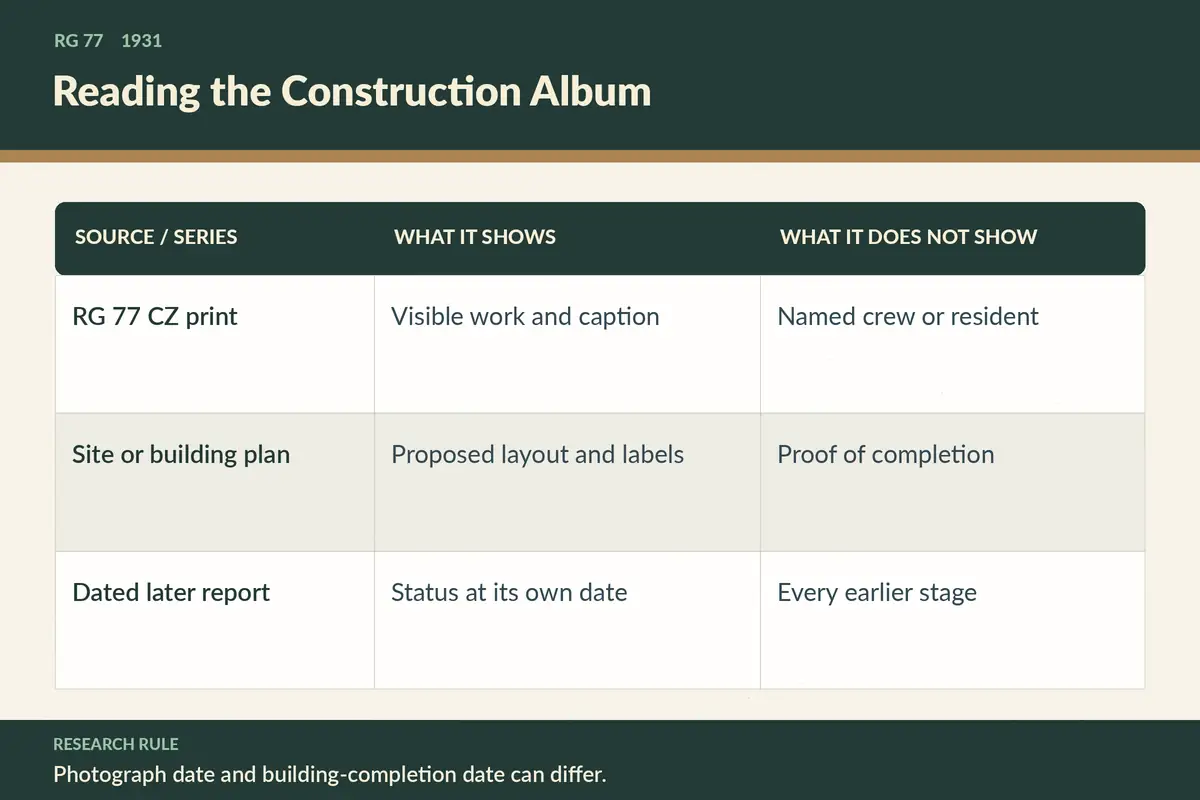
A partly framed roof, a newly graded roadway and a completed façade are evidence of visible conditions at the time of exposure, but not necessarily of an official completion or occupancy date. For each print, note exposed foundations, number of floors, building shape, road alignment, nearby structures and any legible signs. Keep separate columns for caption wording, directly visible details and your interpretation. Different camera angles can make two views of the same building look unrelated.
Use the album’s order cautiously. Prints may have been selected, mounted or described after their exposure, so sequence on a page need not reproduce the exact sequence of construction. Where two photographs appear to show the same structure, explain why: roofline, windows, orientation or distinctive surroundings. If you propose a specific construction stage, compare it with an independent plan or report of the same work. Do not infer that construction finished when the camera stopped returning to the site.
Distinguish a Site Plan From a Built Structure
A plan may show intended positions for hangars, quarters, roads and utilities, while a photograph shows what the camera captured. Align the two using known landmarks and the plan’s revision date. A proposed building number on a drawing should not be silently applied to a structure in an undated image. If the photographs and the plan disagree, consider different stages of construction, map updates or a mistaken identification rather than choosing the more convenient label.
Place modern geography in a separate column. The historical name, installation boundaries and later use of the property may have changed. A photograph’s caption may identify a general base rather than an individual building. Do not convert that broad location into an exact parcel, street address or legal property boundary without a reliable historical crosswalk. Architectural and geographic identity are related questions, but they require distinct evidence.
Find Named Workers and Occupants Elsewhere
An individual visible in a photograph may be unidentified, and an empty construction scene proves nothing about who worked there. A worker claim needs a personnel roster, contract, payroll or other contemporary named document. An occupant claim calls for unit, housing or assignment records from the relevant period. The very presence of an Army installation does not make every person photographed there a soldier or every civilian laborer a member of a particular unit.
For a family narrative, begin with a documented person’s service or employment chronology and ask whether it overlaps the dated construction stage. A surname from a later directory cannot be retrojected onto a photograph from 1931. Preserve uncertainty around unidentified faces; facial resemblance alone is weak evidence. If only the print has been located, describe the visible scene and its archival caption, not an invented crew list.
For a practical photo-comparison sheet, put the archival print on the left and a separately dated plan or later view on the right. Annotate only features that can be seen in both: roof pitch, window spacing, adjacent roads and topographic landmarks. Keep a third column for confidence: certain, probable or unidentified. If the photographs show a construction vehicle or uniformed figure, do not assign a name from equipment type alone. Likewise, one worker in a scene is not evidence for an entire contractor’s crew. A caption such as ‘Albrook Field under construction, 1931’ is more accurate than a guessed building number or unverified occupation claim.
Create a Reproducible Building-History Citation
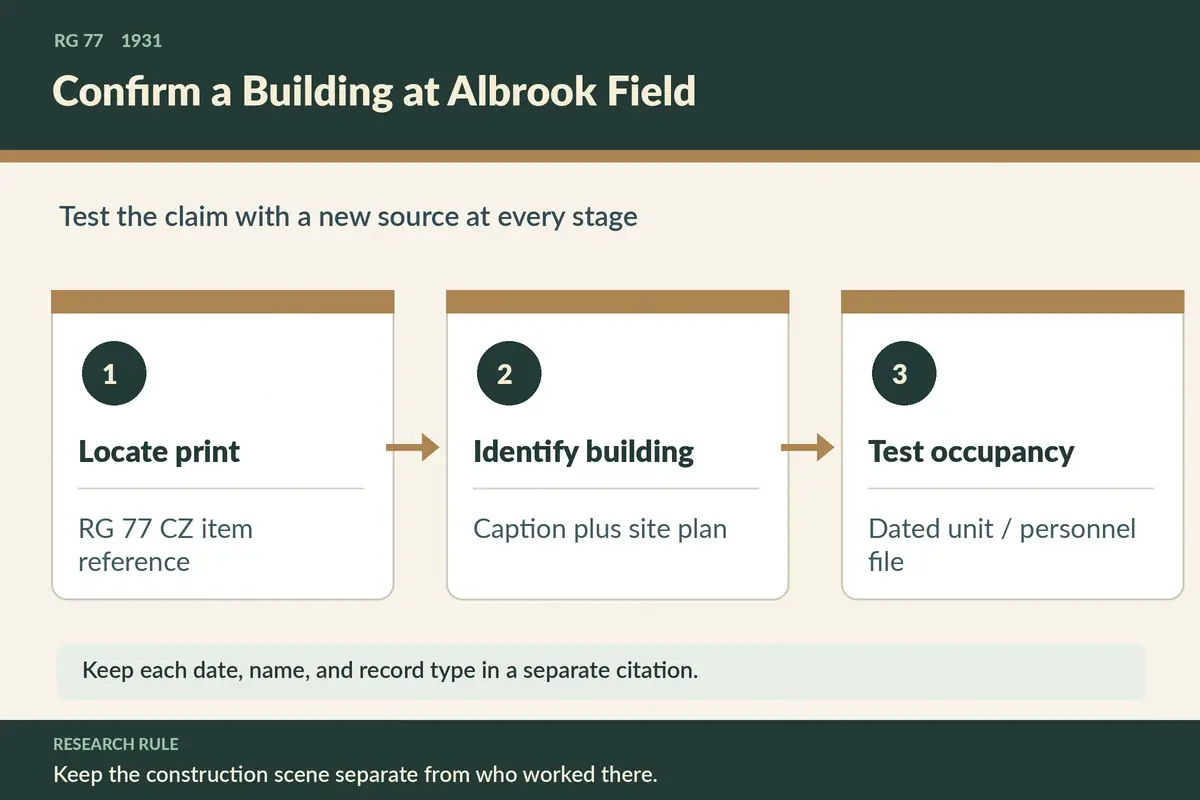
Store a full-resolution copy without cropping away edges, captions or album page information. Record RG 77, the CZ designation, album and item identifiers if established, stated date, NARA catalog identifier if any, and whether the image is a reproduction. In comparative illustrations, identify the date and provenance of each view; do not present an artist’s reconstruction or enhanced photograph as an untouched original.
A strong summary can say that the NARA guide describes Albrook Field construction photographs in 1931 and that a specific examined image depicts a stage of a particular building’s work. The next sentence should state what confirms the building identification or any later occupation. If that second document is missing, label the identification provisional. Archival transparency keeps the photograph useful even when the human story is not yet established.
How We Research the Records and Check Boundaries of Evidence
We used NARA’s RG 77 photographic description and the Still Picture Branch’s image-research instructions. We distinguish collection range from exposure date, visual evidence from caption attribution, and installation context from person-level identity. Read the affiliate disclosure for editorial context.
More House and Local History Guides
Frequently Asked Questions About the Records
The RG 77 guide lists 195 images in albums dated 1931 under designation CZ.
The series description does not guarantee item-level digitization; check the Catalog or ask staff.
Not reliably without an independently named record or clear original attribution.
No. Compare it with dated photographs and completion or occupancy documents.
It is the photographic album designation cited by NARA for the Albrook Field group.