
The National Archives description of RG 49 includes a set of 183 photographic prints labeled KRA, showing California oil fields, derricks, machinery, people and communities used in a General Land Office investigation in 1898–1900. Some were taken by Frank C. Ashton. The images are valuable evidence of industrial landscapes at a particular historical moment, but a derrick visible on land is not proof of who held the mineral rights or employed every person in the frame.
Begin with the RG 49 still-picture description. Search for KRA in combination with California oil fields and any locality named in your family papers. Keep three questions apart: what the photograph actually shows, why the government collected it, and what an unrelated land or employment file might establish. A caption gives clues to test, not a substitute for legal title.
Recognize the KRA Group and Its Investigation Context

KRA is the group identifier given in the NARA guide; the guide calls these photographic prints in albums, not a comprehensive photographic census of every California oil field. The description associates them with a General Land Office investigation and the 1898–1900 period. When using them, note whether a date belongs to an individual picture, an album, or the broader investigation. Do not assume every scene was exposed in the same year or by the same photographer.
Frank C. Ashton is named only as the photographer of some images. Unless a particular print carries a trustworthy attribution, resist applying his name to all 183. Similarly, an album sequence may organize subjects for investigation rather than reproduce the order in which a field grew. Inspect mount lettering, annotations, negative numbers and any accompanying papers. If a modern catalog title differs from an original caption, transcribe both distinctly.
Read Physical Clues in Derricks and Settlement Views
A photographed rig may show a timber frame, steam machinery, tanks, roads, housing, or terrain. Those features help distinguish drilling activity from transport or storage and may support comparison with a historical map. Avoid dating a picture from a single machine type without another control. Equipment could remain in service for years, and photographs can be staged or selectively framed for the purpose of a federal inquiry.
Create an observation table with visible objects on one side and inferred meanings on the other. “Three storage tanks are visible” is an observation; “the operator owned the neighboring parcel” is an inference requiring title records. A distant town skyline may narrow a location but usually does not identify the people inside its buildings. When geography is uncertain, keep a location bracket such as “California oil district, exact site not established.”
Keep Oil, Surface and Mineral Rights Separate

Oil-field photographs often tempt a property conclusion: a well occupies a tract, therefore the same family owned all the land. The evidence does not work that way. Surface ownership, mineral rights, government land status, leases and operating rights may be different legal interests. The appropriate independent source depends on whether the claim is a homestead entry, patented land, a private conveyance, a lease or a production agreement. Identify the tract before choosing the record path.
To test a family title claim, begin with a legal land description from a deed, tax assessment, patent reference, or local map. Research successive instruments and any documented reservations or transfers. RG 49 records may provide federal context, but a photograph in a GLO investigation does not automatically contain the legal disposition of the parcel shown. Do not claim a successful patent or a valid lease merely because the government photographed operations.
Avoid Naming Workers From an Uncaptioned Scene
People in industrial photographs may be drillers, teamsters, engineers, visitors or bystanders. Clothing or tools rarely identify a person by themselves. If your ancestor worked in the oil industry around 1900, search city directories, voter lists, census occupations, employment papers, local news and family correspondence. A matching surname in another town is not enough; build an identity link using age, household, workplace and dates.
A label naming a company does not establish that every pictured worker was employed by that firm. Contractors, itinerant crews and visiting officials may have been present. Distinguish identifying a work site from identifying the people at it. If a family photograph resembles a KRA print, compare the frame and physical details carefully and describe the likeness as a possible match until the original provenance agrees.
Cite Each Print Without Converting the Album Into a Claim
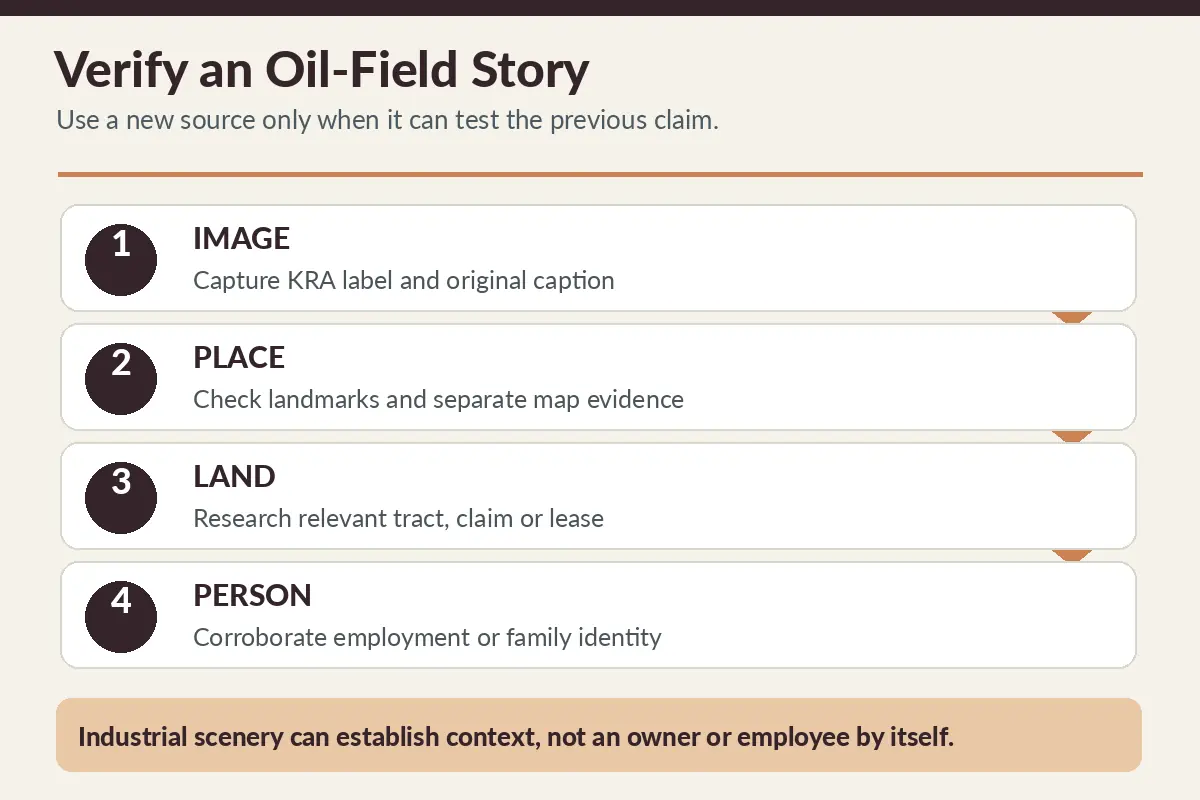
Record RG 49, KRA group identification, original album and image number if supplied, exact original caption, any photographer attribution, and the repository item link. Preserve the full scan including its borders when possible. When quoting a caption, retain its historical wording but explain uncertain or outdated terminology in your own narrative. Do not reproduce an invented archival stamp on an illustration as though it came from the original photograph.
If a photograph cannot be found online, request a precise item or album locator rather than saying the material is missing. The NARA copying page explains available routes for record copies, while actual reproduction arrangements depend on the item. In a final family-history paragraph, keep visible scene, caption, legal-title research and personal identification in separately cited sentences.
An Example of an Oil Claim That Needs a Second File
Suppose a descendant owns a print of an early California derrick and a family letter mentioning oil work. A KRA image might help identify the kind of equipment and setting, but neither artifact proves that the writer owned the well. Begin by dating the letter and establishing the writer’s residence; then use a tract description, deed or lease if the ownership claim is specific. A photograph can supply industrial context while the land record provides the legal relationship. This is a hypothetical workflow, not an identification of anyone in the KRA albums.
Record four separate assertions in the final narrative: the photo’s original label, what is visibly present, what the family document actually says, and what the land or employment record confirms. Even when all four align geographically, do not collapse them into a single statement of personal ownership or employment. A well-documented uncertainty is more useful to future researchers than a vivid but unsupported biographical detail.
More House and Local History Guides
How We Research This Archival Evidence
We base the group identification, number of prints, described subjects, period and limited Ashton attribution on the official RG 49 guide. We then treat each hypothetical land or employment claim as requiring its own local or federal file. The guide alone does not name the owners of every depicted derrick, prove a mineral reservation, or certify the identity of unidentified workers.
Our method keeps item titles, original inscriptions and independent records separately attributable. For disclosure about links and support, see the GenHis affiliate disclosure. No subscription or speculative database entry should replace the actual image caption or an original land instrument.
It is the still-picture group designation for the 183 California oil-field prints described in the RG 49 guide.
No such claim is supported. NARA states that some images were made by Ashton.
No. It establishes visible industrial activity; ownership and mineral rights require land or lease documents.
No. Use original captions and independent named records to establish identity.
The guide identifies the group, not the online status of every individual print. Check the catalog and inquire as needed.