
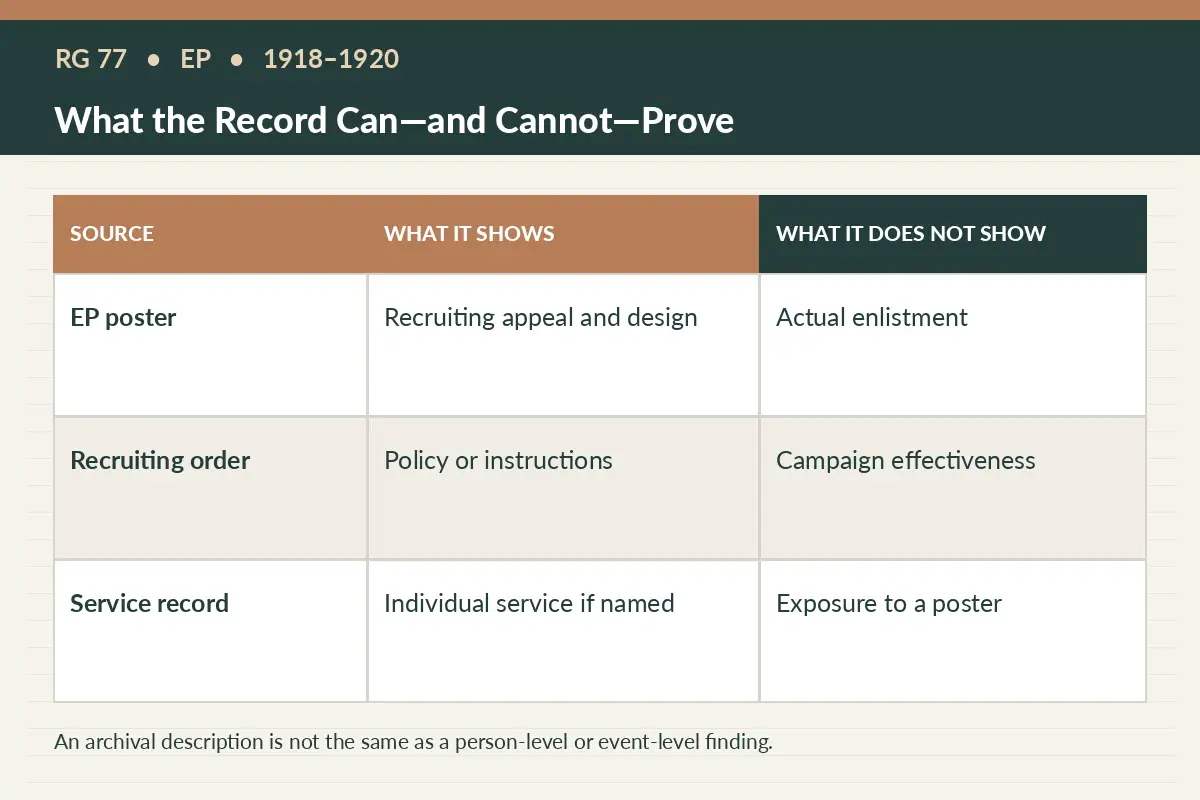
NARA’s guide to the Office of the Chief of Engineers, RG 77, identifies 18 recruiting posters in the EP group dated 1918–1920. It describes material associated with the Engineer and Ordnance Departments, the Transportation Corps, and the Publication Department. The posters can reveal what an organization wanted audiences to believe or do. They do not establish that a named ancestor saw an image, volunteered, was accepted, or served in the role depicted.
A reliable reading starts with a specific RG 77 EP item, not an undated image circulated online. Record the full text, imprint, implied audience, uniform or equipment shown, and any date provided by the original object. Then separate that marketing language from actual recruiting regulations and personnel documentation. The distinction matters especially when a poster seems to promise training, travel, or a particular type of wartime work.
Locate the EP Item Rather Than a Reused Poster Image

A modern social-media image may crop out an agency imprint or printer’s mark. The EP group is only a small set of 18 posters, and its catalog description should be your anchor. Search by RG 77, EP, an exact line of visible wording, and the recruiting organization. Record the full original title and any item number supplied by NARA. Do not assign a new item number based on an online thumbnail’s order.
Compare a reproduction to the most complete version available. Look for borders, bottom credits, pasted corrections, and print colors. Cropping may remove the sponsoring agency, which in turn changes the reader’s impression of the intended audience. A later exhibition caption is useful context but should not replace the original words visible in the poster.
Read Recruitment Language as Persuasion, Not a Contract
Recruiting graphics rely on urgency, selective imagery, and promises of useful service. A shovel, bridge, workshop, railcar, or surveying instrument may represent an appealing occupational identity, not a job assignment made to everyone who joined. Transcribe slogans accurately and distinguish promises in a public appeal from an official service classification or enlistment contract.
If a poster makes a claim about skill, advancement, or duty, compare it with contemporaneous regulations and training records. A 1918 appeal also cannot be read as a timeless description of Army practice. The EP date span extends through 1920, so check the item date before associating its rhetoric with a particular battle, demobilization phase, or veteran’s service period.
Separate the Agencies Represented by the Poster Group
NARA’s summary mentions recruiting posters associated with several organizations, not just Army Engineers. The group includes material linked to the Engineer and Ordnance Departments, Transportation Corps, and Publication Department. A reader should not label every EP image as an engineer enlistment appeal. Use the original imprint and text to identify which body produced or distributed the specific piece.
An image showing tools might fit several occupations, so avoid inferring administrative origin from artwork alone. Create a comparison ledger for each candidate poster: item ID, named office, date, message, and whether the office is explicitly printed or only supplied in catalog metadata. If an office is named only in a modern description, note that as a distinction.
Test a Family Claim Against Name-Bearing Documents
A family may preserve a poster because a relative served in a technical branch, but possession is not proof of viewing it during recruitment. A preserved poster could have been collected much later, bought, or inherited from someone else. The poster documents a campaign message; a service record, enlistment paper, unit roster, or dated letter documents an individual connection.
When writing about an ancestor, identify the actual branch, enlistment or appointment date, duty station, and unit from separate documentation. Only then ask whether an EP poster is relevant period context. Even a successful match does not prove that this exact printed appeal motivated the person. Phrase the connection modestly: the poster illustrates a message circulating in the period, while the service file establishes the individual’s history.
Handle Dates, Reprints, and Misleading Color Carefully

The guide provides the overall 1918–1920 span, but individual production and display dates may differ. A later reprint may preserve original wording while changing paper, ink, or a credit line. Check whether the item is an original printed sheet, a photographed poster, or a modern reconstruction. The appearance of bright colors in a modern image is not sufficient to describe surviving inks.
To date a specific item, use an original imprint, publication number, dated catalog entry, or contemporary newspaper reproduction if possible. Treat vague phrases like “World War I era” as broad context. Keep a separate note for the date when your image file was made; digital metadata describes the copy, not the original printing event.
Publish a Poster Caption With Explicit Evidence Limits
A good caption can identify the RG 77 EP group, the recruiting agency as stated on the sheet, the visible appeal, the NARA item reference, and the period. It should not imply a named soldier enlisted because of the design. If connecting an artifact to a local recruitment drive, seek a dated newspaper notice, station record, or contemporary organizational correspondence.
When requesting a higher-quality reproduction, provide the record group, EP group, exact item title, and identifying notation. Ask whether the complete poster includes margin credits excluded from online copies. Save an unaltered reference reproduction, and label crops or visual restorations as derivatives. Accurate provenance lets a future researcher check the historical wording independently.
More Research Method Guides
How We Research the Original Records and Their Limits
Our research begins with the National Archives guide for RG 77, which supports the existence, general scope, and date range of the EP material. We then distinguish that broad description from the more exact item title, physical form, annotations, and any digital object found through the NARA Catalog. An archival series description is not itself an inspection of all 18 recruitment posters, and an item may not have a digitized copy available.
For claims about a person, location, outcome, or date, we prefer a separate contemporary and name-bearing or event-bearing record over a plausible visual inference. We log variant titles, later catalog notes, uncertain identifications, and the difference between an original object and a modern reproduction. NARA’s reproduction guidance explains why a specific citation matters. This page is informational; our affiliate disclosure explains any relevant site relationships without implying that NARA is a partner.
NARA lists 18 posters dated 1918–1920.
No. The guide names Engineer, Ordnance, Transportation Corps, and Publication Department material.
No. A name-bearing service or recruiting record is required for an individual claim.
No. Inspect each poster and catalog item for a more specific date.
Cite the archival item and state clearly when a derivative reproduction is cropped or modified.