
The National Archives describes a group of 130 photographs in Treasury Building repair albums within Record Group 121, labeled TB, covering 1855–1867 and 1909. A separate group, RT, consists of 130 album views dated 1910 and includes the Treasury Building, Philadelphia Mint and New York Subtreasury. Those are different pictorial groupings, not two halves of a single construction diary. Their usefulness lies in reconstructing the appearance of buildings and stages of work, not in automatically identifying the men and women who carried out repairs.
Start with NARA’s RG 121 guide and its description of TB and RT. Record the exact series designation, album page or item identifier, date supplied, and original caption. Use the Still Picture Branch guide to understand why dates in pictorial descriptions may describe the subject rather than every print’s creation or later filing.
Separate the Treasury Repair Periods Before Comparing Photographs
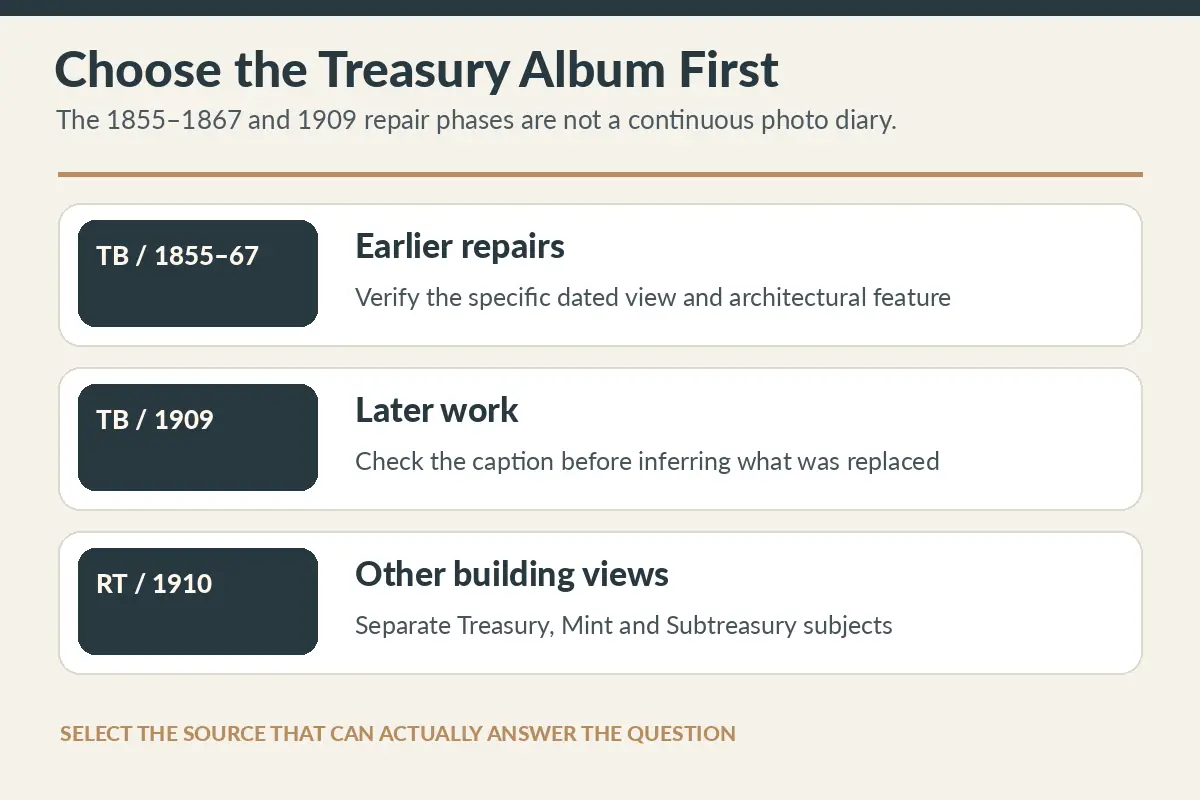
The TB description spans work from 1855 through 1867 and another group from 1909. Do not treat the wide span as evidence that the camera recorded repairs every year. First sort individual images by their own annotations, then note which views remain undated. A photograph showing exterior scaffolding may represent one discrete stage and may be separated from another view by decades. That interval should stay visible in a timeline.
A family story might place a relative in Washington during one of the repair phases. Start with independent residence and occupation sources to identify the correct period, then use the photographs to study the environment. Even a clear picture of workers on a scaffold does not identify an unnamed individual. Research becomes stronger when the picture illustrates a documented period rather than being forced to authenticate a family legend.
Distinguish TB Repair Albums From the Later RT Views
The RG 121 guide separately describes RT albums made in 1910. The RT grouping includes the Treasury Building but also the Philadelphia Mint and New York Subtreasury. An internet reproduction titled only “Treasury Department building” could therefore refer to a different city or site. Record the location from the original caption before comparing façades or inferring that a scene belongs in Washington.
Keep an album ledger with separate columns for series, item identifier, subject building, date, exterior or interior location, and the source of each attribution. If a print appears in two published versions, note cropping and caption changes rather than assuming separate building campaigns. When a feature cannot be matched confidently, describe it as an unidentified section instead of supplying a plausible architectural name.
What Building Fabric Can Reveal About Repair Work
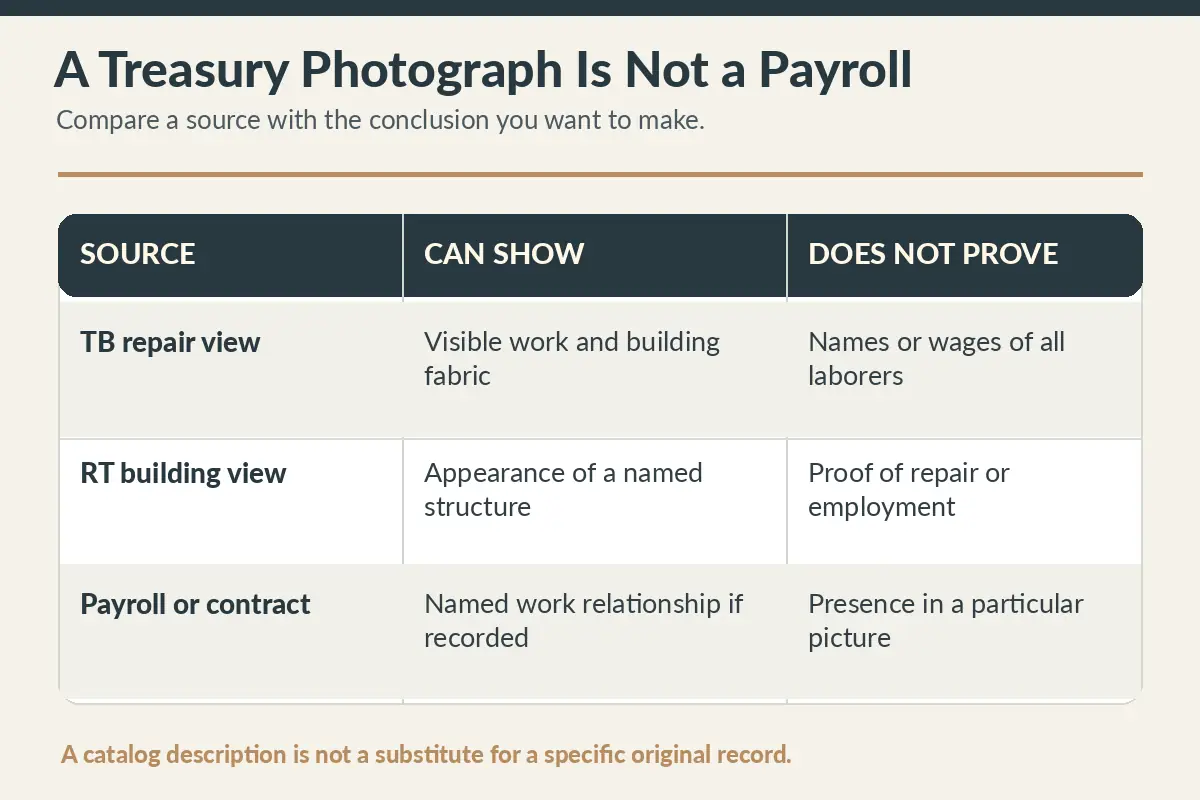
Repair photography is especially useful when it shows stonework, roof lines, doorways, equipment platforms, temporary barriers, or adjacent streets. Compare a feature across images only when you have established a reliable camera direction and dated context. A material that appears newly cut in one image may be older than its visible surface suggests; lighting, cleaning and reproduction contrast can mimic construction changes.
The photographs may suggest a sequence of dismantling and replacement, but the sequence is an interpretation until matched with records such as specifications, approved drawings, engineering reports or contractors’ accounts. Do not infer a final completion date from a tidy exterior. Buildings could remain in use during work, and the photograph might show only one section of a large federal structure.
Find the Worker or Contractor in a Named Document
If your question is whether a relative worked on the Treasury Building, search for a named payroll, contract, voucher, procurement record, correspondence or other record applicable to the exact date and responsible office. A contractor’s name on an agreement does not prove that a particular laborer performed a given task. A wage record may show payment or hiring, but may not prove the person appears in a TB photograph.
Names require identity work outside the building collection. Compare a suspected worker’s full name, occupation, household and Washington address with the candidate record. Where two people share a name, distinguish them through consistent dates and associates. If no individual file survives, report the research gap. The absence of a personal name in an album caption is not evidence that the person never worked there.
Cite the Individual Photograph and Its Historical Limits
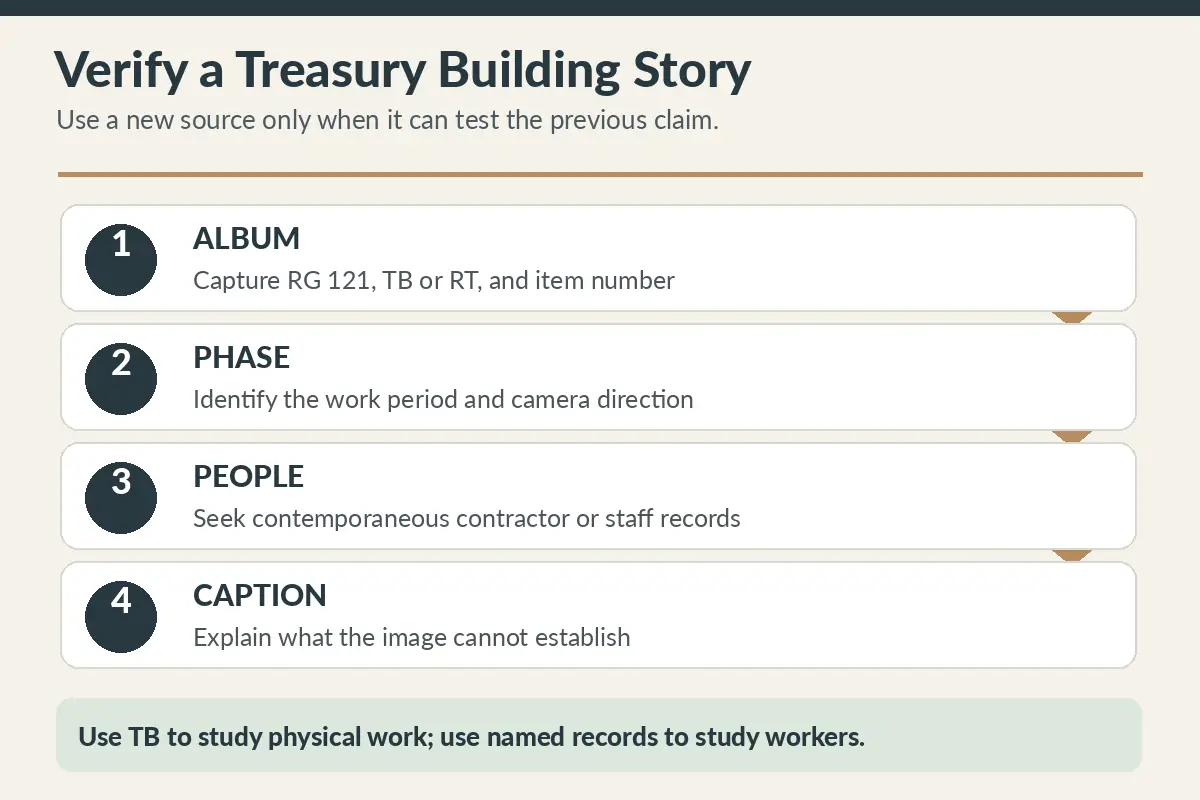
A usable citation should contain National Archives, RG 121, series TB or RT, a specific album or item identifier, and the title or caption exactly as encountered. Add the date shown or the cautious range supplied by the item. Cite a digital reproduction’s host separately when appropriate, and do not imply you saw a physical album when you only used the online collection description.
Explain a reconstruction with layers: what the photograph visibly depicts, what the NARA description says about its grouping, and what another dated document verifies. This is particularly important if a caption claims a worker’s participation, a significant engineering failure, or a specific date of completion. An image can make the building tangible without serving as a substitute for administrative evidence.
When comparing architectural photographs from successive projects, document the exact viewpoint and what lies outside each frame. Two pictures made from opposite corners can exaggerate apparent structural changes. Match stable features such as window spacing and surrounding street geometry before describing a wall as rebuilt. Distinguish a photograph of preparation from an image of completed repair. A researcher can note that the exterior appears changed without stating which contract, crew, or expenditure caused the alteration. This discipline is particularly helpful when a collection spans phases decades apart and when the prints are circulated without their original album sequence.
Worked Example: Was an Ancestor on a Treasury Repair Crew?
Imagine a letter written in Washington in 1909 by someone who mentions “work at the Treasury.” The statement might refer to repair labor, a clerical assignment or work for a contractor. First date and attribute the letter, then search relevant city directories and occupational records. Use TB photographs only after establishing which stage of work might match the letter. A photograph of a worksite offers context but does not identify the letter writer.
If a contractor’s payment document names the same person, compare addresses and job descriptions before declaring a match. Record the documentary connection in one note and the photographic scene in another. A responsible caption might say “view of Treasury Building repairs in the period when the individual reported working in Washington,” while explicitly leaving their physical presence in the image unproved.
More House and Local History Guides
How We Research and Check Archival Evidence
We cross-check the RG 121 descriptions against NARA’s pictorial series guidance, and distinguish documented dates from our own comparisons. If an item description, album page or contractor record has not been personally inspected, we do not claim that it confirms a particular worker, material or completion date.
For any tools, reproduction services or optional research resources discussed on GenHis, see the affiliate disclosure. No commercial partnership or paid link is implied by the archival examples in this guide.
No. NARA describes repair-album material for 1855–1867 and 1909; inspect item captions before constructing a sequence.
TB concerns repair albums; RT identifies 1910 views of several Treasury-related buildings, including locations outside Washington.
Not unless the specific item or independent named evidence identifies that person.
No. Completion should be checked in appropriate project or administrative records.
Give RG 121, TB or RT, the item identifier, and state the date as uncertain rather than inventing an exact year.