
Begin With 500 EX Photographs of Federal Buildings
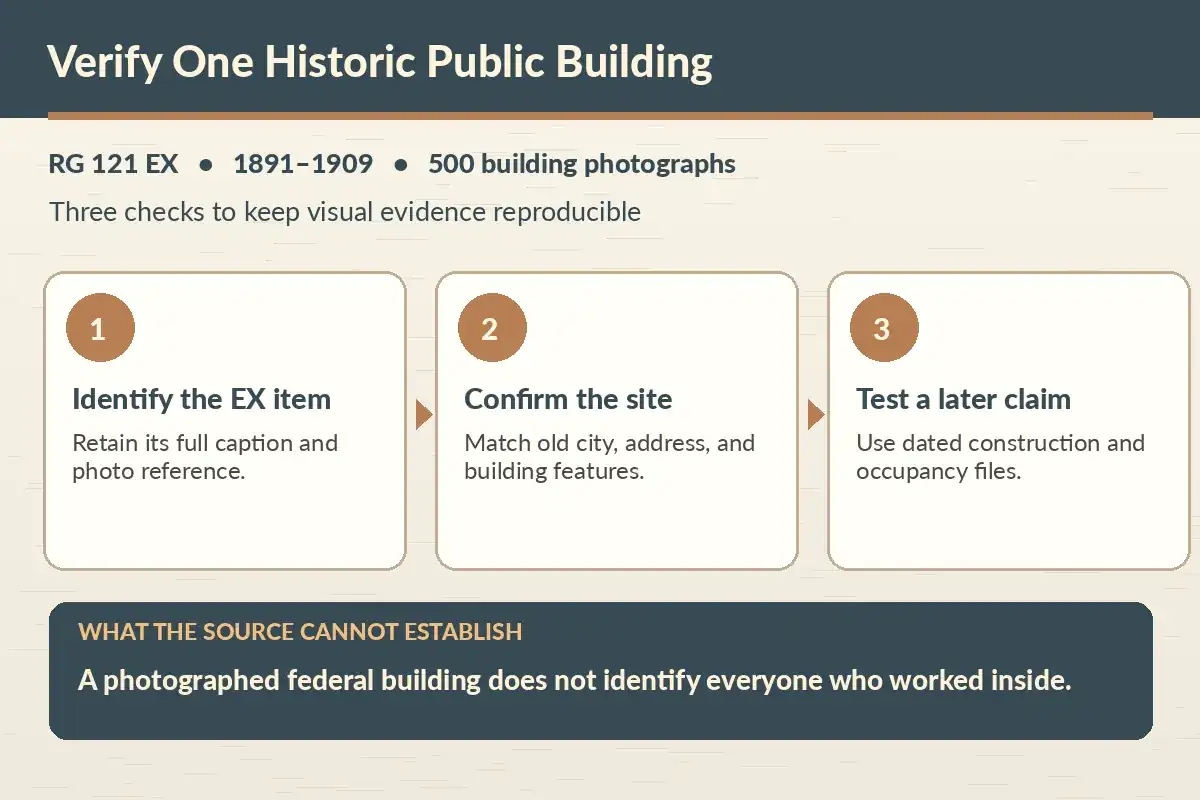
The National Archives describes approximately 500 photographs of public buildings dated 1891–1909 in RG 121 EX. This is a useful starting point for recognizing historic federal courthouses, post offices, and other government architecture. An exterior image, however, does not tell you which offices occupied every room, whether the building had been completed on the day photographed, or whether an ancestor worked there. The proper starting point is a documented site and its original caption.
Other RG 121 photographic groups cover public buildings in 1914 (CJT) and 1931 (MBW). They are alternatives, not successive folders in a single EX series. For an existing structure, the General Services Administration historic-building inventory may provide construction dates, architects, and location. Use that modern catalog as a cross-check, not as proof that a particular nineteenth-century photograph carries the same address or name.
Locate the 500 EX Views in Their Own Series
The National Archives group guide lists the EX designation specifically for public-building photographs from 1891 through 1909. Copy the letters along with RG 121 when requesting material. It matters because the same record group also contains site views, construction imagery, and later artwork collections. A post office subject heading alone may lead to several different series and very different date ranges.
For each EX image, record the full caption, known item number, original printed or handwritten place name, image format, and source of its date. Do not assume that all 500 images have been digitized or individually indexed. Some may require a staff inquiry or a series-level finding aid. An image reused in a later report may differ from the original in cropping or annotation.

Distinguish EX From the 1914 and 1931 Photographs
RG 121 describes other public-building series: CJT has 64 images dated 1914, and MBW has 45 images dated 1931. These separate entries are useful when following one building over time, but no catalog statement says that every EX building reappears in both later collections. A cross-decade comparison must be made image by image, with independently verified locations.
A building might have been enlarged, renamed, reassigned, demolished, or moved into a new federal complex. A second image bearing the same city name is not automatically the same site. Compare a dated footprint, entrance arrangement, distinctive roofline, neighboring structures, and the historic street grid. Treat a probable match as provisional until at least one independent feature or document links the two views.
Match a Historic Address to a Modern Inventory
The GSA historic-building inventory includes city, building name, building type, architect, and construction date for many federal properties. It can help distinguish structures that shared generic names such as “U.S. Post Office” or “Federal Building.” Begin with the historic city and function; then compare construction years and the position of the original facade before applying any present-day building title.
Not every building photographed between 1891 and 1909 survives or appears in the modern GSA inventory. Some became municipal property or were replaced. Search local land records, contemporary directories, insurance maps, and architectural drawings where the modern listing is silent. Do not insert a current building identifier into a historical photograph citation unless the match is demonstrated.

Separate Architectural Completion From Photographic Appearance
A facade photograph may show a building under construction, partly occupied, or fully functioning; the state of the exterior alone rarely establishes the administrative opening date. An original plan records intended construction, while a contract, completion report, inspection record, or newspaper notice can establish a different milestone. Keep design, contract award, construction, opening, and remodeling dates in separate fields.
If scaffolding, unpaved streets, temporary sheds, or a distinctive entry door are visible, describe them rather than guessing the building’s stage. Use a dated city map to place the site, but remember that maps may have compilation and revision dates. Architecture is an especially good source for local history when the reader can see exactly which observed details support a proposed identification.
Research Staff and Visitors From Named Sources
A photograph of a federal courthouse or post office cannot identify the clerks, judges, contractors, postal carriers, or public visitors who occupied it. Even an administrative directory usually establishes an office assignment rather than a specific day of attendance. If a family story involves an ancestor employed there, begin with the agency, occupation, and relevant year instead of reading a name from a facade.
Look for city directories, civil-service appointments, payroll or employment registers, postal records, court personnel listings, or period newspapers as appropriate. Some records are agency-specific and may not be held with the EX photographs. Cite any named personnel source separately. An employee in the city and a building appearing in the same year are still two facts until a document connects them.
Document the Building Identity and Its Limits
A repeatable image citation names National Archives, RG 121, EX, the local item reference, original caption, and the date as supported. Add a separate GSA or local archival citation for a modern building name, construction history, or reuse. When an earlier street address is uncertain, state the verified city and evidence for the candidate site rather than presenting a current street number as an archival fact.
An accurate conclusion might be: “An EX photograph depicts a federal building in this city during the 1891–1909 collection span; a later building inventory suggests a site match, but no employee roster is supplied by the photograph.” Such precision makes the image useful for house and neighborhood history without inventing owners, occupants, or dates.
More House and Local History Guides
How We Research This Collection and Its Limits
The series-specific count, dates, and record designation were checked against the National Archives federal records guide on November 16, 2026. Independent context was compared with a second official research source, while NARA still-picture citation guidance establishes the information needed to locate an exact image. The site topic list and earlier production titles were compared for duplication. A series description does not identify every subject, date, or object in every frame, and access to a fully digitized item cannot be assumed. The figures in this guide are newly drawn explanatory editorial illustrations, not historical negatives or genuine reproductions. We make no unverified claims of commercial endorsements. See the affiliate disclosure for site policy.
NARA lists approximately 500 public-building photographs dated 1891–1909 in RG 121 EX.
No. They are separately described public-building photographic series with 1914 and 1931 dates.
Use the GSA historic-building inventory, then cross-check the original address and historic photograph.
No. Find a named employment, directory, agency, or personnel record.
Look for independent completion or inspection documentation and a photograph whose date and location are verified.