
The National Archives series T 71 includes registers made under British colonial slavery administration, with named enslaved people in many Caribbean returns from 1813 to 1834. Start with a colony and, if possible, parish, estate or person who filed the return. The official archival guide explains digitized and original access. A register is evidence of a coercive administrative system; its categories, spellings and age estimates require critical treatment and never establish family ties simply through shared ownership.
Begin With Colony, Parish and a Name Variant
The registers were produced by administrations that treated enslaved people as legally controlled property. This context determines both what the papers record and what they often omit. Search by the individual’s recorded name where it is known, but also collect a colony, parish, plantation or estate, and a possible owner or returning agent.
First names may dominate a return, and surnames may be absent or imposed by record keepers. Do not infer a family name from the enslaver’s surname. As the National Archives guide notes, records of individuals before these registers can be considerably harder to locate.
Understand Which Years and Colonies Survive
The first colonial registration dates vary. The Archives describes slave registers from 1813 to 1834 and broader T 71 records running beyond the registers into compensation-related administrative papers. Not every year, colony or local district has the same form or sequence.
Before deciding that a person disappeared, establish that the return exists for the expected colony and registration year. Some digital databases reproduce only subsets of T 71, while the originals and related materials in Kew may contain more than an online name entry. Record the precise series, piece, registration date and responsible jurisdiction; 1813 does not imply the existence of a register for every island.

Follow Return-Filer Indexes to Original Entries
The principal name index is not always an alphabetical index of enslaved people. Some T 71 volumes index estate owners, attorneys or the person who submitted a return; others have name indexing under a plantation or enslaver.
A failed search for an enslaved person’s name therefore cannot eliminate a possible original register entry. Begin with parish, property and known return filers when direct searching fails, then inspect the relevant register pages, not merely the search result. When a digitized provider has a record, confirm whether its heading describes the colony, estate and official return year or is an automatic label produced during transcription.
Transcribe the Fields Without Adopting Their Assumptions
The custodian identifies possible fields such as individual name, age, sex, reported nationality and parish, with owner information. The forms may also record changes or movements between returns. Note what the page literally says, using quotation marks when historical language is necessary and explaining discriminatory or coercive categories.
Do not transform a recorded age into a verified date of birth or a nationality label into self-identification. The administrative interest in counting and controlling people limited the opportunity to record their own family histories. An absence from a column is not proof of death, sale, migration or freedom.
Compare Consecutive Returns Carefully
To track a named person across multiple registration years, compare colony, parish, plantation or estate, any person number, reported age, sex and return-filer identity. A change in estimated age may reflect guesswork rather than two distinct individuals. A person missing from a later list could have been transferred, had a name changed, died, been freed or simply been omitted from the copy that survives.
Look for a dated change note and corroborating source before assigning a reason. Build a year-by-year evidence grid in which every observed name and absence has its own citation and uncertainty level. Resist building a continuous life story solely from repeated administrative listings.

Separate Enslavers, Agents and Named Individuals
One property record may identify an owner, an estate manager, a legal attorney who filed a return, and dozens or hundreds of enslaved people. Their names are not interchangeable roles. A modern index may emphasize the more searchable owner’s surname even when the question concerns another person.
Record the filer’s role, estate name, names of people listed and the actual page separately. An enslaver’s documented ownership does not imply biological ancestry, and two people appearing in the same estate list are not necessarily relatives. The broader National Archives slavery research guide provides context for additional legal and administrative records.
Link to Later Freedom and Civil Records With Care
The British Caribbean emancipation transition and later civil, church and community records can help test identities appearing in early registers, but record coverage, naming practices and legal circumstances differ by colony and period. When following a name after the abolition of slavery, look for the same locality, neighbors, family associations and independent dated events; do not assume all people sharing a first name and estate name are one individual. Compensation-related T 71 papers concern claims made to slaveholders, not compensation awarded to the formerly enslaved. Avoid treating an estate payment as proof of the location or subsequent fate of every person formerly recorded there.
Write a Respectful Two-Candidate Comparison
Suppose two children named Sarah appear in returns from adjacent Jamaican parishes with close ages. A surname assigned later in a baptism or marriage record may appear to connect them, but the register alone cannot make that link. Compare registration year, estate, reported birthplace when present, names of other people associated with each return, and later independent documents.
Keep each candidate separate until there is a persuasive, sourced connection. Reproduce only the parts of a historical list necessary to support the finding and preserve the dignity of the people whose lives it records. Avoid converting uncertain administrative classifications into definitive personal identities.
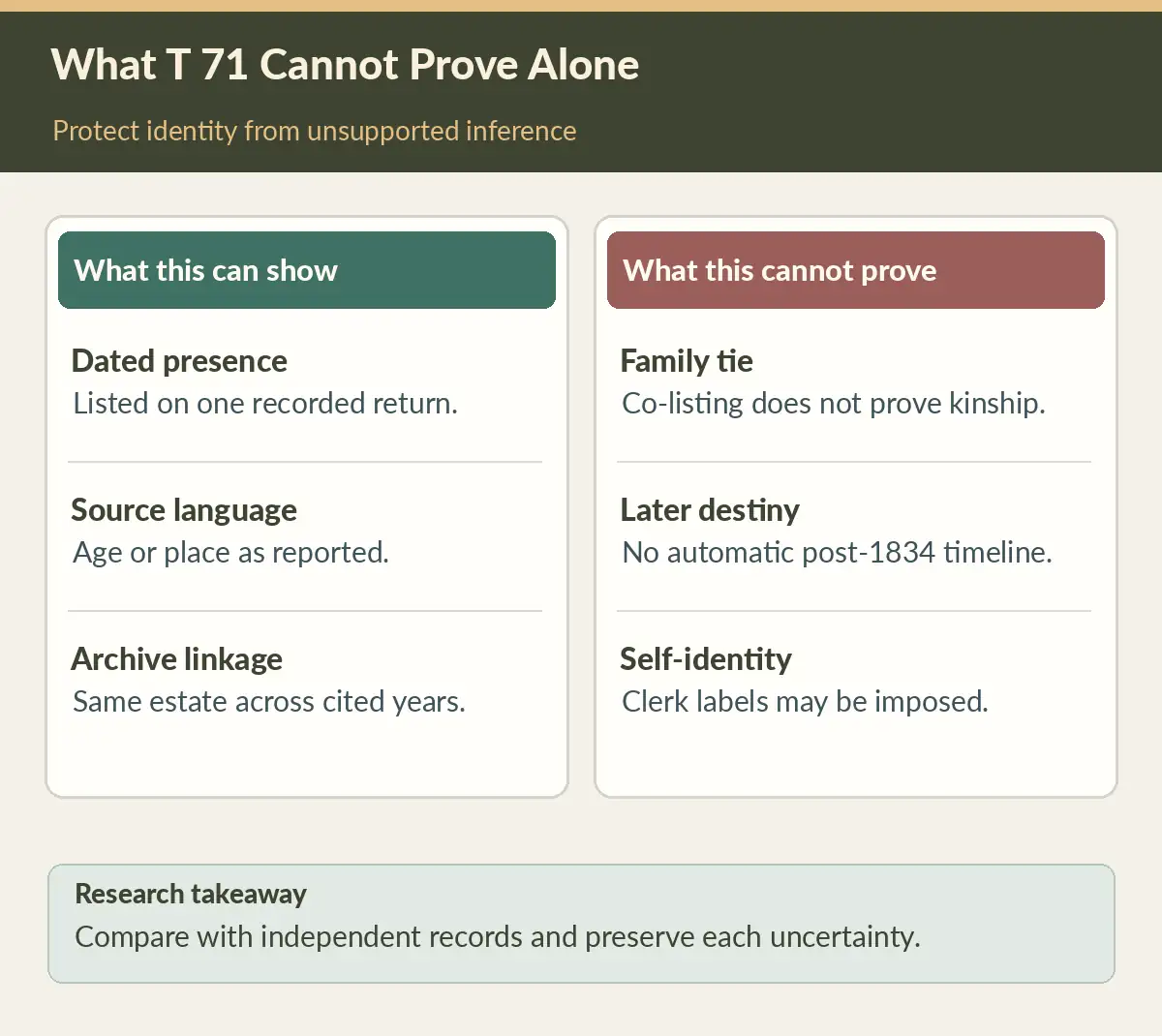
How We Research T 71 Registration Evidence
We locate the colony and parish before judging a name match, identify whether an online result is an enslaved individual’s entry or an index to an owner or agent, and read the actual original image. We transcribe names, ages and status language as source statements without adopting colonial classifications.
We compare consecutive returns and independently produced church, civil, court or later family records. If only an index survives in the research environment, we disclose that limitation. The affiliate disclosure provides site transparency and has no bearing on official T 71 evidence.
More Records and Archives Guides
Preserve an Exact Archival Reference
Cite T 71, the colony, parish or estate, volume or piece number, folio or page, year and the exact person or filing agent, followed by the digitized provider or Kew holding consulted. If a subsequent document in the Slave Compensation Commission collection is used, cite it separately rather than implying it comes from the same register image. Keep alternative name spellings and the words used by the clerk in a transcription field; write a separate humane interpretation with the limits stated. A precise trail allows future researchers to reassess identities as more original records become accessible.
No. The beginning and survival of registration vary by colony and local administration.
Sometimes, but owner, estate, agent and parish indexes may be essential.
No. Co-listing under coercive ownership is not evidence of kinship.
No. Compensation claims concerned payments to enslavers, not to the people whose labor had been coerced.
Record the colony, date, T 71 piece, page or folio, estate or parish, and the original individual entry.