
C 211 contains abstracts of petitions for Chancery commissions and inquisitions concerning people historically described in legal records as ‘lunatics’ or ‘idiots.’ Those are period terms, not descriptions we should apply to a person today. The National Archives describes C 211 as covering roughly 1627–1932, with name-searchable catalogue descriptions from 1853 onward. This is not a run of hospital case notes, nor is an abstract the complete surviving file. Treat it as the opening lead to legal oversight of a person’s affairs.
A petition could ask the Lord Chancellor to determine whether an individual could manage their own affairs. Petitioners were expected to support the request with sworn evidence, but the associated affidavits generally do not survive. The petition abstract can give the gist of what was alleged; it cannot substitute for the missing testimony. Make the first research question precise: who sought an inquiry, when, and what procedure followed? That is far safer than asking what illness a named ancestor supposedly had.
Choose a Search Route on Either Side of 1853
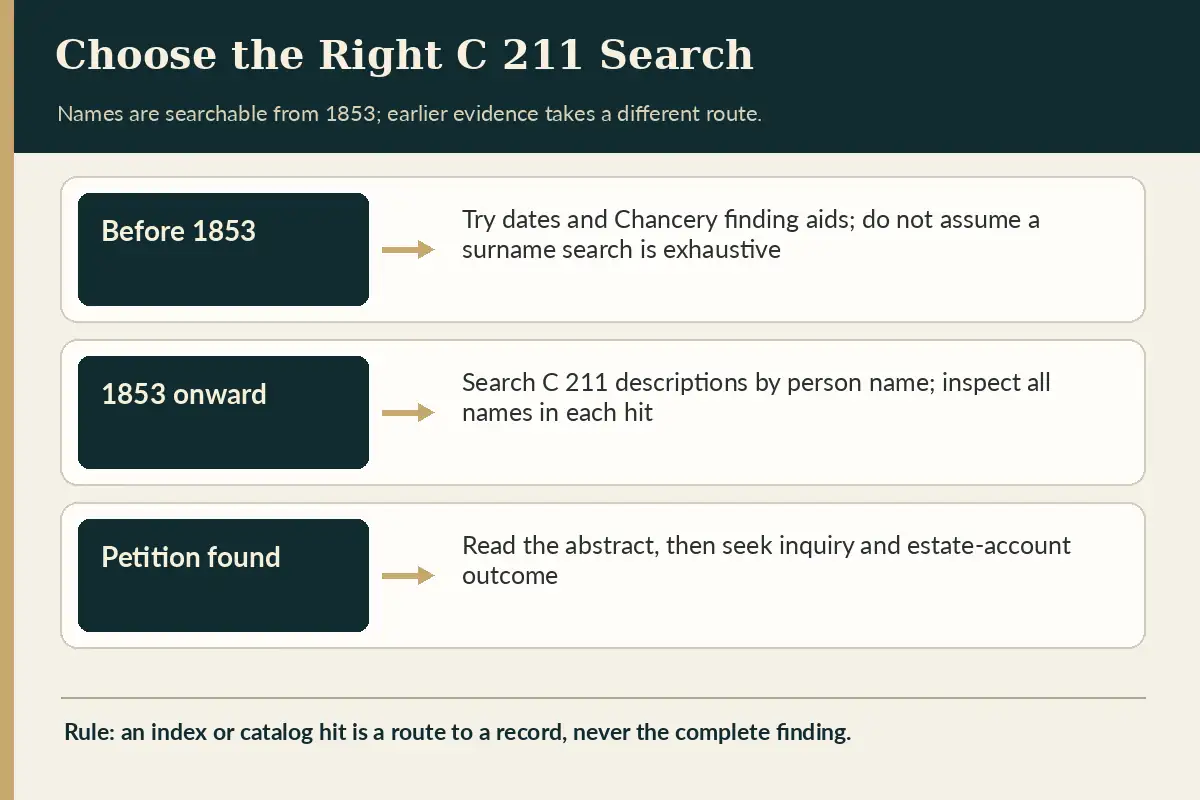
For an inquiry from 1853 onward, begin with the name-search option in C 211, using spelling variants, additional surnames and the known place. The National Archives warns that its series search can find any name present in a catalogue description. A hit therefore might refer to a petitioner, the person whose affairs were at issue, a committee member or someone else. Write down the role only after reading the description and the underlying item.
For an earlier event, do not treat a failed surname query as conclusive. Search within the series by period and relevant descriptive terms, then seek advice on older finding aids or chronological references. A family story may date an institution admission, estate transaction and Chancery petition differently. Keep those dates in separate columns rather than forcing one supposed ‘case date.’ Always record the exact C 211 piece reference, not merely a website result title.
Separate the Petition From the Court’s Finding
The legal sequence matters. A petition asked for an inquiry; the Lord Chancellor could order commissioners to investigate; an inquisition could then record a finding. If a person was formally found unable to manage their affairs, their person and estate might be placed under committees appointed for distinct responsibilities. None of these stages should be silently presumed from a petition summary. Build a procedural ledger with a row for each event, the original words used and the document that supports it.
For example, an abstract reporting that a brother claimed a sister was unable to handle property is evidence that the brother made an allegation. It does not establish that the allegation was true, that the sister was confined, or that the brother obtained legal control of assets. The correct follow-up is to locate an inquiry outcome and the authority by which anyone later handled the estate. Avoid reproducing sensational historical labels as if they were reliable diagnoses.
Follow the Estate Without Assuming Family Relationships
The National Archives identifies possible later records in C 101, the Chancery Masters’ accounts, whose indexes are among IND 1, and in J 103 for registers of committee bonds for 1817–1904. These record classes answer financial and administrative questions rather than re-creating a complete personal biography. When appropriate, ask whether an account was actually filed and whether it concerns the same individual identified in C 211. A bond may be evidence of security given by a committee, not proof of inheritance.
Compile a role table: petitioner, person under inquiry, committee of the person, committee of the estate, and any accountant or beneficiary explicitly named. Repeated surnames can suggest connections without proving them. Confirm kinship through independent marriage, parish, probate or deed records. If an account gives a location, check whether it describes the estate, the administrator or the person whose affairs were supervised; those places can be entirely different.

Handle Missing, Closed, and Sensitive Material
Because affidavits usually did not survive, do not claim that the C 211 abstract includes the whole evidence presented. Other records may survive only sporadically, and some twentieth-century case materials can be subject to access restrictions. A no-result search in one Chancery series is not a finding that no inquiry occurred. Record the precise coverage, index type and spelling tried so the next researcher can reproduce the search.
If a record concerns a person who may still be living, avoid publishing identifiable medical speculation. Even with historical individuals, distinguish legal categories imposed by institutions from present-day clinical language. Rather than writing ‘the ancestor was mentally ill,’ cite a specific petition or finding, its date and its historical terminology with context. Your goal is to preserve what the archive can show without turning a procedural record into a personal verdict.
Build a Claim-Level Proof Note
An effective note states the question, the source’s exact reference, the author or legal function of the document, the claim it directly supports and the separate question still unanswered. One sentence might establish that a petition was filed by a named individual in a particular year. Another, only after consulting it, might describe a later order. Do not blend the two because a calendar lists them near one another.
Use an independently sourced timeline to test whether dates, aliases, addresses and known property holdings fit the target person. If two candidates have the same name, a document naming a manor or relative may help discriminate, but explain each linkage. An archivist’s series description is an excellent guide to scope; the original item remains the evidence for an actual ancestor. The final proof note should be cautious enough that someone else can contest or confirm every step.

More Records and Archives Guides
How We Research This Archive Route
The National Archives’ mental-health and asylums research guide sets out the historical Chancery procedure and C 211 coverage. Its wording records past legal classifications; our article does not treat those classifications as modern diagnoses. We distinguish petition, inquiry and committee actions before stating any outcome. The archive guide establishes which record series to investigate; only an inspected record can support a statement about a named person.
Use the official Discovery explanation for catalogue-search limitations and the archival citation guidance to record a piece and folio. The privacy and sensitivity of historical mental-health material make accurate attribution especially important. See our affiliate disclosure; no affiliate purchase is required to inspect the official research guidance.
No. It records allegations and legal procedure in period language. A petition alone is not a clinical diagnosis or necessarily an inquiry result.
C 211 name-searchable catalogue descriptions begin in 1853. Earlier material needs a date-led search and other finding aids.
The National Archives says the underlying affidavits generally do not survive; petition abstracts usually preserve only their gist.
Depending on period and survival, check the indexes to C 101 accounts and committee-bond material such as J 103.
No. Administrative appointment and family relationship are different claims requiring their own evidence.