
Chancery Significations C 85 is most useful when a researcher distinguishes the administrative record from the event or relationship it mentions. Begin with a reference, the document’s author and date, and the specific question you want to answer. The safest method is to choose the correct record type, read its own wording, and seek independent corroboration before claiming a person, place, or outcome. This guide gives a source-specific route for C 85; see the official National Archives research guidance and the related reference resource for context.
Understand the Church-to-Crown Paper Trail
C 85 contains significations of excommunication: formal notifications reaching the royal authorities about people reported as remaining disobedient after ecclesiastical excommunication. The National Archives identifies these records as a distinct class of Church–Crown communication and warns that they contain little personal information about most individuals. The presence of a signification does not establish that an arrest followed. A spiritual or ecclesiastical sanction and its possible secular enforcement are different events, generated by different authorities.
When reading a C 85 entry, identify the authority that sent the notification, the individual or group named, the date of the communication, and the administrative jurisdiction. Avoid adding a reason for excommunication when the surviving text does not specify one. The series may point toward conflict involving a religious house, debt, or ecclesiastical discipline, but each case must be read from its own wording and corroborating papers.
Find the Correct Date and Province
The National Archives guide directs researchers to search C 85 by date and by province or name of a religious house where appropriate. Build a query around the region and period first, then a documented name spelling. Medieval ecclesiastical provinces do not map neatly onto modern counties or diocesan changes. A person could be associated with a house in one place and appear in correspondence originating from another.
Record each calendar date as presented; when a regnal year or ecclesiastical dating convention is present, preserve the original form in your notes. If modernizing the date, state that it is a conversion. Medieval personal names often appear in Latin or variant spellings. A match in name alone does not establish that two references concern the same person. Note institution, role, year and the named ecclesiastical official to test identity.
Pair the Signification With an Episcopal Register
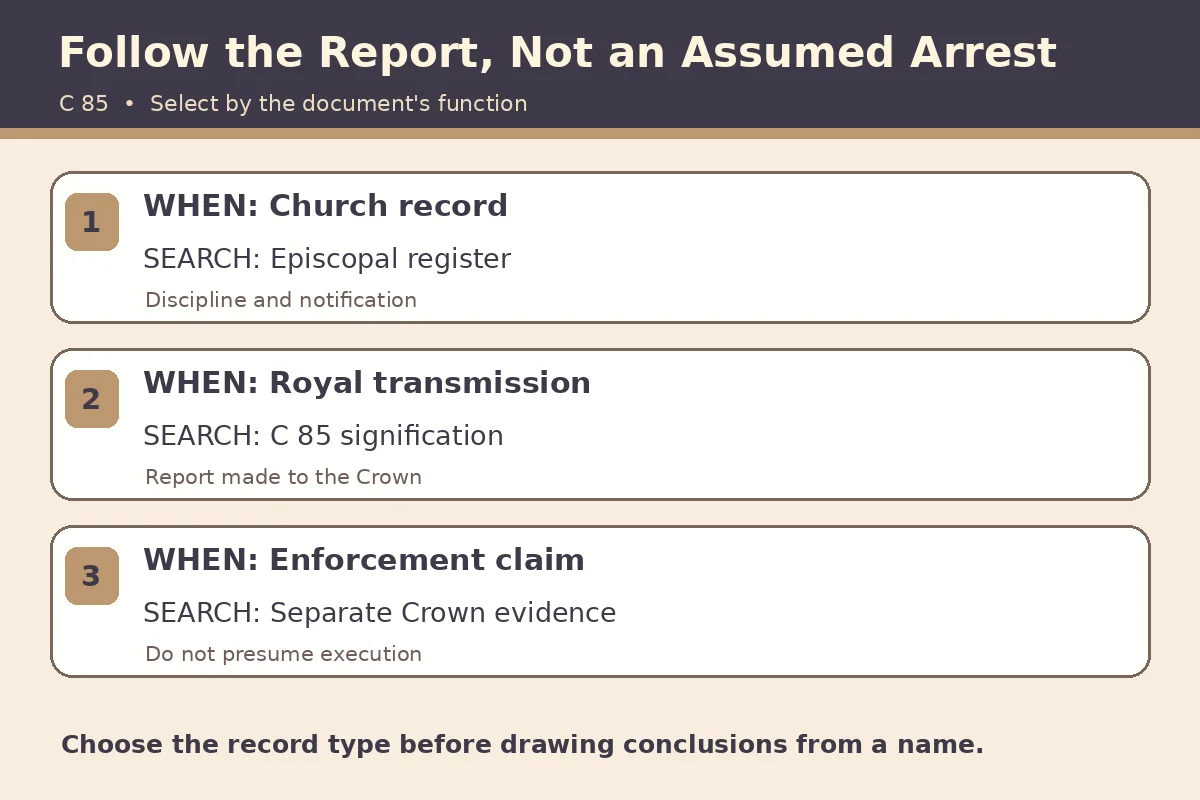
An episcopal or archiepiscopal register can preserve a preceding ecclesiastical instruction or the text of an official communication. This offers the first route for checking the local stage of a case. The York Archbishops’ Registers database, for example, describes a 1332 signification concerning Henry de Shirokes and explicitly cross-references TNA C 85/182/43. Such an identifiable match is much stronger than treating a C 85 catalog entry in isolation. The two records may show different steps, even when they refer to one dispute.
Compare the sender, recipient, named person, date, and wording. A register may summarize an order to notify or discipline someone; the C 85 record may show transmission to royal authorities. If the dates differ, they may reflect different stages rather than a contradiction. Do not write “he was arrested” unless independent evidence actually records detention or execution of an enforcement process.
Separate Legal Status From Personal Identity
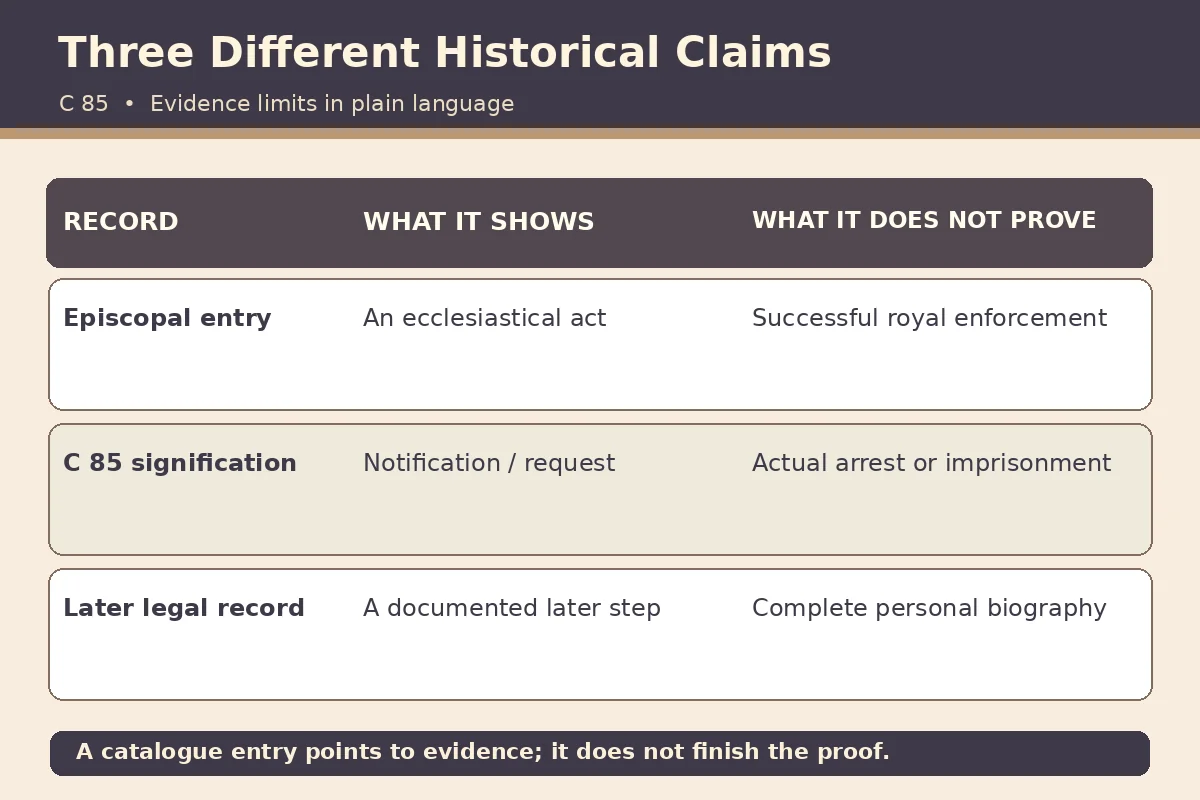
An excommunication record does not normally provide an ordinary household biography. Treat any title, office, religious affiliation, and place name as specific attributes tied to the document date. “Former warden” is not equivalent to a lifelong appointment. A Latin name and nearby parish are insufficient to merge multiple people. Compare chronicles, episcopal registers, charters, accounts, or parish evidence appropriate to the period, and explicitly record where the correspondence only identifies an official status.
Be careful when describing causes and consequences. Excommunication could arise within many ecclesiastical processes; the C 85 signification does not itself prove underlying misconduct or resolve a disputed allegation. Use the neutral phrase “reported as excommunicated” or “the notification names” when that is all the source demonstrates. This guards against turning a medieval administrative accusation into a modern judgment of character.
Look for Enforcement in a Different Record
For a claim about an arrest, imprisonment, release, or other royal response, seek separate contemporaneous Crown or legal evidence. The church-to-state notification is evidence of a requested or reported administrative step. It is not the same as an executed warrant or a documented period in custody. The records might not survive as a continuous sequence, and official action may have been delayed, refused, or modified.
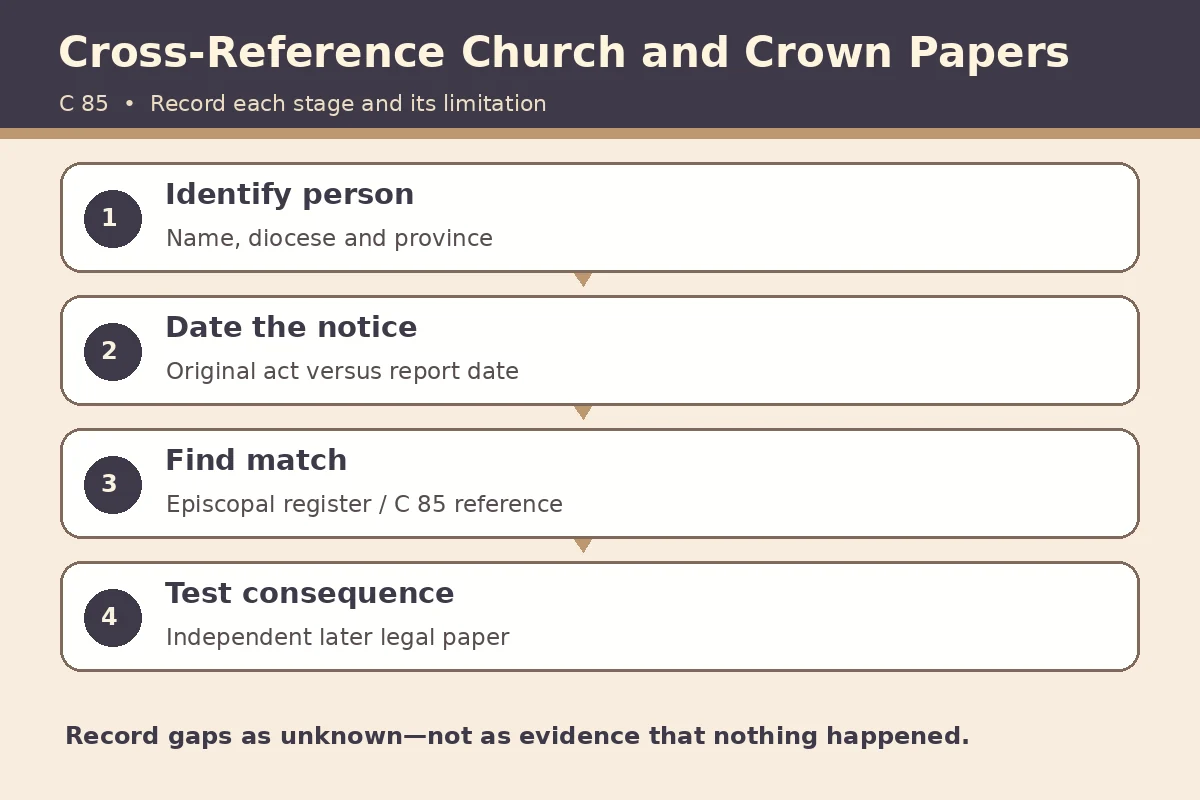
Build an action table: ecclesiastical decision, signification sent, royal process issued, outcome documented. Enter a date and citation only when the relevant record exists. Where a stage is not found, label it “not established,” not “did not occur.” If a secondary book narrates later consequences, trace its cited primary source before reproducing the claim in a family or place history.
Write a Cautious Historical Conclusion
C 85 is particularly valuable because it records an institutional relationship between medieval religious and royal governance. It can reveal a name, a communication, and the existence of a dispute invisible in parish materials. Yet its brevity means that even a well-matched record may support only a narrow conclusion. Cite the original C 85 reference together with any matching bishop’s register page, and distinguish the date of the church act from the report date.
When a name cannot be traced further, say so. Search by province, date, house, and variant spellings before reporting a gap. Do not infer guilt, poverty, rebellion, arrest, or family status solely from a signification. Reliable medieval genealogy often consists of a few carefully attributed facts and transparent unknowns; the restraint is a strength rather than a deficiency.
More Records and Archives Guides
How We Research C 85 Records
We begin with the National Archives series-level description and then read the second cited source to test the surrounding record system. Every search is logged by name variant, date, jurisdiction, and full archival reference. We separate an explicit statement in a source from a reasoned interpretation and from an unverified possibility. Cross-record matches require compatible dates and roles as well as a matching name. We never treat an index, map, petition, or summary as a substitute for the original when an original can be consulted.
This article is independent research guidance, not proof of a particular person’s biography, a guarantee of document survival, or professional legal advice. For transparency, read the GenHis affiliate disclosure. Links to public archives are provided for research, not as claims of sponsorship.
No. It records a signification of excommunication to royal authorities; look elsewhere for enforcement evidence.
Use date, ecclesiastical province, or the name of a religious house as advised in the National Archives guide.
Usually not in detail. The National Archives warns that C 85 contains limited personal information.
Yes. They can preserve a related church act; the York register for Henry de Shirokes cross-references C 85/182/43.
Not necessarily. Report only the reason explicitly documented and check related ecclesiastical case records.