
C 210 contains Petty Bag Office specifications of English inventions from 1709 to 1852. This guide identifies the original record path, shows exactly which claims the source supports, and explains which separate evidence is still needed.
Start with the Patent, Then Choose the Office
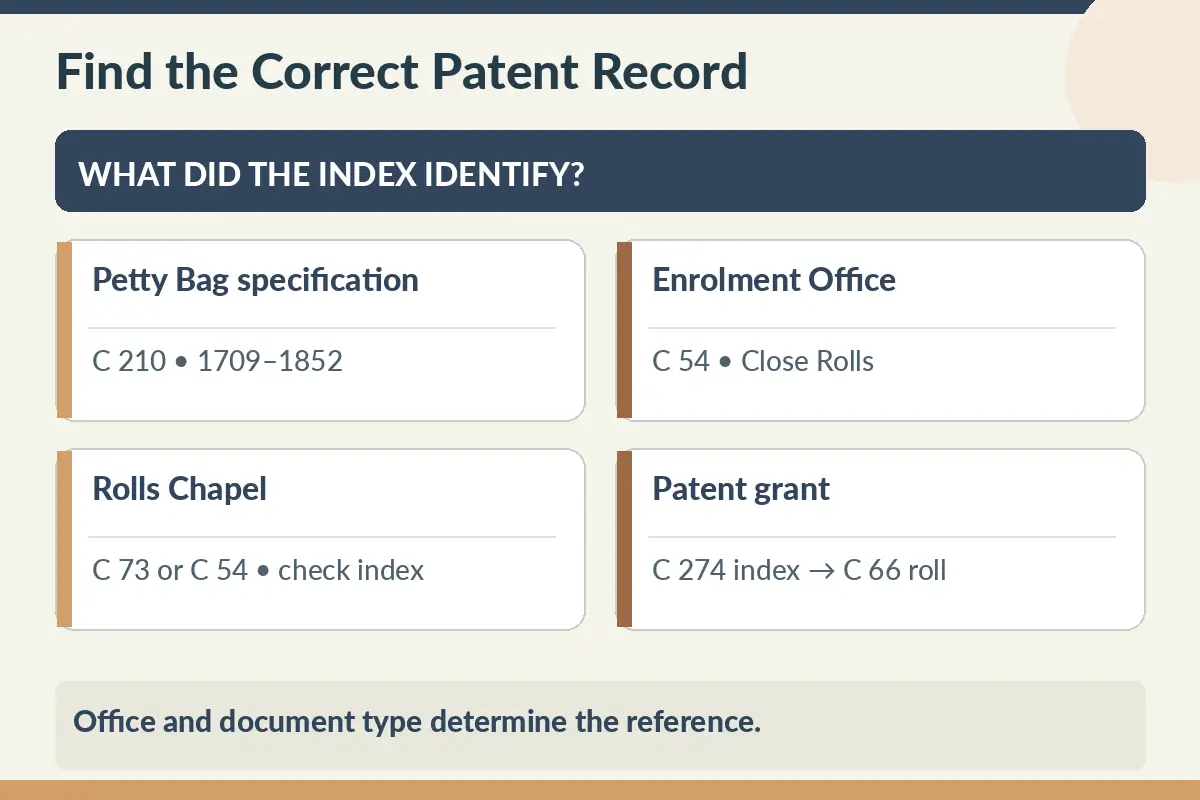
C 210 contains Petty Bag Office specifications of English inventions from 1709 to 1852. The National Archives’ patent guide explains that specifications could be enrolled separately from the letters patent and in different Chancery offices. An invention’s grant was recorded on the Patent Rolls in C 66; a technical description might instead be in C 210, C 54 or C 73. This is why an early patent number cannot be used as though it were already the location of a specification drawing.
Start with the named patentee, approximate date and invention as described by a contemporary source. Then establish whether you seek proof a legal grant was made, an enrolled technical specification or evidence that a device was actually manufactured. The sources answer different questions. A drawing proves that a design was recorded in the particular document, not that a factory made the invention or that a named worker used it.
Understand the 1709–1852 Petty Bag Boundary
The Archives specifically identifies Petty Bag Office specifications in C 210 for 1709–1852. It notes that specifications became obligatory from 1734, although technical descriptions began earlier and dates of filing could be later than the actual grant. The Patent Office assumed responsibility in October 1852, with later patent records normally directed to the British Library. Treat those dates as useful search gates, not evidence that every invention of the period has a Petty Bag roll.
An inventor active in 1740 may have a specification filed months after a grant, or filed with a different Chancery office. The Woodcroft reference index helps determine where to look. Do not route everything marked “Rolls Chapel” into C 210: C 73 and C 54 have their own finding aids and historical quirks. Record the office attribution, the grant date and the specification enrolment date separately, especially when building a timeline for a family inventor.
Convert the Woodcroft Entry to C 210
The National Archives gives a precise Petty Bag procedure: the Woodcroft alphabetical Index of Patentees has been marked with modern C 210 references; specifications are also listed by date in two volumes labeled “Refers to C 210, vols 1–2.” Volume 2 includes a name index arranged by initial letter in three sequences. Where a list supplies a part number, prefix it with C 210 to obtain the modern archival reference. Record the index volume and line so another researcher can repeat the lookup.
Confirm that you are using the Petty Bag index, not a close-roll division letter or a Rolls Chapel report number. Check the year, spelling and invention summary against the Woodcroft entry before requesting the roll. Do not fabricate a C 210 reference merely because an inventor’s name occurs in an online patent summary. The piece may require reading room consultation; the Archives warns that parchment rolls can be large and difficult to handle.

Read Technical Descriptions Without Assuming Production
A specification describes a proposed invention in the form preserved and may include working details or drawings, depending on the document. Some early inventions had little detailed description, and sources before the standardized specification requirement need particular caution. Transcribe what the image or text actually labels: mechanism, component, view, dimension, inscription or date. Do not turn a schematic into an engineering performance claim that was not tested in the record.
Separate the people named on the grant, the people who wrote or witnessed the specification and the people who supposedly manufactured or operated a machine. A legal patentee might hold rights while another workshop built prototypes. Patent descriptions can be ambitious, and even a complete, intricate drawing is not a shipping receipt, exhibition account or workshop ledger. To prove manufacture, seek independent contemporary trade catalogues, company archives, correspondence or invoices tied to the same invention.
Cross-Check C 66, Other Enrolment Offices, and Date
The National Archives guides readers from published Woodcroft indexes and C 274 annual patent calendars to the enrolled C 66 grant, while separately consulting Woodcroft indexes for the specification office. For the Petty Bag path use C 210; for Enrolment Office close-roll entries use C 54, and for appropriate Rolls Chapel entries check C 73 or C 54. Not every patent produces both types of readily located original, and the search route depends on the office that kept the record.
Use a two-date worksheet: grant date and specification enrolment date. Copy the inventor name and short description from each original, noting spelling differences. Do not treat a document dated by a regnal year as a straightforward calendar-year equivalent without checking the conversion. If a drawing has been detached or is referenced separately, use the Archives’ catalogue details to establish present custody before claiming the roll contains all the associated sheets.

Report an Invention with a Tested Evidence Limit
A careful finding might state: “A Petty Bag Office specification in C 210 describes this named mechanism and carries the recorded enrolment date; no independent evidence of manufacture has yet been located.” Cite the specific roll or part as actually found, the C 66 grant if examined, and independent records for any real machine. This is more useful than a speculative story that the patentee constructed an industrial empire because a diagram survives.
Keep the full Woodcroft conversion trail, original name variant, patent and specification dates, alternative offices checked, and access instructions. If only an index entry was consulted, label it an index. If a published nineteenth-century copy was used instead of the original parchment, say so. A reproducible search protects both the inventor’s documented legal rights and the limits of what the surviving design can tell us.
More Records and Archives Guides
How We Research, Cite Sources, and Test Limits
The record families, dates, historical jurisdiction, index methods, and evidence limitations above were checked against these source pages: The National Archives guide; The National Archives citation guidance; Discovery catalogue guidance. A series description explains what a collection is and where to begin; it does not establish that a particular unseen item contains a given person or that a reported event occurred. We distinguish source transcription from reasonable historical inference, with no invented sample cases presented as real discoveries.
For every claimed match, retain the archive series, precise piece and item where available, the date as written, an access note and the independent source used for identification. Do not interpret a failed name search as proof that an event did not occur when records may be unindexed, missing or organized by place. See our affiliate disclosure; this method requires no paid relationship or endorsement.
The National Archives identifies Petty Bag Office patent specifications in C 210 for 1709–1852.
No. C 66 records patent grants; C 210 is one possible series for separately enrolled specifications.
Use the marked Woodcroft index or the Petty Bag date volumes and put C 210 before the correct part number.
No. It documents the enrolled design; independent evidence is needed to establish actual production or use.
Check the appropriate C 73 or C 54 finding route rather than forcing the entry into C 210.