
MAF 326 can help answer a specific historical question, but the series title alone is not evidence that a named person, road, site, or event existed exactly as family tradition describes. The starting point is to understand the record creator, the kind of source preserved, and its limits. This guide provides a source-first method for finding the appropriate record, tracing its date and jurisdiction, and corroborating a claim without transforming an index, proposal, recommendation, or report into a fact it cannot establish.
Start With a River Reach, Not an Accused Factory
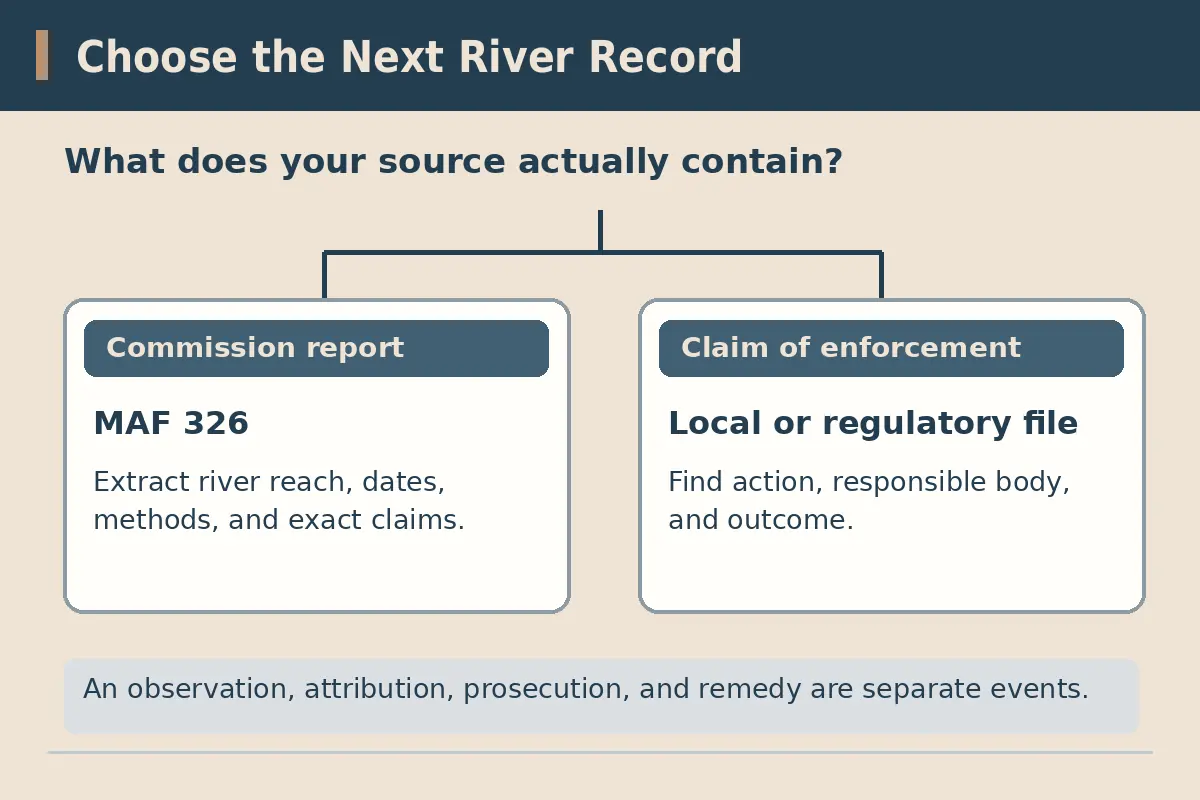
MAF 326 contains reports of the Standing Commission on River Pollution according to The National Archives’ environmental-history guide. It is a promising starting point for a documented history of environmental concern or inquiry, not a ready-made list of criminal convictions. Begin with a river name, tributary or named stretch, historic local authority, and approximate period. River names can cover many miles, and a report on one reach cannot automatically establish conditions upstream or downstream.
Write the proposition in a testable form: “A commission report investigated pollution near this locality,” rather than “A named factory poisoned the village.” Family letters, newspaper complaints and a surviving riverside photograph can provide search leads, but each has a different perspective and dating problem. Record the exact locality and who made each allegation. If a historic mill, tannery or sewage outfall is involved, note it as a potential subject until the source actually attributes conduct or a measured effect.
Distinguish Observation, Interpretation, and Attribution
Examine the report’s author, purpose, geographic scope, date, and whether it offers field observations, tabulated measurements, testimony, recommendations or a summary of previous work. The methodology matters: a single observation, a repeated sampling program and a resident’s complaint give different kinds of evidence. The wording used for water condition, pollutant or suspected cause should be quoted accurately with page references. Historical analytical techniques and categories are not automatically equivalent to modern regulatory limits.
Do not translate a reported association into proven legal responsibility. A commission could describe effects, identify possible causes or recommend action without determining liability. If a report discusses several industrial sources or municipal waste, list them as separate claims. Use a table with columns “source wording,” “date and reach,” “support,” and “unproven inference.” This helps distinguish a commission’s observation from a modern investigator’s speculative reconstruction.
Historical parish and administrative boundaries do not always follow a river. Search both banks and neighboring authorities where a reach crossed a jurisdictional line. In early records, a mill stream, brook, drain and named river may refer to connected but distinct waterways. Trace the geography with dated maps and record any uncertain identification instead of merging place names.

Use Related Series Without Making a False Sequence
The same National Archives guide identifies MAF 49 for records of the River Pollution Joint Advisory Commission. That is a related administrative route, not a compulsory next volume after MAF 326 or proof that each commission report triggered a particular decision. Other policy records may be held under different departments that regulated agriculture, industry, local government, or public health. Begin with the agency and date named on the report before expanding the search.
To find the right file, search by the contemporary river name, town, works, catchment, or pollutant where appropriate, then browse series descriptions if keyword results are sparse. A catalogue hit may represent a long report covering multiple locations; it does not mean the full text is searchable in Discovery. Note the piece number and access status, then inspect original pages or request them. A non-result should be described as a limited search, not as proof a river was clean.
Check What Local Authorities Actually Did
If your research question is whether a cleanup followed the report, look for dated water authority papers, local council minutes, parliamentary questions, legal notices or court records appropriate to the time. Record which body had responsibility for the relevant river and action. An investigation and a recommendation are not the same as a statutory order; an order is not proof that work was completed; a later photograph does not quantify water quality. Assign every step its own evidence.
Imagine a hypothetical 1960s report mentioning discolored water below a mill. A family history then says the owner was convicted. To substantiate that allegation, a researcher would need independent court or official enforcement evidence identifying the responsible legal person, charges, findings and date. Do not infer a conviction merely because a mill was located near an affected reach. If an environmental improvement is claimed, look for comparable later measurements or a dated administrative completion record.

Describe the Community Without Erasing Uncertainty
A local environmental history may combine scientific documents with family testimony about fishing, swimming, odors, employment, and the landscape. Such accounts are valuable, but they should be attributed to their speakers and not silently translated into measurements. People who worked at riverside factories might have knowledge of conditions but not control over decisions. Resist assigning blame to individual workers from a commission’s broad description of industrial activity.
Write the final history as a timeline with separate rows for a reported concern, observed condition, proposed remedy, authoritative response, and demonstrated result. Preserve dates and places for every source and make clear where a report is only a contextual source. The archive may leave unresolved the health effects, individual responsibility, and full environmental recovery of a river. That is not failure; a precise boundary around the evidence makes the account more trustworthy and easier to extend.
If a report includes numerical concentrations, copy units, sample dates, and locations exactly before attempting comparison. Different methods, seasons and collection sites can make an apparent trend misleading. Avoid converting old values to modern thresholds without documented method equivalence; a basic family-history guide should not masquerade as a modern environmental risk assessment.
More House and Local History Guides
How We Research This Archive Series
This guide starts with the official description in The National Archives’ research guidance, not a claim that we have inspected a particular person’s private file or a specific original piece. The archival statements here concern the series or research method. A hypothetical example is labelled as such; it is not a newly discovered historical event. We use the Discovery search guidance to distinguish keyword matches from archive holdings and document contents, because catalogue descriptions do not transcribe every word of an original.
For every real candidate, record its historical place or person’s name, the creator, document type, date, full MAF 326 piece or item reference, access restrictions, and the exact claim being tested. The official citation guide explains how to document those references so another researcher can retrace them. An unread document remains a catalogue lead, never proof of imagined details. If a record is missing, preserve the searched terms and dates and examine survival and alternate custodians before interpreting the gap.
Before sharing a conclusion, audit the difference between original source wording and your interpretation. Require independent evidence for any further claim about an individual, property owner, legal effect, or completed action. Respect archival access limits and living people’s privacy. This website also provides an affiliate disclosure; no paid partnership or commercial access is implied by these archival references.
The National Archives identifies reports of the Standing Commission on River Pollution in this series.
No. Reported conditions or recommendations must be checked against separate legal or enforcement records.
MAF 49 is identified by The National Archives for River Pollution Joint Advisory Commission records; relevance depends on the question.
Use the historical river or tributary name, locality, stretch, date range and responsible authorities.
Only with care about units, collection methods, location, timing and any documented equivalence.