
MAF 25 holds central government correspondence and papers concerning common land; many files contain a historical account, draft order, or map. A draft scheme in such a file does not by itself prove that access rights were changed or that a named family owned the land. This guide gives a precise source route, identifies what the archive can and cannot show, and names the independent documents needed before a personal or geographic conclusion becomes defensible.
Locate the Common Before Searching for a Name
Start with a place, not the surname of an alleged commoner. Common-land disputes and administrative files were often grouped by the name of the common, parish, district, or the authority corresponding about it. The National Archives lists MAF 25 as its principal registered-file series on commons; many pieces contain accounts of a particular common’s history, draft orders and maps. That description is not a promise that every file has all three elements. Write down the modern locality, the historic parish, alternative spellings of the common, and any known adjoining town or estate. A named person may never appear in central correspondence at all.
A common is a landscape with a history of use and legal rights, not automatically land owned collectively by all nearby residents. Rights of common can attach to particular holdings or exist under different historical arrangements. Do not infer a right to graze, gather materials, or cross land simply because a family lived nearby. In an initial worksheet, separate three questions: where was the common, what regulations governed a particular act of use at a specified date, and who held a particular right? The answer to the first question rarely completes the other two.
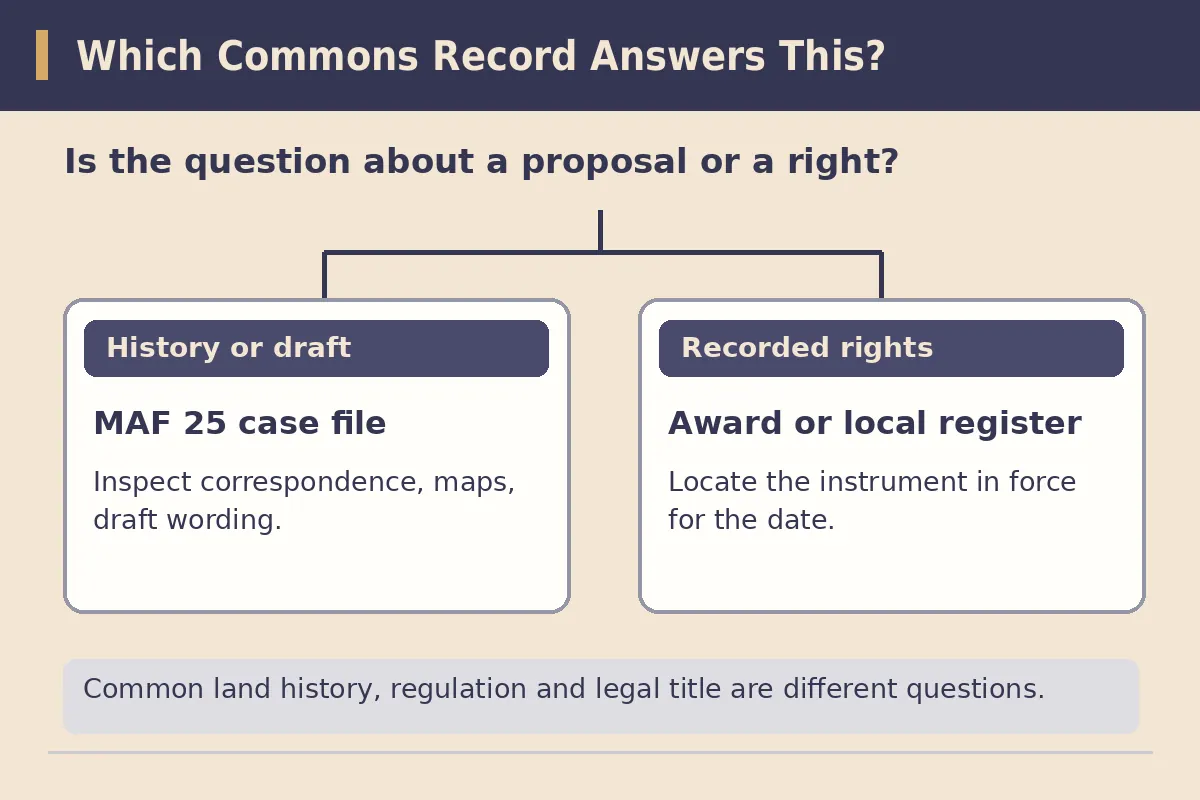
Read a Draft Scheme as a Proposal
Search Discovery using the common’s name and restrict to MAF 25; check for spelling variations and changes in local-government boundaries. Save the full reference and examine the catalogue’s date span. In a physical or digitized file, distinguish an early memorandum, a submitted petition, the version of a draft order and correspondence written after the proposal. File chronology can be disordered because enclosures were added later. A map included with a proposed scheme may describe the land as an administrator hoped to regulate it, not the legally settled boundary or the final pattern of public use.
When extracting wording, mark its status explicitly: “draft,” “submitted,” “circulated,” “revised,” or “approved,” but only if the evidence supports that label. If an official objected to a proposal, capture the objection without assuming the scheme was withdrawn. A minute describing favorable consideration is not itself a sealed order. Record the name of the body with legal authority and search for the relevant final instrument, effective date and any conditions. Keep superseded map versions as separate images or notes rather than blending them into one fictional definitive plan.
Put every map or plan on a dated sheet with four fields: reported author, scale, legal status and the feature being measured. The wording “attached to draft” is much more informative than a generic label such as “commons map.” Make the comparison explicitly: a later registration record shows a specified status at its date, not what an earlier petitioner was entitled to do. If an annotated map lacks a revision date, do not treat its annotations as contemporary with the base sheet.

Compare Commons Papers With Awards and Registers
MAF 24 concerns statements of claims to rights of common and valuers’ awards, an administrative role different from MAF 25 correspondence. An individual claiming a right in MAF 24 does not necessarily prove the claim was upheld. The National Archives also identifies MAF 30 for schemes of regulation under particular Commons Acts, and explains that registers developed after the Commons Registration Act 1965 were kept by county councils. Those later registers may be held locally; they cannot simply be projected backward to prove who exercised a right centuries earlier.
Build a crosswalk of document, date, area and effect. For example, one column contains the MAF 25 draft discussion, another the final regulating instrument if found, and another the relevant later register. Keep a blank cell when the necessary document cannot be located. A claim of grazing in an award cannot be upgraded to ownership without deeds or other title evidence. Equally, a surviving map of a common may trace boundaries and neighboring fields but not show who occupied every cottage drawn on it. Distinguish the mapped parcel from the person you hope to identify.
Check the Same Parcel Across Different Maps
Where a file includes a map, transcribe the map’s title, scale if shown, creator and date or revision note. Compare boundary landmarks such as a road, stream, field name or parish limit against another historically dated map. Differences may result from redrawing, surveying conventions or changes in use, not necessarily formal enclosure. If the parcel has a number or lettering system, preserve the key instead of converting it to a modern property number without evidence. Establish whether the map was deposited with an enacted instrument or merely enclosed in correspondence.
Local archives can hold parish records, inclosure documentation, council minutes, estate deeds and later registers. Some awards or maps survive at county record offices rather than The National Archives; the official enclosure guide discusses these copies. Check which repository holds the actual legally operative document for the period of interest. When information conflicts, prefer an instrument proving the right at the relevant date over a later narrative summary, while preserving the summary as historical testimony. A single map is not a land-title abstract, and a long-used path does not on its own prove a recorded legal entitlement.

Write an Evidence-Status Finding
Imagine a draft MAF 25 map showing a proposed fence across a common. Without further evidence, you may say that a fence was proposed or depicted on that dated plan. You may not say it was erected, that a particular household lost its grazing right or that the legal line moved. A responsible research note gives a full file reference, the draft’s wording, the date of any response, and the next record needed to test adoption. If you find a final order, compare its text and plan with the earlier draft: the definitive boundary or exceptions may differ.
An unanswered search should lead to narrower work, not a broad negative claim. List alternative names of the common, known parish boundaries and neighbouring districts, and record which MAF 25 descriptions were examined. If there was no file, investigate whether the records were held by another branch of administration or local archive. If a family is the object of the research, connect that family only through individually naming documents and tested identity matches. The most valuable result is often a precise timeline of regulation and use with legal title still marked “not established.”
A negative result in MAF 25 is narrow. The series is central government registered correspondence, not a universal historical census of rights. County or parish evidence may be the correct starting point for family-level claims. Archive the exact spelling variants and search limits so another person can reconstruct why you stopped searching in this particular series.
More House and Local History Guides
How We Research This Archive Series
This guide starts with the official description in The National Archives’ research guidance, not a claim that we have inspected a particular person’s private file or a specific original piece. The archival statements here concern the series or research method. A hypothetical example is labelled as such; it is not a newly discovered historical event. We use the Discovery search guidance to distinguish keyword matches from archive holdings and document contents, because catalogue descriptions do not transcribe every word of an original.
For every real candidate, record its historical place or person’s name, the creator, document type, date, full MAF 25 piece or item reference, access restrictions, and the exact claim being tested. The official citation guide explains how to document those references so another researcher can retrace them. An unread document remains a catalogue lead, never proof of imagined details. If a record is missing, preserve the searched terms and dates and examine survival and alternate custodians before interpreting the gap.
Before sharing a conclusion, audit the difference between original source wording and your interpretation. Require independent evidence for any further claim about an individual, property owner, legal effect, or completed action. Respect archival access limits and living people’s privacy. This website also provides an affiliate disclosure; no paid partnership or commercial access is implied by these archival references.
Historical background, correspondence, draft orders and sometimes maps; inspect the exact piece to determine what survives.
No. Find the final legal instrument and its effective date before claiming a change.
No. A claim or award concerns the stated rights and context, not necessarily ownership.
The official guide explains that county councils maintained registers following the 1965 act; check relevant local custody.
No. Use separately dated and identifying residence records before claiming occupancy.