
C 225 concerns the laws, ordinances and decrees of Commissioners of Sewers, a historical drainage authority. A decree can record a rule or obligation, but it does not prove an embankment was repaired, that a flood was avoided, or that everyone named owned the adjoining land. This guide gives a precise source route, identifies what the archive can and cannot show, and names the independent documents needed before a personal or geographic conclusion becomes defensible.
Start With the Function of a Sewers Commission
The historic word “sewers” does not necessarily refer to a modern foul-water sewer. Commissioners of Sewers dealt with water management, drainage and the protection of land, including the maintenance of channels, ditches and embankments in relevant districts. The National Archives environmental-history guide points researchers to C 225 for laws, ordinances and decrees of Commissioners of Sewers. Those are legal or administrative records. They are not a continuous construction log and should not be described as one. A local historian may use them to reconstruct what an authority ordered, assessed or regulated without claiming to know the state of every watercourse afterward.
Write the historical drainage district and approximate date before looking for a person. Wetlands, reclaimed land and rivers could cross parish boundaries; today’s local authority area may not match the jurisdiction of an older commission. Identify the document creator and the exact locality named. A statute, ordinance, decree and later notice are different kinds of act, so preserve the original terminology. The word “repaired” should not appear in a conclusion merely because a decree required repair. The central distinction is between jurisdiction, legal obligation, actual expenditure and resulting physical change.

Find the Relevant Decree and Its Parties
Search Discovery using C 225 and a historic place name, drainage feature or possible commission name. Test variant spellings of a river, fen, marsh, bank or settlement. Check the piece date range and the scope of its description. If a record is only catalogued at a high level, it may require inspection to discover the names and watercourses within it. Copy the complete reference and note what was actually searched. An isolated reference to a ditch or wall does not establish that the person you are researching maintained it or owned the neighboring parcel.
When reading the original, record the authority acting, date of the decree, location, affected land or watercourse and any stated duty or assessment. Distinguish a person who appears as an officer, juror, landholder named in an allegation, witness, debtor or person ordered to undertake work. The legal role shown by a particular phrase is not interchangeable with ownership or residence. If a translation, abstract or later calendar is available, use it to locate the text but verify the original wording before relying on the status of an individual or a named estate.
Treat a phrase such as “upon the east side of the marsh” as a historically situated locator. Match it first to a named feature in the same document, then to a dated map, not to an exact modern coordinate derived from intuition. Rivers and embankments change, so a location claim should carry a defensible uncertainty range. Record both the wording and the modern interpretation as different entries in a research log.
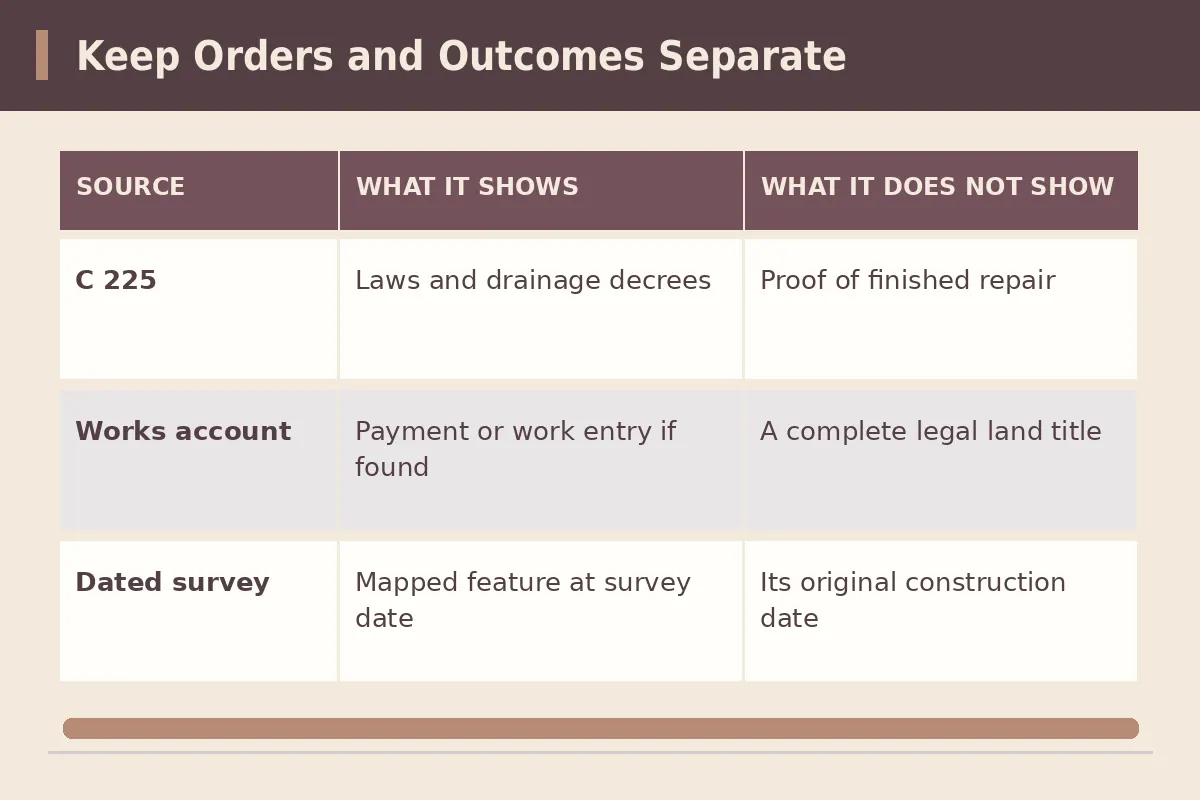
Do Not Confuse Ordered Work With Finished Work
A decree requiring a bank to be cleared may be evidence that the authority demanded work at that moment. It does not show when the work started, whether the instruction was challenged, what materials were used or whether the bank then resisted flooding. Even a dated account of an assessment may only establish a proposed levy. Look for separately created works accounts, contractors’ payments, inspection notes, correspondence or later orders describing compliance. Each source answers a different question. A reference to a flood risk or past breach should be reported as an attributed historical statement, not an independently proven event unless supported elsewhere.
Build a chronological table with four columns: order date, person or body charged, independently dated action and later physical evidence. Leave empty cells empty. If a later ordinance repeats an instruction, do not automatically interpret that repetition as either success or failure of earlier work. A new commission may have modified duties or boundaries. Compare an order with a survey of the same watercourse and the same named site. The survey will establish a representation at its own date, not the day when a bank was first dug or altered.
Test Land, Water and Ownership Separately
Old drainage jurisdiction is geographically complex. A boundary following a river in an early text may describe a watercourse that later changed alignment, name or scale. Where possible, use a dated plan close to the ordinance, then compare with a later map that shows identifiable neighboring landmarks. Mark uncertain location matches rather than drawing an exact modern line from ambiguous wording. Maps in a land-history project should always retain survey date, scale, original label and the source in which they were found. A decree affecting several holdings does not imply all were owned by one person.
A person assessed for drainage maintenance might hold a legal interest, have responsibility in a particular capacity or be mentioned as an occupant. To prove ownership, trace independent deeds, manorial or legal records relevant to the time and place. To prove occupancy, find person-level evidence that actually records residence. If the object is an old house, distinguish a drainage obligation that affected its district from a repair performed on that building or plot. The historic landscape matters, but a legal duty is not a biography and a land assessment is not a complete pedigree.

Create a Reproducible Drainage History
A defensible case summary might say that a Commissioners of Sewers decree required certain maintenance in a named locality in a stated year, while available evidence has not yet established whether the work occurred. That wording is much stronger than claiming the historical riverbank was rebuilt because an ordinance says it ought to be. Cite the exact record and quote the operative language. For every interpretation, note whether the detail comes from the manuscript, a printed edition, a catalogue description or a modern mapping exercise.
If a C 225 search does not find the desired district, check different spellings, neighboring jurisdictions and related drainage series in later agriculture departments. This does not mean C 225 is a universal index to flooding or land reclamation. Keep separate files for the legal question, the engineering history and the people involved, even if the same parish appears in all three. Finish with a list of unresolved tests—such as a missing inspection, uncertain parcel identity or unknown approval date—rather than manufacturing certainty from a single compelling archival document.
If original material is hard to read, preserve spellings, marks of abbreviation and date formats in the first transcription. A normalized or translated version can be placed alongside, with doubtful readings flagged. Changing historical words silently can make a regulation appear to apply to a different location or person. Be equally careful about the distinction between an ordinance, an assessment and an independently evidenced completed job.
More House and Local History Guides
How We Research This Archive Series
This guide starts with the official description in The National Archives’ research guidance, not a claim that we have inspected a particular person’s private file or a specific original piece. The archival statements here concern the series or research method. A hypothetical example is labelled as such; it is not a newly discovered historical event. We use the Discovery search guidance to distinguish keyword matches from archive holdings and document contents, because catalogue descriptions do not transcribe every word of an original.
For every real candidate, record its historical place or person’s name, the creator, document type, date, full C 225 piece or item reference, access restrictions, and the exact claim being tested. The official citation guide explains how to document those references so another researcher can retrace them. An unread document remains a catalogue lead, never proof of imagined details. If a record is missing, preserve the searched terms and dates and examine survival and alternate custodians before interpreting the gap.
Before sharing a conclusion, audit the difference between original source wording and your interpretation. Require independent evidence for any further claim about an individual, property owner, legal effect, or completed action. Respect archival access limits and living people’s privacy. This website also provides an affiliate disclosure; no paid partnership or commercial access is implied by these archival references.
The National Archives identifies it as Commissioners of Sewers laws, ordinances and decrees.
No. Separate orders from surviving works accounts, inspections and dated physical evidence.
Not necessarily. The historical commissions concerned drainage and water-management functions.
Only to the extent the specific wording supports a role; use independent title evidence for ownership.
Combine the decree with dated surveys and works records, and preserve uncertainty between observations.