
C 78 is a series of enrolled Court of Chancery decrees and orders, dated 1534–1903. A researcher investigating an estate, enclosure, trust, or disputed parcel can use it to discover what the court directed. But the act of enrolling a decree did not by itself prove that land changed hands, money was paid, or a family occupied the property. The National Archives’ Chancery research guide distinguishes pleadings, orders, final decrees and enrolments. Start by deciding which stage of the case you actually need.
For a repeatable search, separate three questions at the outset: which office created the source, what that source actually states, and what independent record could test your interpretation. A catalogue hit is a lead, not a complete transcription. Keep source, date, place and role alongside each tentative claim. The diagrams below show alternatives and conditions rather than a promise that every record survives.
Decide whether the decree was enrolled
A Chancery suit could leave several different classes of evidence. The original pleadings describe the dispute; depositions report what witnesses said; decrees and orders record the court’s directions. Enrolment created a further record, usually at an extra cost, and C 78 preserves that enrolled text. If a search finds no C 78 entry, it is unsafe to conclude that no decision existed. A decree might have remained only in the decree-and-order books, or a case might have ended by private settlement or arbitration.

The archive guide identifies C 79 as a supplementary series of enrolled decrees for 1534–1903. For a suspected C 78 entry, record the court, parties, approximate decision year, and property location before looking for a roll. If the issue instead concerns a pleading or witness account, do not keep searching the decree series for evidence it was not designed to contain. Use the distinction as a research routing rule, rather than a rigid sequence that every lawsuit must follow.
Search party names and the land description together
Search Discovery for the first plaintiff and first defendant, then reverse or vary the order. The archive calls this abbreviated case name the ‘short title.’ Different papers connected to the same dispute may have different short titles when parties or procedural positions changed. Add manor, parish, county, field name, and alternate surname spellings to create a second search pathway. Catalogue detail varies: a place query that returns nothing does not establish that the decree is absent.
For older C 78 material, place names can be useful; the enclosure guide explicitly recommends searching for persons or localities while warning that much of the series, especially later records, lacks detailed descriptions. If the property crossed parish borders, list every historical unit used in the case rather than imposing today’s postal address. Create a candidate table recording each roll reference, approximate date, parties, property language, and your reason for including or excluding the hit. This keeps two similarly named estates from merging.
Read the operative order and not only the dispute
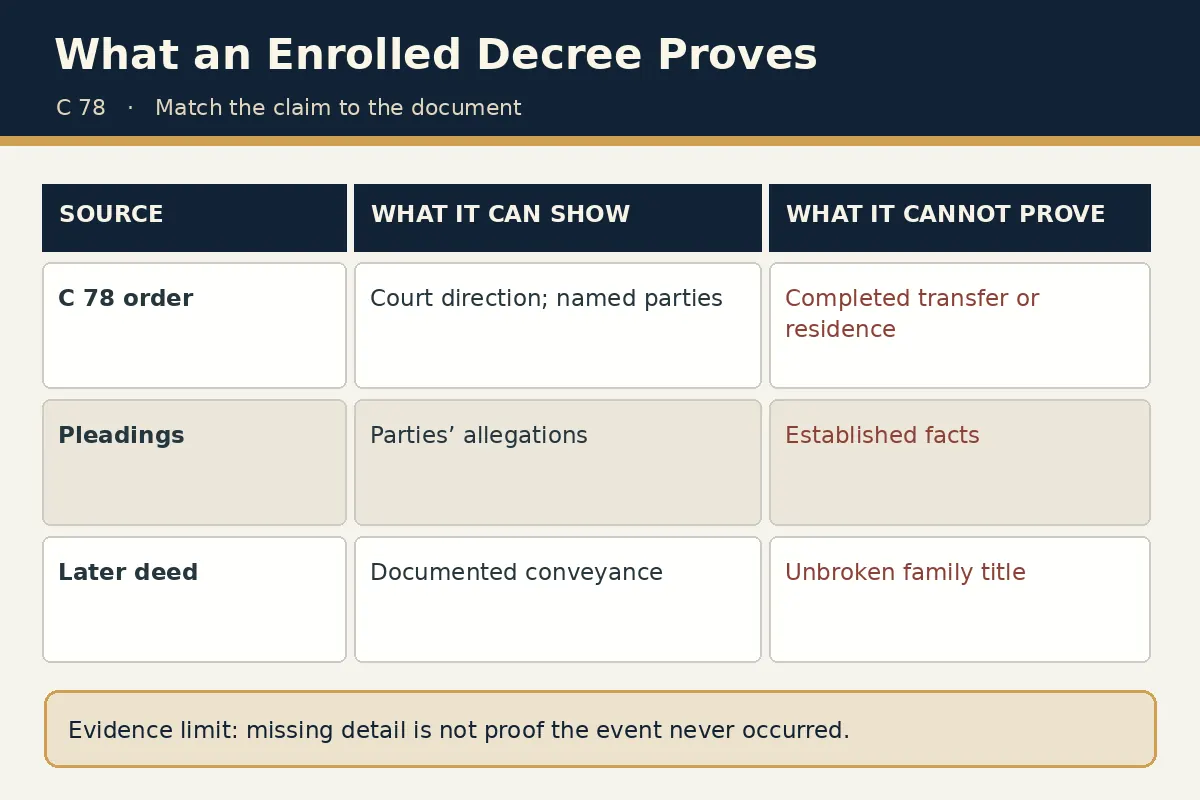
A decree may recite allegations, findings, earlier instruments and an order that one party must perform a specified act. Those layers have different evidential weight. Transcribe the operative clause carefully: was the court ordering execution of a conveyance, payment from an estate, a boundary arrangement, or an accounting? Also record conditional wording such as ‘upon payment’ or ‘subject to’ rather than rewriting the decision as an unconditional transfer. A judgment about possession is not automatically a record that physical possession changed that day.
Identify people by documentary role: plaintiff, defendant, trustee, tenant, executor, witness or person merely named in a recital. A surname and manor appearing together may suggest a research lead but cannot create a parent–child relationship. The guide makes clear that a case’s papers were historically filed by category, not as a unified modern case bundle. A decree can therefore refer to testimony, bills and masters’ reports held elsewhere. Cite exactly which text makes the particular claim.
Separate the roll date from the history of ownership
Keep three dates apart: the events alleged in the case, the court’s judgment, and the enrolment or later procedural action. The first could precede the last by years. The C 78 coverage from 1534 to 1903 describes the series, not a guaranteed continuous chronology for every litigant. An enrolment after a person’s death may concern executors or heirs; it does not show that the named testator remained alive on the enrolment date. Where the text uses earlier deeds, note whether these are presented as evidence or independently inspected originals.
To test actual ownership, look for a later deed, property tax assessment, manorial record, conveyance or estate account matching the relevant parcel. Record how much each establishes: the court can describe a legal entitlement; a signed deed may document a conveyance; a rent roll can identify an occupier or payer. None is interchangeable with an entry showing residence. If subsequent records conflict with the decree, preserve both accounts and investigate the change instead of assuming the court record is wrong.

Build a reusable C 78 claim ledger
Use one row for each claim about the property. Include the exact C 78 reference, a short quotation or accurate paraphrase, the date as written, the status of the person named, and a column headed ‘still unproved.’ For example, ‘court ordered trustees to convey’ is narrower than ‘the claimant owned and lived at the house.’ Then add a second source that tests the operative act, rather than merely repeating a printed digest of the decree. A negative property search is only informative after its archive, locality, period and name variants are recorded.
For publication, give the historical location alongside its present location with clear uncertainty where boundaries changed. Cite the source used for each geographical identification. Distinguish an original roll, a transcription, a modern catalogue description and a family-tree assertion. The final research note should say what the decree ordered, which land it concerned, which parties were involved, and which independent documents do or do not show execution. This method is more useful than a confident but unsupported ownership narrative.
More House and Local History Guides
How We Research and Verify These Records
Our starting points are research guide from The National Archives additional archival guidance. We checked the series descriptions, dates and stated survival or access limits on November 2, 2026. The diagrams are explanatory reconstructions, not reproductions of historical manuscripts. We distinguish a catalogue summary, an original document, a later transcription and an independently checked claim; none should be silently substituted for another. Use the full piece-level archive reference and folio where available.
Every suggested research route is conditional on the surviving records for the place and date in question. We do not infer a negative historical event merely because a public search yields no result. Dates that appear in later indexes can be editorial and must be differentiated from the date written in an original document. This guide contains no paid partnership claim; see our affiliate disclosure.
No. It proves a documented role or mention within an enrolled legal proceeding; a separate title or conveyance source may be necessary.
Not all decrees were enrolled. Some appear in decree-and-order books or separate case material; catalogue descriptions are also incomplete.
It is the supplementary enrolled-decree series identified alongside C 78 in the Chancery guide.
Yes, especially for some earlier material, but a failed place search is not a conclusive negative result.
Record the event alleged, decree date, enrolment date, and subsequent documented transfer separately.