
RG 43 is an index series for miscellaneous foreign birth, marriage and death returns associated with the General Register Office. It is a finding aid, not the complete foreign vital record and not a guarantee that every event involving a British person abroad was registered. The underlying non-statutory registers and returns include RG 32–RG 36, while some index coverage concerns Army or statutory material. The National Archives’ overseas vital-record guide explains that British consular registration and local foreign registration can be separate systems. Use the index to seek a specific surviving entry, not to manufacture an overseas life event.
For a repeatable search, separate three questions at the outset: which office created the source, what that source actually states, and what independent record could test your interpretation. A catalogue hit is a lead, not a complete transcription. Keep source, date, place and role alongside each tentative claim. The diagrams below show alternatives and conditions rather than a promise that every record survives.
Determine the country, event and registration system
Start with three facts you can document: the locality, approximate year and kind of event. A marriage in a British consular register may not be the same document as the local civil marriage required by that country. The National Archives warns that returns made through British representatives were distinct from registrations required locally. Similarly, a birth or death aboard a British registered vessel follows a different shipping-record route. Decide which jurisdiction could have created the evidence before entering a surname into any overseas index.
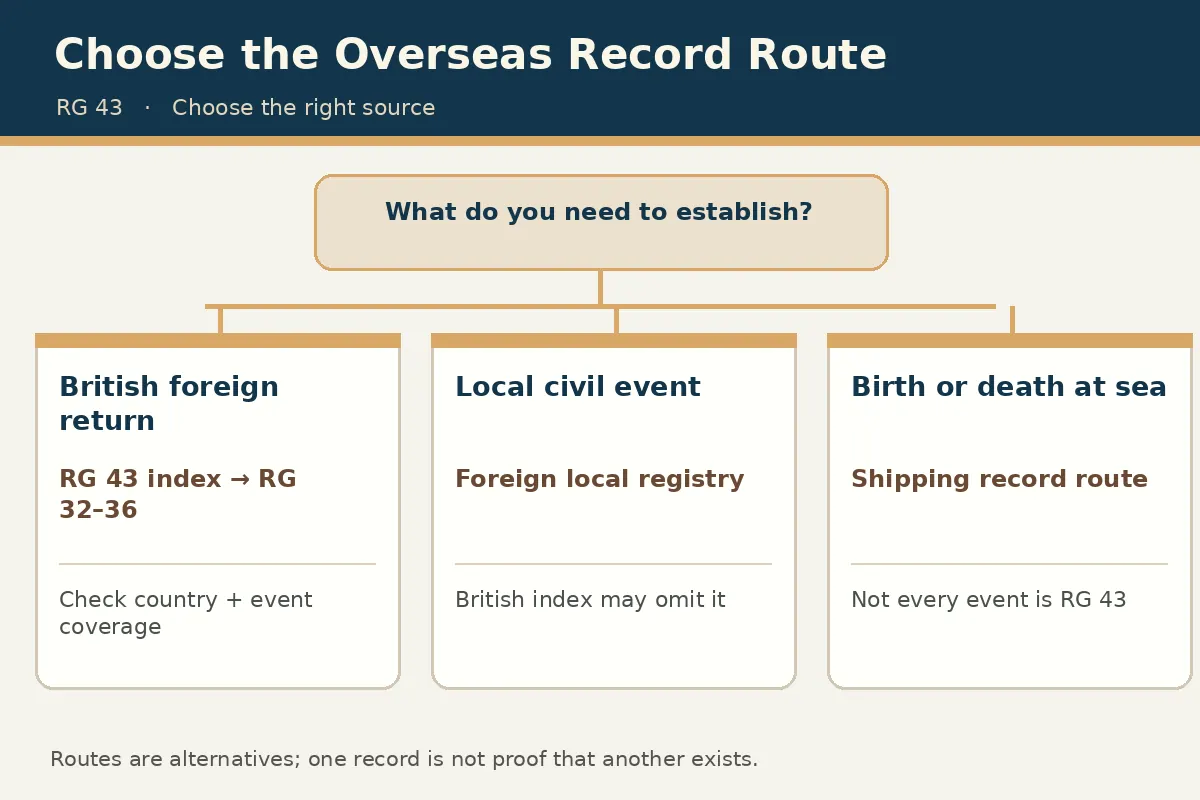
Then check the archive guide’s country-by-country table for the event type and years surviving. Some places have baptisms but not births, or burials rather than civil death registration. Others have single-year holdings or sets of register volumes. The broad series dates do not promise coverage for an individual location throughout those years. An apparently empty index search is meaningful only after you identify whether the relevant kind of register was expected to survive and be indexed.
Use RG 43 as a pointer to a volume
The National Archives identifies RG 43 as indexes to non-statutory foreign returns in RG 32–RG 36, as well as selected other registers. When a candidate appears, record the exact heading, spelling, index reference, type of event and any corresponding piece indication. The goal is to reach the underlying register image or volume, not to treat the index wording as an original certificate. Search variant spellings, initials and possible changes in naming conventions without claiming that every variant names the same person.
An index entry may omit important context, including informant or witness, parental relationships, the exact location, or subsequent correction. If the underlying record can be viewed, transcribe it separately and distinguish its event date from when the return was filed or copied. A return from a consular officer could have been forwarded after the event. When reporting a match, explain which text comes from the index and which from the original return or register. Avoid using a database title as if it were an archive reference.

Check named gaps and indexing exceptions
The archive’s guide explicitly notes particular missing or unindexed material. For example, it describes Belgian military deaths in a 1914–1920 portion of RG 35 and states that those are not indexed in RG 43; it also notes missing certificates for specified initial letters in that set. These exceptions show why a negative name search is not an event-level conclusion. Record the precise country, register reference, relevant years, and whether you searched the index or examined the underlying volume.
Some overseas returns were non-statutory or submitted unevenly. A household may have used local registration without British representation, and a British consular record might not be duplicated exactly in every database. Do not assume the absence of a British return is evidence that no child was born or no marriage took place. Conversely, two entries with similar names in local and consular systems should be compared by date, place, partners and other identifying data before being treated as the same event.
Make a sound identity match across jurisdictions
A strong match combines more than a name: use the stated locality, parents or spouses, profession, age, residence and independent travel or family documentation as available. Watch for different calendars, language conventions and transliterations when dealing with international records. A foreign place name may appear in English or another historical spelling. Maintain the record’s original wording beside a modern geographical explanation, and state the evidence for that identification rather than simply replacing an old town name.
Where the event is documented in two systems, record the relationship between them. One source may be a direct original record and the other a later copy or notification. Their agreement is useful, but two derivative entries stemming from one informant do not create two independent witnesses. If they conflict, do not discard the inconvenient date. Check whether one dates registration, notification, burial, or the underlying event. An unresolved contradiction belongs in the research note until a better original can be found.

Document your search and next repository
For every search, note whether you used RG 43, browsed RG 32–RG 36, examined consular papers, or consulted the General Register Office’s overseas indexes. Keep access methods separate from historical coverage; a record requiring payment or an on-site visit is not evidence that the record does not exist. The National Archives’ official guide discusses third-party providers but does not imply that every relevant entry is freely available online. Capture the full original reference, not only a vendor’s screen label or transcribed name.
A defensible conclusion reads: ‘An index entry points to a return of a specified event, and the corresponding register confirms [the information actually written].’ If no record has been located, describe the precise jurisdictions, periods, spelling variants and volumes checked. State any known exclusions. That leaves a transparent path for a future researcher to seek local civil records, shipping sources or a different consular post rather than turning absence from one British index into a false denial of a family event.
More Place and Jurisdiction Guides
How We Research and Verify These Records
Our starting points are research guide from The National Archives additional archival guidance. We checked the series descriptions, dates and stated survival or access limits on November 2, 2026. The diagrams are explanatory reconstructions, not reproductions of historical manuscripts. We distinguish a catalogue summary, an original document, a later transcription and an independently checked claim; none should be silently substituted for another. Use the full piece-level archive reference and folio where available.
Every suggested research route is conditional on the surviving records for the place and date in question. We do not infer a negative historical event merely because a public search yields no result. Dates that appear in later indexes can be editorial and must be differentiated from the date written in an original document. This guide contains no paid partnership claim; see our affiliate disclosure.
No. It indexes selected miscellaneous foreign returns, with gaps and additional material handled differently.
Relevant foreign returns include RG 32 to RG 36; inspect the specific record described by the index.
Not necessarily. Local foreign civil registration and British consular returns may be distinct.
No. The National Archives explicitly lists some wartime deaths in RG 35 that are not indexed in RG 43.
Combine name with event type, locality, date, associated people and original record wording.