
National Archives RG 59 describes 303 maps enclosed with U.S. Foreign Service inspection reports from 1906 to 1939. Many were municipal maps printed in local languages and then annotated to locate American consulates, embassies, customhouses, business districts, or other points of interest. They can answer a precise geographic question: where did inspectors mark a post? They do not, by themselves, establish that an ancestor lived at the post, worked there, applied for a visa, or passed through the building. See the National Archives record-group description for the exact scope of this material.
A detailed NARA State Department inventory distinguishes entry 866, the numbered map enclosures, from entry 865, the inspection reports themselves. This distinction is the working key: begin with city and inspection date, locate the map number, and link it back to the report. The guide counts 277 city maps and 26 broader geographic maps within the 303-item group; it does not guarantee that every city has an image online or that every reported post retained an enclosure.
Select an Inspection City Before a Surname

Inventory entry 866 arranges the maps alphabetically in two groups: regions and countries in one, cities in the other. Its 303 items were assigned individual numbers, listed in Appendix D of NARA Special List 37. A city spelling may differ between the map, the original foreign-language printing, and a modern name. Record variants before concluding that a post is missing. A map labeled for a large region may not pinpoint an individual neighborhood or residence.
For an individual consulate, search the city name in entry 865 inspection reports rather than assuming a map is self-explanatory. The reports are arranged by city, and diplomatic inspections starting in 1925 are interfiled with consular inspections. That date matters: a map of a diplomatic mission and a consular office are different claims. If an office moved, a map made during an earlier visit cannot establish the later address. Preserve the report date and the date printed on the map.
Read Foreign-Language Map Annotations Carefully
NARA states that many sheets were originally published municipal maps later annotated for inspection work. An annotation showing a consulate may have been added after the base map’s printing. Do not treat all labels as contemporaneous with the map publisher. Compare ink colors, symbols, marginal notes and printed legends where visible, but avoid guessing the hand or date of an annotation. Capture original place-name spellings and translate them with a note on the translation’s uncertainty.
Some annotations mark a consular residence rather than an office; others point to customs buildings, harbors or business areas. These labels are not synonyms. A line near a harbor is not evidence of a specific immigrant ship, and the location of an American consulate does not prove an individual entered its doors. NARA’s inventory includes a few general maps about consular districts and American residents; those broad maps must not be converted into address-level personal evidence.
Pair Map Entry 866 With Report Entry 865
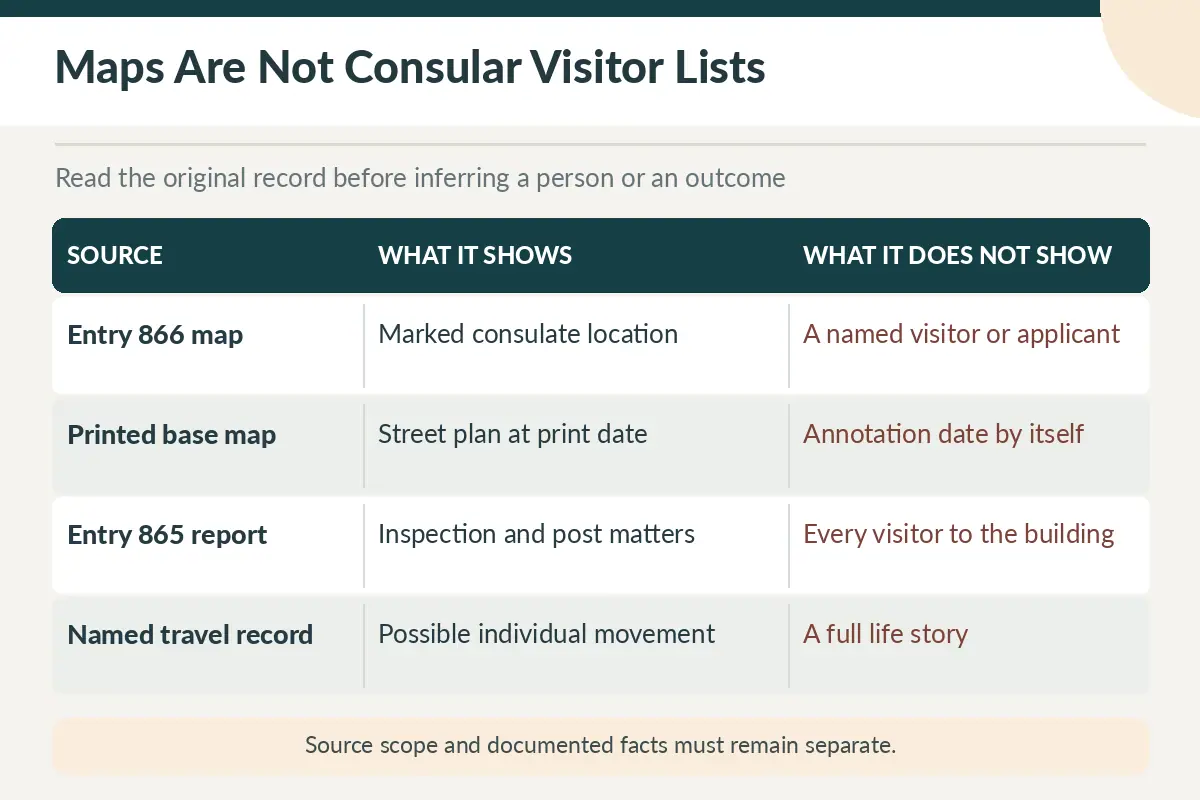
The corresponding Foreign Service inspection reports may address personnel, buildings, office hours, government property, trade, and visa or immigration work. That is an outline of possible report subjects, not a promise that any one report includes a list of applicants or residents. A map might show a building without naming its clerks; a report might describe office staffing without giving each person’s private address. Keep questions about administrative geography distinct from family records.
When seeking a particular person, start with a known name and a dated role from independent evidence. A consular inspection might identify an official, but that should be checked against appointment registers, personnel material, consular correspondence or local directories. The fact that a report discusses passport procedures does not make it a passport application file. Your ledger should distinguish “map marked the post,” “report described post operations,” and “named record places this person there.”
Trace a Post Through Administrative Change
The 1906–1939 span crosses changes in consular and diplomatic administration, local street names and city maps. NARA notes that diplomatic post inspections began in 1925 and were interfiled with consular reports. A map made before that point might emphasize different facilities than one from the 1930s. Compare city, office type and date rather than linking two similar marks as though an institution occupied the same building continuously.
For a contested address, establish a chronology: date of printed municipal base map, date of inspection, annotation if dated, and independent city directory or land record. The earlier map can be a geographic clue even if a later source establishes the actual occupancy period. A local political or boundary change may also alter which consular district served a town. Do not infer a person’s nationality, citizenship, or immigration status from the location of a diplomatic facility.
Work a Hypothetical Consular Address Search

Suppose a family letter says a relative visited a U.S. consulate in a European port in 1928. Start by identifying the port’s historic name and check the entry 866 map list for the city or region. If a map exists, obtain its number and inspect the annotations. Next locate the city’s entry 865 inspection report nearest the alleged visit. The result may establish where the office operated but not that the relative personally appeared there.
Look for a travel document, dated letter with a return address, a consular registration, or another record naming the individual. If the available inspection report mentions only facilities and staff, describe the evidence as institutional context. The correct conclusion may be that an office stood in the city at roughly the right time, while the visitor’s identity remains unproven. This preserves a useful historical reconstruction without inventing an appointment or transaction.
Cite the Map Number and Source Limits
A sound reference begins “National Archives, RG 59” and adds map enclosure entry 866, the numbered item and its place, plus the related entry 865 report when consulted. Include the original printed map title and annotation date if stated. NARA Special List 37 supplies a route between listed reports and enclosures. The number 303 is a collection count, not the reference number for a particular consulate. Record exact item details rather than only citing a guide webpage.
A positive map find is not proof that all inspection maps survived or that they are downloadable. The National Archives Catalog may describe a series without every item image. When no relevant map appears in the online results, check both country and city arrangements and ask reference staff with your city, years, and desired report. Your publication should state whether its inference comes from a map annotation, an inspection report, or a separate document about a named person.
More Place and Jurisdiction Guides
How We Research and Verify Archival Claims
We compared the record-group guide with the relevant National Archives research guidance, checked the cited record-series distinctions and dates, and reviewed overlap with existing GenHis titles and the supplied WordPress inventory. Our decision charts summarize the scope of the inventories; they are not reproductions of historical maps or documents. Where an individual item has not been examined, the wording makes that limitation explicit rather than claiming a personal find or a confirmed event.
The purpose of this guide is to make the next check reproducible: record RG 59, the exact series or entry, title or item number, original date, later-copy date where applicable, and an independent confirming source. Online descriptions do not guarantee that every sheet or photograph is digitized. Check terms and access requirements for the specific item. Read our affiliate disclosure; this educational guide does not assume any compensated records service or an unverified partner arrangement.
NARA entry 866 lists 303 enclosures: 277 chiefly city maps and 26 country or regional maps.
No. The finding aid has distinct region and city arrangements; individual maps have numbers.
No. Find a named consular, travel, correspondence, or other contemporaneous record.
Entry 865 contains the inspection reports; entry 866 holds the map enclosures.
No such guarantee follows from the inventory. Check item-level availability and consult NARA as needed.