
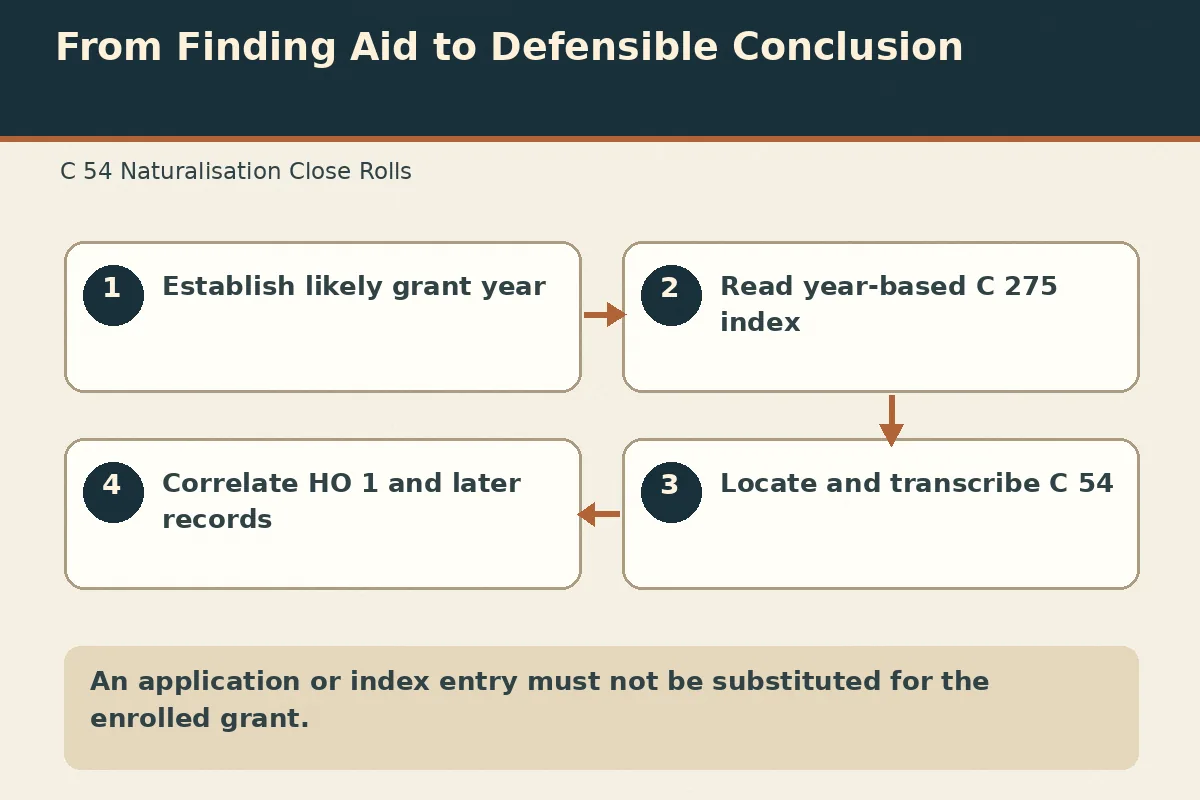
For an immigrant who may have become a British subject between 1844 and 1873, the decisive research problem is whether naturalisation was actually enrolled, not merely requested. The National Archives identifies naturalisation entries on C 54 close rolls, located through the separate C 275 printed index. A case file in HO 1 may supply family details but is a different form of evidence. Start with the event year and the exact wording of the final record.
Begin with a question you can test: a named person, a particular place, a precise date window or a document type. The official archive guide establishes the scope of this series; it does not substitute for an original item. Keep a research log with the exact reference, original wording, record creator, retrieval method, contradictory clues and unanswered questions. This protects a family narrative from a plausible but unsupported inference.
Understand why the grant and petition are different sources
An HO 1 naturalisation case paper may describe the applicant’s birthplace, profession, residence, family and proposed change of status. The petition is valuable precisely because it preserves a person’s account at a particular moment. Yet a request, even one accompanied by character references, is not itself the legal outcome. The archive’s citizenship guide separately directs researchers to C 54 for enrolments in the 1844–1873 period.
Write two distinct research questions: ‘Did this person apply?’ and ‘Was naturalisation enrolled?’ Track the answers in separate columns. An applicant can appear in papers from a different year from the final document, so a surname match without dates does not connect the two automatically.
Use the year-first C 275 index as a locator
The National Archives says the printed index to C 54 naturalisations is arranged by year. Without an approximate year, first use correspondence in HO 1 or other contemporary clues to narrow the search. At Kew, consult the relevant index volume and record the individual’s name, any number attached to the entry and the precise index location. The index is a route into a roll, not an image of the enrolled text.
Do not mistake the whole C 54 series for a dedicated nationality register: close rolls also contain other types of enrolments, including land deeds. Keep the category and date of the index entry in your notes, so a similarly named deed does not become a false citizenship result.

Find and read the original C 54 enrolment
The index number forms a key part of the reference needed to identify the appropriate C 54 material. The National Archives advises on the printed catalogue and the Map and Large Document Reading Room at Kew for this process. Once the roll is located, inspect the wording and any names, dates or formal statements actually present. A catalogue title or a typed secondary transcription is not the same thing as the enrolment itself.
Make a source citation with repository, department and piece reference, date, index reference and folio or membrane if the source permits. Record whether you consulted the original, an image or an abstract, and avoid inventing fields that a specific enrolment does not include.
Recognize the changes around 1844 and 1870
The process changed over time. Before 1844, naturalisation generally required a private Act of Parliament; from 1844 the Home Office route became central. The 1870 nationality legislation then changed the framework again. Because the C 54 naturalisation pathway described here is specific to 1844–1873, dates near the legal transitions require extra care. Choose sources by the applicable period rather than assuming all nineteenth-century grants were filed identically.
The archive’s citizenship guide describes later certificates and case papers in other Home Office series. Do not apply the year-index routine automatically to someone naturalised in 1890 or to someone who merely declared an intention to settle. Historical nationality categories also require care with contemporary legal definitions.

| Source | What it can establish | What it does not establish |
|---|---|---|
| HO 1 petition | Applicant and requested status | That status was granted |
| C 275 index | Year and enrolment locator | Certificate wording |
| C 54 close roll | The enrolled document, if found | Every later change in nationality |
Resolve two people who share a surname
Suppose an HO 1 search identifies two similarly named applicants. Compare the document’s age or birth details if supplied, profession, address, spouse, children, country of origin and application date against the enrolled record. Treat these as evidence only where the document actually states them. A matching surname and a broad date range are too weak to establish that the person on the close roll is the family member you seek.
Build a small identity table with each candidate in a separate row. Mark missing fields as unknown rather than treating silence as agreement. Use census returns, a contemporary directory or a dated family certificate to tie the candidate to the same address or household.
Use the Gazette and civil records as independent tests
The National Archives points researchers toward published naturalisation notices in The London Gazette. A relevant announcement may assist with timing, but read the actual notice rather than relying solely on an index snippet. Compare it to the C 54 enrolment and other dated civil records. A Gazette entry, an enrolment and an HO 1 petition can collectively establish a much stronger chronology than any one search result.
Keep source independence in view. Two web sites repeating the same Gazette notice are still one underlying source. A later marriage, census or probate document may help identify the same person; it may not independently confirm the exact legal terms of nationality.
Document the limits of a negative search
A blank C 275 search is not evidence that a foreign resident never became British. The person’s nationality may have changed under another mechanism, the estimated year may be wrong, the entry may use a spelling variant or another relevant record set may apply. Likewise, a person resident in Britain need not have been naturalised at all. First audit the index years, names and methods actually examined.
Report a bounded result, such as ‘no matching entry found in the consulted C 275 years,’ rather than ‘never naturalised.’ Preserve an exact list of index volumes and candidate entries examined. This makes the conclusion reproducible and tells the next researcher what remains untested.
Worked Example: Separate a Lead From Evidence
Consider a fictional merchant recorded in an 1856 directory as foreign-born. An HO 1 petition dated 1858 mentions a London address, while a possible C 275 hit is dated 1859. The sound result is not ‘British citizen in 1858.’ It is: petition observed in 1858, possible enrolment locator in 1859, original C 54 wording still to be checked. If the enrolment names a different merchant with a similar surname, the hypothesis fails. The dates and names here are illustrative, not transcriptions of any historical file.
In a real case, retain the exact original reference and write a one-sentence proof statement with its limitation. If a crucial document has not been inspected, say which missing item would change the conclusion. Never give an invented person, address, date or image caption the authority of a historical source.
More Records and Archives Guides
How We Research This Record Series
This guide compares the primary official research description with a second National Archives guide. We checked the series scope, arrangement, historical limits and the difference between a catalogue description and a document examined directly. The illustrations are original explanatory artwork, not purported scans of documents. We also compared the topic and intended research result with the available GenHis article catalog.
For a reproducible finding, keep the institution and full piece reference, the creator and date of the document, your image or reading-room access method, important quotations, and any negative or contradictory evidence. A site or series name is not an original record citation. An application or index entry must not be substituted for the enrolled grant. The affiliate disclosure explains our site policy; no partnership or paid search service is assumed here.
No. It proves the existence of an application or related correspondence; a grant needs its own evidence.
The National Archives directs researchers to C 54, using the annual printed index in C 275.
The documented route for the historical printed index requires consultation at Kew; do not assume every entry has a digitized image.
C 54 is a close-roll series used for multiple kinds of enrolment, not exclusively for nationality.
No. Reassess date, spelling, legal mechanism and source coverage before interpreting a missing entry.